One of the tricks employed by those who construct crossword puzzles is to include words which have multiple meanings.
Take the word ‘mean’ for instance. It may immediately have meant to you, ‘to be stingy, one with an ungenerous nature’. Then again it might have meant ‘something in the middle’. Or it might also have meant, ‘the significance of something’. It is this third meaning which I intend to explore.
People with a philosophical bent of mind are often quizzing on what they construct as ‘the meaning of life’. This is as if the question, although perfectly constructed, can be answered. In reality it is one of those questions that has no answer, like a Zen koan. The Zen koan however is constructed because there is no expectation of an answer. Intellectual philosophers imagine that logic is without boundaries, when it is not.
‘Quick, who can save this cat?’

The ‘life of meaning’ is a far more fruitful place for philosophical meandering, because when we understand what everything in life means, then we must be approaching an understanding of life.
When I was a young man studying architecture, there was a course entitled ‘Architecture Studies’. This did not convey the content of the course at all and I did not sign up for the lectures; not least because the Professor who introduced the course had a highly debilitating stammer which I thought I could not endure for a year. The serried ranks of students had great difficulty containing their laughter including, I am ashamed to say, myself.
It turned out that this professor was only the head of the department and therefore gave no further lectures, for obvious reasons. Instead lectures were presented by one of the most inspirational teachers I have ever had. (I took the course without gaining credits for my degree as I was fascinated and delighted the ‘head of department’ earned his money in some other way than lecturing.) John Steel came from California, had long straggly hair, tan leather trousers with a lace fly and taught us to question everything.
He told us that when he studied anthropology, instead of heading out into the jungles of Borneo with the other PhD students, he remained behind and studied the tribe who were his professors. How I would have loved to have seen the look on their faces when they read his thesis!
In the third year of this course we focused on ‘meaning in buildings’. How buildings convey very subtle thought forms that have meaning to the creator and users of buildings is a fascinating, if little considered, subject.
We were lead in this year by professor Robert Maxwell who had made this theme uniquely his own. We read about semantics and semiology and how all life and all things are imbued with meaning, both consciously and unconsciously. The master creator will be fully conscious of what knowledge and or wisdom the building is to contain and convey. This additional level of complexity in design is not optional for without it, I would argue no building can be ‘great’.
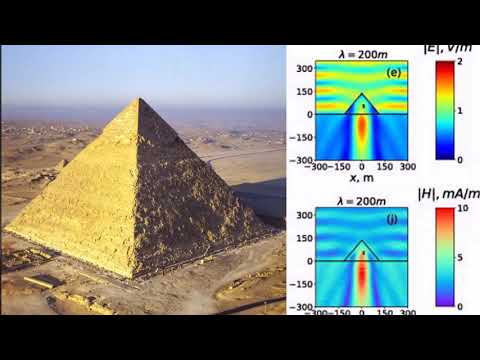
The Pyramid of Cheops has to be the most obvious example of a building, despite or because of being geometric in form, is layered with levels of significance that we are still in the process of understanding today.
Pyramid; electromagnetic images at various frequencies
The challenge of seeping meaning into a creation is common to anything from popular songs to domestic appliance design. In popular songs, the lyrics can lift a mediocre melody into a new dimension and a singer songwriter who exemplified this has to be Leonard Cohen. His songs lumbered along on a series of notes that moved unspontaneously one tone at a time in either the upward of downward direction. Amadeus M0zart would have laughed if you told him the songwriter was famous. But Mozart might not have understood the high level of the poetry that Cohen achieved and how the meanings he explored, were loved by his fans. His contemporary Bob Dylan was likewise a major poet, and a slightly better constructor of melodies.
Contemporary Rap Music has learnt nothing from the example of the great musicians from the past and makes little of no effort in constructing melody. The whole song is contained in the rhythm of the words as if the complexity of melody is just too difficult, which is a loss to the genre and it’s advocates in my view.
Finding meaning in words is not hard to understand, but finding meaning in household objects?
If you wander into a shop selling kitchenware there is a brand which specialises in bringing salad tongs, toast racks and cruet sets, to life. They are given arms and legs and cute smiles that grin up at you creating that all important ‘love me’ moment.
The previously ‘dead’ object of utility has been ‘Lazarused’.
The Japanese are a culture who collectively love any object imbued with character and meaning. The front view of a Japanese car for many years, had to contain a smiling face rather than a sad one. Smiles sell.

Such examples of life entering objects of human design are sadly rare. Most buildings never feel the pencil of a loving creator that breaths life into form.
The anthropologist studying modern western culture will find few objects imbued with life and might conclude that 2020 culture is impoverished of meaning.
If you have no religion, then your walls of your living room will not be hung with smiling images of your guru, might not have a saint or cross on your wall and the sideboard will be empty of smiling Buddhas. But don’t worry, says popular atheistic culture, ‘just do what you want’.
But imagine you wake up one morning and decide on a whim, that you want a tattoo on your arm. You don’t know why, it is just something you ‘want’.
So you find yourself sitting on an uncomfortable metal chair in the waiting room of the local tattoo parlour. You are flicking through a well thumbed booklet of tattoo designs whilst listening to the gentle buzz of the tattoo artist’s machine behind a curtain.
As the moment draws nearer for your initiation, you realise that you cannot decide what you want. You quite like the Maori swirls but actually, the Tibetan clouds take you fancy as well. Or should you go for ‘I love Mum’, perhaps not macho enough?

I would be very interested in a study of people who have chosen to be tattooed and how they made their choice. Do you think that the majority would present a meaningful explanation? ‘This is a prayer that my Aunty taught me when I was a child and I never want to forget it’ or ‘this is my blood group in case I have an accident’. Two thoughtful examples, but from what I have seen of the content of tattoos the answer is more likely to be ‘it’s what I wanted’.
Given that many in a multi-cultural western population will have few anchors of faith or ties with other belief systems such as ‘Hells Angels’, I expect that the majority of tattoos will be without meaning.
This is not a criticism of tattoos or those who have chose to have one. Traditionally, so called ‘primitive’ tribes around the world will have learnt to impregnate the skin with swirling patterns and designs that their ancestors taught them. The human skin was a book for writing on long before the invention of papyrus.
The problem we have today is that we have no subjects of interest and the readers don’t care if they did. Is this true even for architecture?
‘What is your favourite colour?’ asks the interior designer.
‘Blue’.
Most interior designers will know the significance of different hues and the psychological impact of these colours on mental processes and emotional responses. But the client will probably not understand these effects or wish to have them interfere with what they want. ‘I don’t know anything about art but I know what I like’ is the mantra of the uninitiated majority.
Those sceptical about the impact of colour in human messaging, should consider the skills of advertisers and marketeers.

When the BBC have a red background to their logo there is a reason for this. It shows strength and an outgoing desire to search for truth.

The Guardian newspaper online, chose yellow and black because this combination signifies a willingness to explore issues beyond the conventional. In nature it’s a waspy warning; in journalism it’s means ‘cutting edge’.
So to conclude, we ignore complexity at our peril. Yes, you can get by with just following a hunch and what you like. But you will rarely imbue your soul with the richness of any self or cultural understanding in this way.
By becoming a ‘skin deep’ society we risk losing contact with the expressions from the souls of our ancestors and beyond. We become no more than ink beneath the epidermis, injected to form a meaningless configuration. It stays for your whole life the body is returned to the ground.
Better luck next time.
 Matters Blog