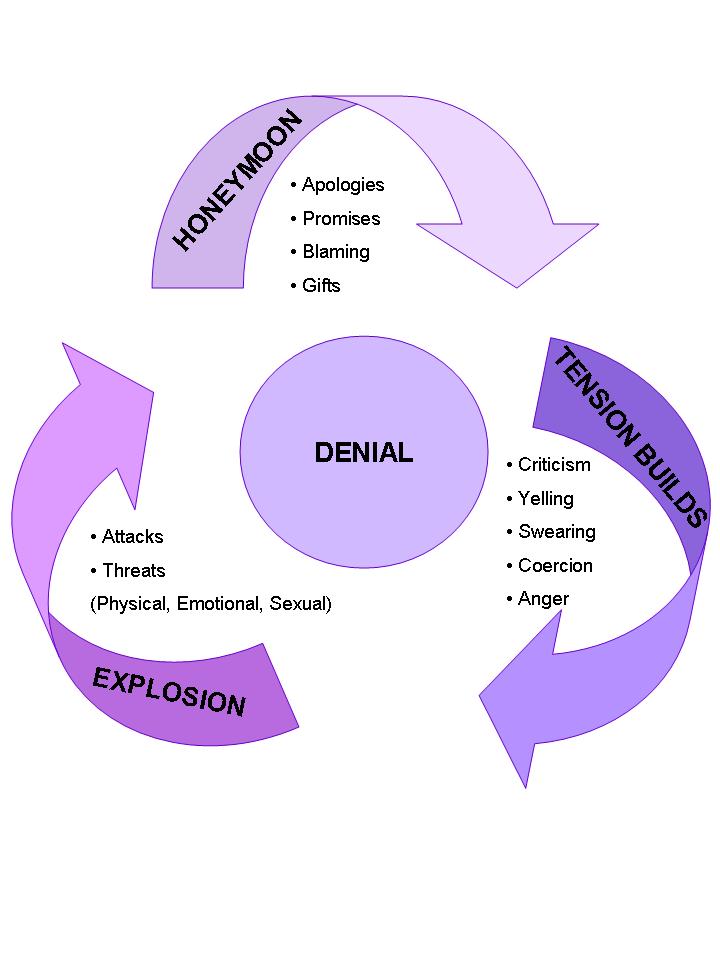
Word War

picture credit: Domestic Violence Co-ordinating Council / Delaware / USA

Is it wrong for a victim to commit a crime against their abuser?

Consider a wife who has suffered various kinds of abuse over many years from her husband. One day she picks up a kitchen knife and stabs him to death. You have seen this story in movies and books many times and one is always split between compassion for the victim and condemnation of their crime of murder.

Now chose a word to describe the action of wife;

Attack? Defence? Pre-emptive? Revenge? Anger? Terrorism?

Most courts would find the wife guilty of murder. Her defence of ‘self-defence’ or ‘after years of abuse’, would be considered as mitigating circumstances and might reduce the sentence significantly.

When children fight they will commonly defend themselves with an accusation; ‘so and so started it.’

They might have been a peaceable victim who was attacked by a bully. In most ethical standards and laws, a violent act permits self defence by the victim. If the bully claimed to have attacked in order to prevent being attacked this is unlikely be regarded as permissible unless the victim had made to strike and the bully blocked the attack before striking back. Children can confuse adults with this simple excuse or ‘defence’ for violence and so do modern leaders!

The abused wife who retaliates in anger is like a country that has suffered abuse from a neighbouring state for many years. If brought to breaking point, the victim state will decide it has had enough of violent attacks and incursions onto their land. They will strike back. The question is, did the victim start the violence by objecting to abuse? Who ‘started it’ becomes almost impossible to define as the origin of the violence and the definition of the first act of violence is difficult to pin point. It probably wasn’t a single agressive act but multiple acts of passive aggression by either party.
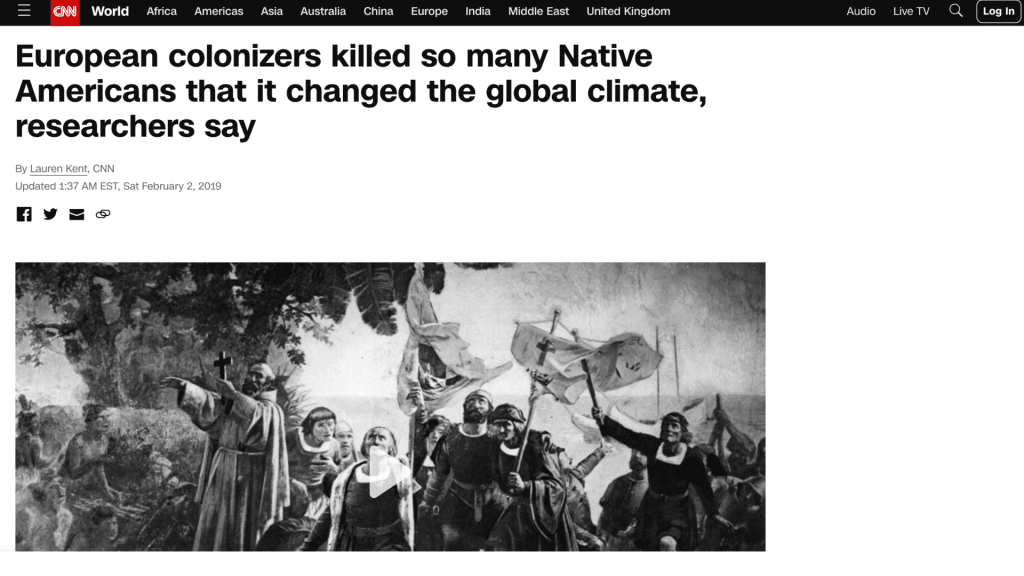
picture credit: Communitycommons.org

In the eighteenth century, the United States of America slowly dispossessed and committed murder and land theft against the indigenous population as had done other European colonisers before them.

The State of Israel was created by occupying Colonial powers in 1945 from which point onwards to the present day, Israel land stole land from and murdered anyone who was in the way.

Are not both of these examples of the ‘wife-beating husband’ and a continuous ‘they started it’ mentality? How much provocation should original and entitled inhabitants suffer before fighting invaders?

Today the Zionist government in Israel is trying to persuade the world that those who fight back against the genocide of Palestinians, are ‘terrorists’.

Over the decades the words ‘Jewish’ and ‘anti-Semite’ have become used as if by an innocent abused wife. It is certainly a fact that Jewish people have had a hard time through out modern and ancient history. They have been the victims of violent and non-violent abuse in many countries culminating in their attempted genocide by the National Socialist government of Germany in the early 20th century.
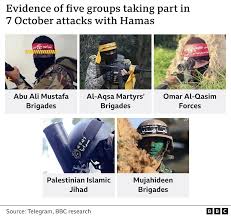
picture credit: BBC

When the Zionist government uses the defence today of ‘he started it’, the first question is when it started (certainly not on October 7th 2021) and how to reach a peaceful conclusion for this unhappy hostorical marriage of Jews and Palestinians.

The child in the playground who shouts ‘he started it’ does not realise that there are almost always passive options to violence, even if it is public humiliation or martydom. The Christians will tell you stories about this of their ‘turn the other cheek’ Messiah being murdered by the Jews of that time.

The Zionist government of Israel and the United States of America defend their invasions of Arab states over the last few decades by claiming that they are the innocent victims of ‘terrorism’. But who are the true terrorists?
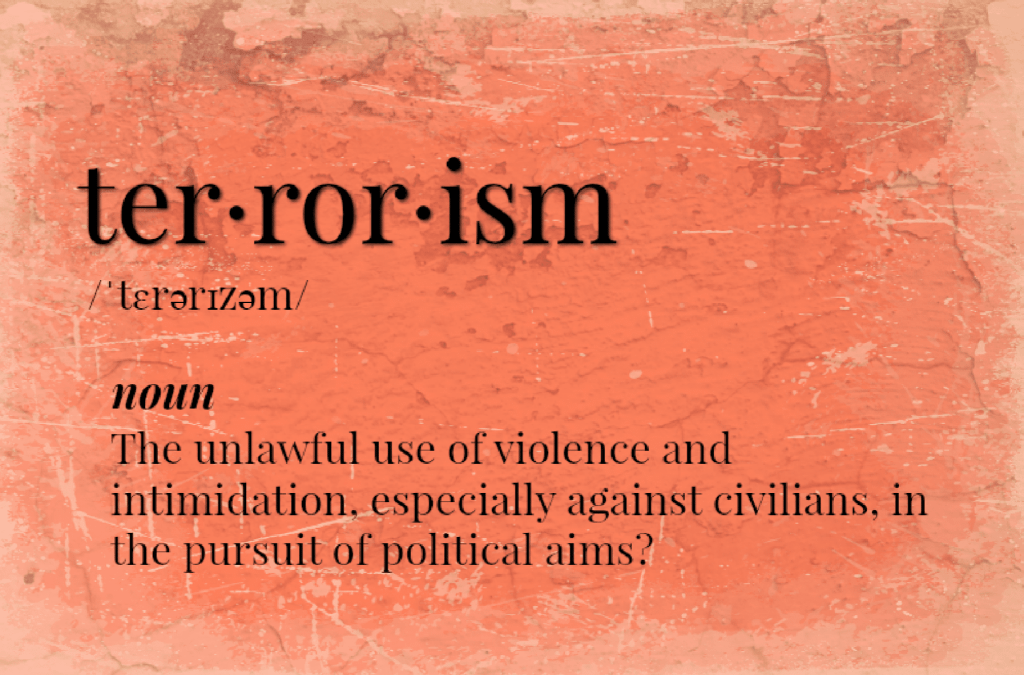
picture credit: Ryttch Magazine

A short detour to examine the word ‘terrorism’ is required. All violence creates fear in the victim but is this terrorism? The term is defined as;

‘…the calculated use of violence, or threat of violence, against civilians or non-combatants to induce fear and coerce governments or societies to achieve political, religious, or ideological goals.’

This is a definition according to AI; so open that it also clearly defines ‘war’ in it’s modern form, with civilians victims rather than military targets. Therefore I believe that ‘terrorism’ is more than this definition. It omits to define who is using this violence against civilians? Is it a nation’s armed forces or a small group of political extremists such as the IRA or ETA in the twentieth century?

Today nation states are deploying their armed forces for extreme ideological goals outside of the international laws of War. By any definition, abandoning law is unlawful and therefore this is terrorism.

As we are examining words used in war, let us consider the difference between ‘killing’ and ‘murder’. You will often hear news reports that civilians have been ‘killed’ by missiles but is this more accurately ‘murder’?

The AI definition of murder is;

‘The unlawful premeditated killing of one human being by another.’

We are told that modern drones and missiles can hit targets with laser accuracy. And yet, photographs of Gaza today are almost identical to photographs of cities ‘carpet bombed’ in WW II.

So if a missile lands on a school or hospital killing civilians, is this a ‘mass murder’ or a ‘mass killing’ – verbally sanitised as ‘collateral damage’? There is clearly a legal question of whether the missile was intended to be launched and targetted so as to cause loss of innocent life.

A soldier killing an enemy soldier is lawful because each expect to fight each other to death but civilians have no such expectation.

Today countries such as the USA and Israel will argue that they do not respect International Law and Courts of Justice as a sort of ‘get out’ clause. Time will be the judge of this but history suggests they will need good lawyers.
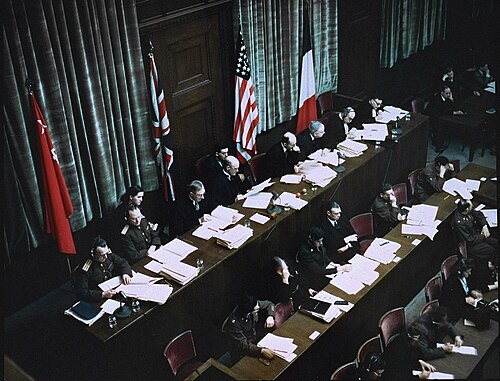
Nuremberg Trials after World War Two

Murdering innocent people should not be a subject for debate in countries that consider themselves ‘civilised’ but today leaders use words in such a way that they feel they can justify the most heinous crimes against humanity, by merely changing definitions. Trump has not declared war against Iran and his missiles and invading troops are a ‘military operation’. As there is ‘no war’ he argues that he does not need Congress to approve going to war on behalf of the people of the United States.

In my view, we all have a responsibility to understand not only what we are told but how we are being told it. Using language to alter truth exists in every language but our primary responsibility must surely be to not to manipulate language for

unholy ends.

You can quote me on this…when we do not stand up; we lie.

The Empires Strike

For centuries, Europe was dominated by Empire building around the world. In the Twentieth Century the Empires, such as the British Empire, finally broke down and gave autonomous sovereign states their freedom back. It might have appeared that the age of ’empire building’ was over, but that is far from the case.

In the Twenty First century it is clear that Empires are back. Key to the once powerful British Empire had been the Navy and control of the seas around the world. Today the vulnerable global ‘key points’ are canals and pinch points in shipping lanes. The Houthis in Southern Yemen potentially control the infamous Straits of Hormuz; gateway to the Red Sea and Suez Canal. They will stop attacking Israeli shipping, they say, when Israel stops attacking Gaza. Neither the British, USA or Israel have tested this, preferring to extend the genocide in Gaza and attack Yemen, than take the Houthis at their word.

One of the strategic reasons for the establishment of a pro-Western State in the Middle East in 1948 (Israel) was, and still is, control of the Suez Canal. In 1956 the British, French and Israelis sought to gain control of the Suez Canal when Egypt nationalised it, moving their tanks from the Gaza Strip into Egypt. In my view, this imperative has never gone away.

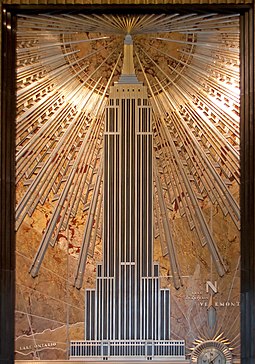
The Empire State Building, New York

MAGA? America is already ‘great’. It consists of a continent joined by an isthmus at Panama; again, a critical shipping route. The republic of the United States of America has a ruling president who wants to expand it’s 50 State Empire northwards and south. ‘Look at this arbitrary line between the USA and Canada,’ mocks Donald Trump, as if it means nothing just because it is straight. If it was meaningless, then Canada could claim the USA, as perhaps could Mexico and Denmark, but because of international law and common sense, they do not.

Putin wants the old Union of Soviet Socialist Republics back and China the island of Taiwan. Should then the British march back into India and Pakistan?

Should the French re-take French speaking Algeria?

Should Japan be given back it’s ‘Imperial’ territories in mainland China?

Should Italy claim back it’s Empire around the Mediterranean?

The list of historical reversals is absurd to all but the greedy and unpopular politicians who seek to stay in power indefinitely by empire building. Opponents are fed to the lions.

Today, Gibbon’s ‘The Fall of the Roman Empire’ is a critical read for the Trumps and Putins and Shi Jinpings of this world.

It is available in eight volumes and was read by a famous world statesman when he was twenty years old; Winston Churchill.

Now he knew a thing or two about world statesmanship and his preference for ‘jaw jaw instead of war war’.

Defence?

It’s all violence

At some point in it’s evolution, humanity has to decide whether to accept violence or not.

At present, it appears we accept violence within certain rules. We say that if you did not initiate the violence, then you can be violent towards the aggressor, to any degree. This is called ‘self defence’ and few can think of an alternative. But why should defence be more morally right than attack? Can either be justified? What is the difference, morally?

Suppose you were a citizen of the United States of America and you own a gun and know how to use it. You are woken in the middle of the night by a noise downstairs. You arm yourself and go down to investigate. You see a dark figure and shoot. At this moment you believe you are acting in self defence, as is your right. You switch on the lights and to your horror you see the body of your teenage son lying on the floor. He was creeping back into the house after a secret night drinking with his friends. This is not fiction. This happens.

Just because the law enables a gun to be the solution to your ‘problem’, was this the only solution? Were there other more proportionate actions you could have taken? Yes, you could have switched on the light before you shot at a higher risk to your own life, or you could have called the police. You could have just done nothing. Each approach is problematic but only one invites heart break.

I lived in a country where only specialist police carry guns, England. Good peace keepers should be skilled at talking down a potentially violent situation. It’s a technique and can be learnt. Now many officers carry a Taser non-lethal gun as well as non-lethal CS gas. Non-lethal is a practical half way to non-violence.

Between attack and defence there are a thousand grey variations. The best option is always somewhere between total war and total defence; not either or. Ultimately they both are characteristics of the same thing; violence.

Fortunately most sovereign countries do not attack each other and a state of peace exists. But we know that peace is a fragile situation, where historical, economic and political rivalry bubbles away under the surface like a dormant volcano. Violence has to be contained for peace to exist and this is created using ‘deterrence’. Joining forces with another group of nations is one method of deterring attack. Not being a threat is another and here we realise that it is impossible to deter another nation without them being scared of you. Russia is presently in this conundrum with it’s relationship to NATO countries.

We watched as Russia reached a tipping point and claimed that Ukraine had a Fascist army. Historically, the communists (Soviet Union) and fascists (Nazi Germany) were enemies and this history still clearly carries some import as ‘justification’. By fighting ‘fascists’ Putin possibly feels he has his predecessors moral high ground on his shoulder. Coupled with a perceived threat from an expanding NATO and Ukraine moving towards joining the European Union; Putin is clever though and he does not use the word ‘war’ or ‘attack’. He insists he is acting in ‘self defence’ to NATO’s growing threat and his military action is just a ‘special operation’.

Words are master deceivers and suit Putin well. Because two words, ‘attack’ and ‘defence’ are the same thing; a resort to violence is claimed to be justified.

Zionist politicians in Israel have more or less done the same thing. They have an historical antagonism towards the people of Palestine whom they have been squeezed into smaller and smaller enclaves. Any similarity between this and the Warsaw Ghetto in the Second World War is of course, purely coincidental. The question is whether Palestinian or Isaraeli fighters are defending their country by attacking their neighbour. Defence quickly escalates into violent action that can get wildly out of control. The question of ‘proportionate’ use of violence (an eye for an eye) is the current debate.

So how can non-violence ever replace violence? The answer is it probably can’t whilst humans are attached to a materialistic and territorial lifestyle which they guard with weapons. In this respect humans are less sophisticated morally than most animals who rarely fight their own species to the death.

We learn to deal with violent conflict as children in the school playground. When we become adults we are expected to rise above violence as a solution to problems.

Two boys start fighting in the playground. A huddle of eager spectators quickly forms around them. These bystanders are too immature to try to pull the boys apart and instead encourage them. A stronger third party with moral responsibility for order is required; a teacher.

The teacher breaks up the mob and marches the two boys off to the headmasters office.

‘He started it!’ is a common defence from children. Their false logic is that when attacked there is no other response than a defensive counter attack. There is usually an option to run.

If we change the scale of our example, to that of governments and countries, you will find that ‘he started it!’ is also used as a justification for the use of violence by sovereign states. Only a third party intervention from a body with higher moral and political authority has the power to stop and settle wars. After the horrors of the second world war the League of Nations and subsequently United Nations was created to step into this role. The objective voice of world opinion should, in theory, make the warring parties ‘see sense’ and the more mature aim of seeking a peaceful resolution.

The United Nations and the United States of America, could go to the preesnt Israeli Zionist government and point out that killing innocent women and children in Gaza is morally unjustifiable. Putin could be hauled into the headteacher’s office by the United Nations, but has not.

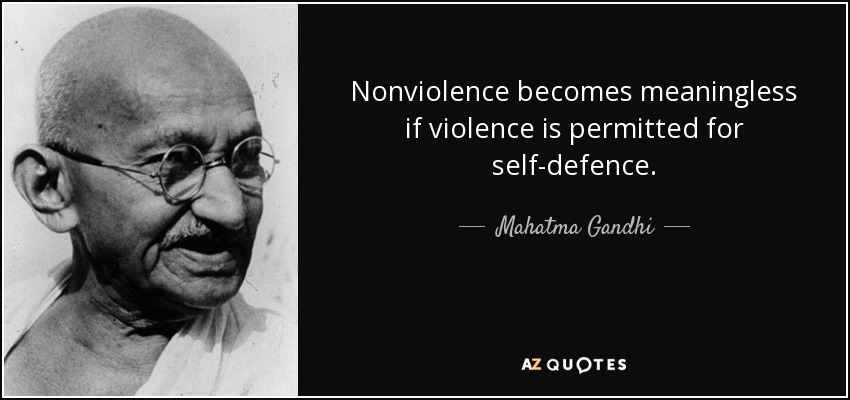
Mahatma Gandhi lead a nation using moral authority based on non-violence. He wanted the British to leave India and for Indian people to govern themselves. His tactics using moral discipline, diplomacy and example turned out to be more powerful than the military might of the British Raj.

War was described by Carl von Clausewitz as ‘ the extension of politics by other means.’ Personally, I would be more precise and describe war as the extension of politics by violent means. This creates the logical possibility that peace is the extension of politics by peaceful means.

Of course, peace is an abstract idea and never completely exists but there is a place close to total peace which might be reached using skilled, non-lethal force.

To use a personal example, when I was a boy at school, I never sought to fight. When I was inevitably confronted aggressively, I stepped forward, put my leg behind the thigh of the aggressor and pushed him to the ground. Yes, it was violent but it only hurt a bully’s pride.

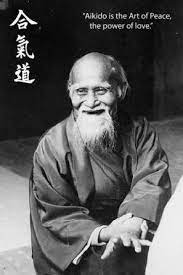
This was the extension of politics by peaceful means, meaning no one was hurt. Later in life I came across Aikido. This an unusual martial art in that it enables winning a fight without confrontation. For this reason it requires no strength and is ideal for women and the elderly.

An interesting example was given me by one of the teachers. He was on an ice-rink when he felt a hand going into his pocket and pulling out his wallet. Instinctively he grabbed the wrist of the thief and continued the forward movement of the pickpocket’s body. The result was to send him rapidly across the ice rink. In Aikido, the art is to avoid conflict using simple non-aggressive moves that eventually tire out or restrain the opponent until help arrives or submission.

City dwellers would do well to learn the tactics of pickpockets even if they do not feel able to defend themselves physically. Usually they work in teams in crowded places and choose victims carefully. This is done by the ‘spotter’. Then the thief moves in using much the tactics of the illusionist in a theatre to distract and act deftly. Then a third party intervenes by preventing escape or creating another distraction.

Governments would do well to learn from these examples at a micro scale of conflict. Having a clear aim is vital to managing any violent unsolicited action. The method of conducting the conflict and ending it with minimum force and casualties for both attacker and defender and vital. Fast and deft military moves have time and time again proved their worth on battle fields.

When Napoleon wanted to teach the Zhar of Russia a lesson for breaking their pact of unity in 1812, he formed an army and headed for Moscow. Contrary to most other opponents Napoleon had fought, the Russians did not line up and wait to be shot or cut down by flanking cavalry. Instead they conducted an extraordinary retreat, burning everything in their wake. Only when Napoleon reached Moscow did they choose their moment to swiftly counter attack. Napoleon’s army fled in disarray and only 5% of the original army returned to France.

Sun Zhu in his famous book on military tactics said, ‘engage with the ordinary, win with the extraordinary’. A little side stepping and originality can nimbly avoid a cataclysmic confrontation like Ukraine v Russia. ‘Give some ground,’ is one solution.

Special forces, such as the British Commando’s came to the forefront of military tactics in the Second World War, where small teams of four men used guerilla tactics against an unprepared enemy. Casualties for the attacking side were minimal compared to strategic gain.

Ultimately the choice is not whether to attack or defend but to avoid unecessary violence by what ever means possible. There are always alternatives that require imagination and focused problem solving techniques in exactly the same way the animals avoid killing their own species. There is no ‘perfect’ state of non-aggression where humans in their present terratorial state of consciousness are concerned. Perhaps in the future, peace will break out and violence will never be the preferred problem solving option. In the words of , ‘what if there was a war and nobody came.’

“Ah! There is the rub.”