In my previous two essays I have investigated and speculated over the ancient origins of two well known hill figures in Southern England. These are the Long Man of Wilmington and the Cerne Abbas Giant.
I shall now expand on some of the entomology of the place names, possible associations and derivation from ancient mythology and their significance.
This type of study might be called ‘sacred archaeology’ where the study of the past reveals not only the every day lives of the ancient people but their spiritual practices and level of awareness.
In my first essay I investigated the origins of the hill figures and suggested that they origins lay in the land known as Atlantis. The catastrophic earth changes that seeded the inhabitants of Atlantis around the world are described in detail elsewhere.
Taking on the hypothesis that the Atlantean people shared their advanced knowledge with developing Kingdoms such as Mesopotamia and Early Ancient Egypt, it becomes possible to trace common myths, gods, through the millennia.
Thoth – Judging the Soul with a balance.
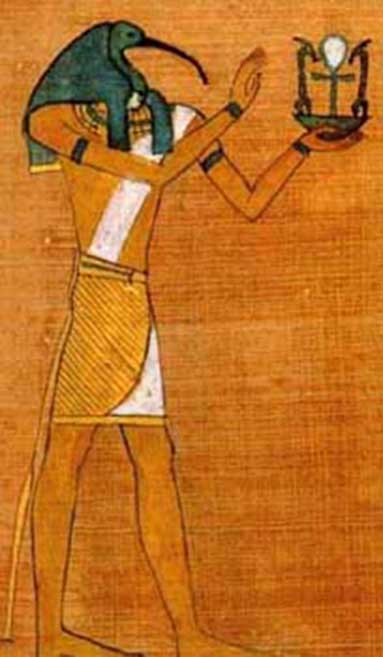
Note the Ankh symbol at the centre representing the human soul. The two staffs either side represent balance between the masculine and feminine.
For instance the Ancient Egyptian god of the Underworld is known as Thoth, usually depicted with a staff. He is the keeper of esoteric knowledge, writing and conducts the passage of souls into the Underworld. These god like characteristics carry through into the Celtic world around 800 to 450 BCE, during the Iron Age.
Cernunnon wearing a Torc around his neck, where the throat chakra is postioned.
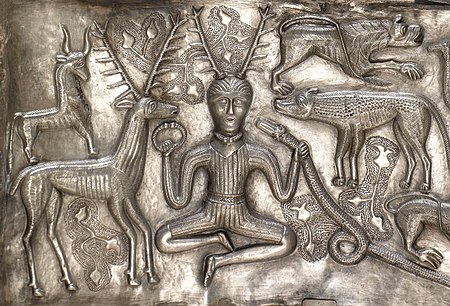
In the Celtic pantheon there is a god of the Underworld known as Cernunnon. He is depicted with antlers and is commonly seated cross legged and holding a serpent (masculine) and a torc (feminine).
I referred to the Long Man’s vertical staff symbol in the previous essay as representing conductors of energy (present today as the Magician’s wand) The rod or rods become ‘aerials’ able to induce tellurgic currents from the earth and waters below through the human body into the air and fire of heaven above. The human body and staffs of a particular length (ergo wavelength) are able to induce through resonance, tellurgic currents.
The Long Man of Wilmington in Sussex, England.

These vertical forces are depicted in the figure of the Long Man of Wilmington and are echoed in the pillars, church spires and obelisks of later and earlier civilisations. They even emerge as the pillars of the sun and moon in the Freemason tradition, one of the most direct connections we have today to this ancient knowledge.

The ability to transform oneself spiritually by literally ‘tuning’ into the earth at sacred places is shown in the depictions of Cernunnos to be even more sophisticated than the gods with vertical staffs (or serpents).
The vertical Idas in the human body and the horizontal chakras are a fundamental part of the very ancient system of Yoga.
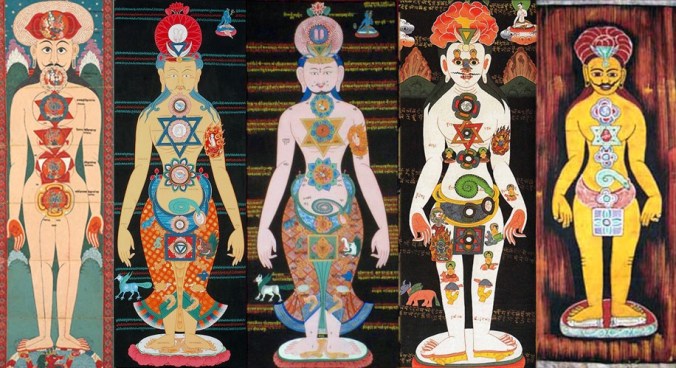
(Further description of the horizontal nature of chakras can be found in my blog chakracard.wordpress.com)
What is important in the depictions of Cernunnon is that the earth energy is depicted as snakes wrapped horizontally around his waist. This is a direct symbolic connection between the spiralling underground water below a sacred place, known to Dowser or Water Diviners such as Guy Underwood who wrote ‘The Patterns of the Past‘. The circular motion of the chakras is signified in their description by clair clairvoyants as ‘wheels’ or ‘lotus flowers’.
The author’s depiction of the horizontal chakra wheels in three dimensions instead of the conventional two dimensional images.
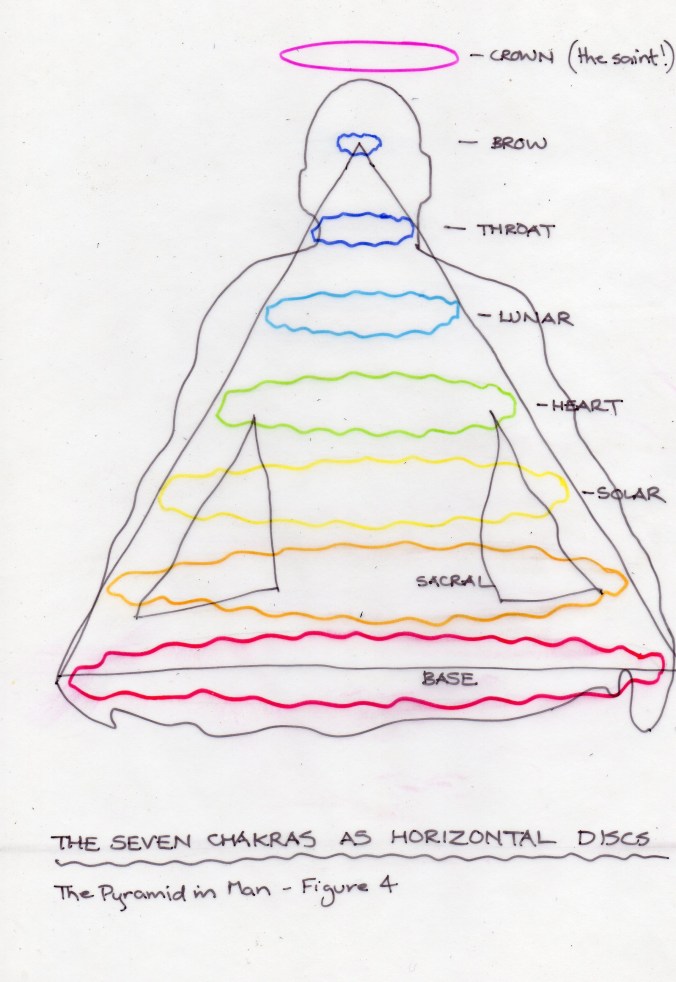 Note the author identifies a lunar chakra balancing the solar chakra with the heart chakra as the fulcrum. This observation is thrown in for free! The justification is examined in the essay to which I have previously referred. The prescence of a Lunar Chakra in humans, substantiates the ancient knowledge described in this essay.
When the human body sits cross legged, it forms the shape of a triangle or pyramid – a shape repeated in built form across the world from Atlantean traditional knowledge. The fact that Cernunnon is seated is not insignificant. Few gods are shown seated as they do not exude power over the viewer as much as if they are standing. But Cernunnon was not a symbol of power of the gods or the priests or elders over the common people. He was showing how to balance the horizontal energy of the human body with the vertical energies. When this balance is achieved then a ‘fixed point’ is created as an infinitely small and infinitely large centre of the universe in the human heart.
The Christian symbol of the cross and other cruciform symbols such as the Ancient Egyptian ‘ankh’, symbolise this knowledge.
And as if Cernunnon had not made the point enough, he wears two antlers on which are hung ‘torcs’. The number two is important (as in the Long Man of Wilmington) as it symbolises the complimentary nature of the solar and lunar energies and their ideal harmonious relationship. The antlers are ‘aerials’ used by deer not only to fight but more importantly, as sensory organs containing blood and nerves.

Place two metal rings on these vertical forces is to introduce the feminine vulva with the masculine phallus, or the moon and sun energies. This is highly significant for the spiritual aspirant who communes, by the invitation of the magus or shaman, with the spirit of the local god, during initiation.
If you had not already linked the entomology of the word Cernunnon with the place name of the Cerne Abbas giant, then I shall do so now.
The Celtic polities linked their word CARNUTES with ‘The Horned Ones’.
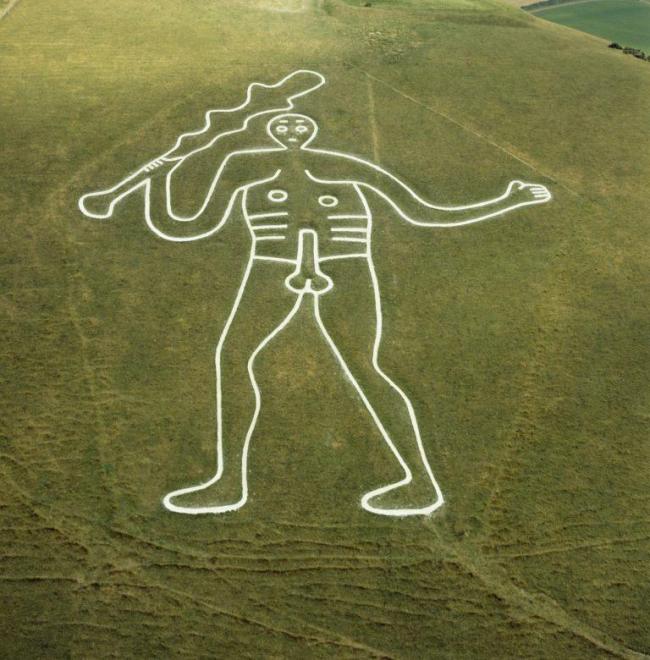
But the Cerne Abbas giant of today has no horns, you may observe. He does have one obvious sexual feature that in modern English slang is referred to as a ‘horn’ – but perhaps that is too speculator to be meaningful, or perhaps not.
The figure we know today as the Cerne Abbas giant is not seated nor wearing antlers of horns. He has clearly been changed at a later time and I suggest that we have the Romans to thank for that.
The Romans also have a god of the Underworld, who is known as ‘Dis Pater‘. You might immediately note that ‘Abbas‘ and ‘Pater‘ share the meaning of ‘father’, odd if coincidental. Cicero, the Roman historian, suggested it meant ‘father of riches’.
‘Dis’ is reported in Wikipedia as being a contraction of the word DIVES meaning wealthy or rich. This is itself derived from the DIVUS or DIUS meaning god like or divine via the form DEIU.
This is highly significant as the whole spiritual process is one of making an ordinary person achieve divinity or divine qualities – treasure stored in Heaven as Jesus said. And Jesus we know, constantly referred to God as ‘Father’ curiously family orientated in common speech but significant in this ancient use of the word ‘Abbas’.
Julius Caesar claimed in his Commentaries of the Gallic Wars that the Gauls ‘claimed descent from Dis Pater’. This is therefore an important god to all Celts, whose memory was carried on by the Romans.
Venus by the Ancient Greeks achieved a level of art the Romans could not replicate.
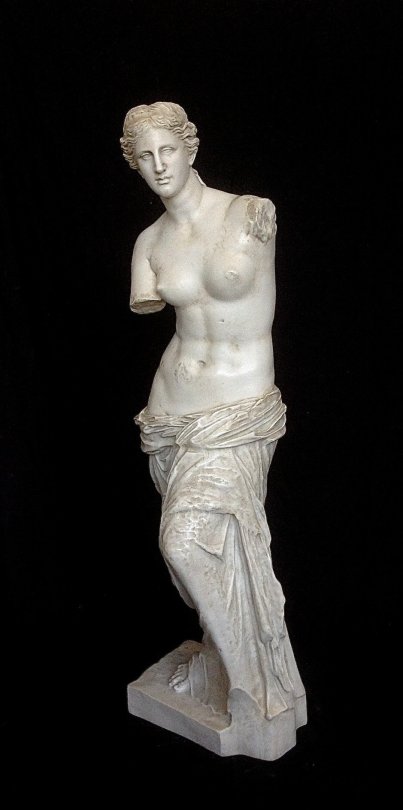
In my view the Romans were lesser beings than the cultures who preceded them. The transition in sculptures from Greek to Roman shows how poorly skilled they were in this area of culture alone. The Romans were skilled engineers and soldiers who, in my view, lost their understanding of most ancient knowledge. Perhaps because of this, their empire was doomed to descend into decadence, and on that subject books have been written.
The figure at Cerne Abbas, has become a war-like giant, who stands erect in more than one sense. He wields a war club above his head instead of antlers, clearly a figure interested in overcoming others rather than himself.
The Roman Dis Pater; note his horns and the horned stag and bull at his feet. Balancing feminine and masculine figures stand either side of him in place of the staffs or columns.
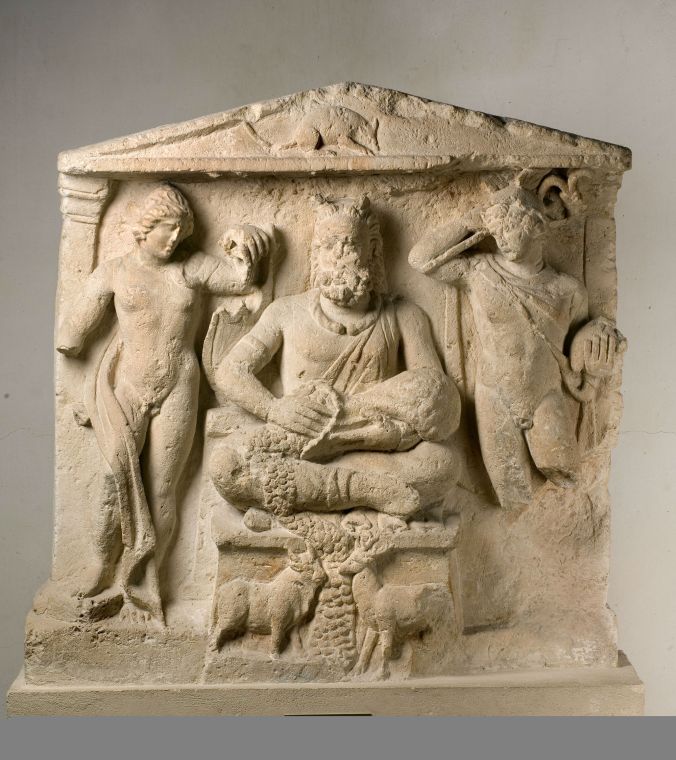
The Cerne Abbas Giant, I therefore believe, is a lesser figure of the Celtic Cernunnon god who late morphed into the Roman Dis Pater.
The former gods balanced the masculine and feminine energies within themselves, whereas the Cerne Abbas Giant allowed himself to degenerate into a slave of the masculine energy only.
***
A Crop Circle that appeared near the Cerne Abbas Giant
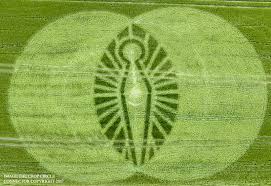
The Vesica Pisces is formed by two overlapping cirles (sun and moon) in which a knife stands erect; an affirmation of the masculine and feminine balancing energies described in this essay.
***
Afterword;
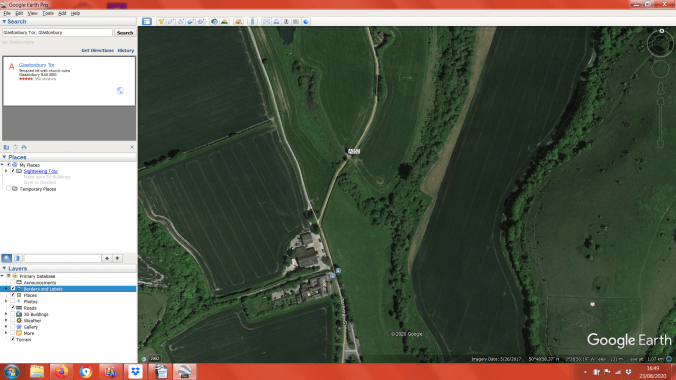
And then I was looking at Google Earth a few weeks after writing this essay and found this same crop circle in a field about five hundred metres away from the giant, top middle. The giant is in the bottom right corner above the capital G. Thanks Google Earth!
 Matters Blog