This month, on 4-5th July 2020, there will be a lunar eclipse. The shadow of the earth will trace a dark path across the moon. Whilst the moon does not have a dark side it does act as a projector screen for the earth’s shadow. Normally, the moon enables light to be reflected from the sun to lighten our nights, as well as help mankind reflect on it’s shadow nature.
picture credit: curlytales.com

On 21 June 2020 there was a solar eclipse which curved around the earth from the Horn of Africa to China. Being only about 53 miles across the umbra shadow cut a relatively narrow road. To the people in it’s path, it was almost certainly an awesome experience.
To lose the light of the sun during the day when it would normally be a reassuring, continual presence, can be frightening. Humans are not naturally nocturnal creatures. We avoid the darkness and emerge from our sleep when the sun’s fingers cross our bedsheets and tickle our chins.
How comfortable our existence becomes! We are always guided by the light, warmed by the infra red or cooled in the shade. We become creatures of the light and self styled spiritual gurus in the west have adopted the title, ‘light workers’. A more balanced approach would be to examine shadows as well as light. Only in this way can the whole be understood. In reality there is no such thing as dark, only an abscence or reduction on light intensity which we call ‘dark’.
Events like solar and lunar eclipses and of course the night, underscore the ‘unwelcome’ reality that there is a dark side to everything. Sometimes the darkness creates fear, sometimes safety. A frightened child may run to the comfort of the wardrobe, only to find a Lion and a Witch and adventures therein. Even the internet has a ‘dark’ cavern where shady characters gather to share and enjoy the unmentionable.

We ignore the spiritual and psychological reality of ‘darkness’ at our peril. For, like all external phenomenon – the cycles of nature – we have shadows within. They contain aspects of ourselves which are not necessarily ‘bad’ by any natural comparison but are deemed ‘bad’ by the arbitrary rules and regulations of society.
Bad in this context naturally excludes causing harm to others. The ‘bad’ is simply that part of our own nature which we are told as children and adults, is wrong to express.
Cultural taboos, customs and norms, laws; all draw boundaries around us which we are forbidden to cross.
Such ‘bad’ behaviour might be a refusal by a child to ‘do you are told’. I was once made to sit in a chair all afternoon staring outside, because I had rebelled against my parents rule that I return for lunch everyday. That day, I was having too much fun riding on top trailers of hay on the local farm. (This was the 1960’s when children played outside all day. Other people were not then regarded as ‘dark strangers’ as they are today by many fearful parents. )
Today I remain an ‘outdoor’ person and ‘sun lover’ much to the amusement of others who tend not to expose their bodies to it’s health giving rays. As an adult I can see that this is their choice and I have mine. There are rational reasons for both standpoints. I stand by my choice as an expression of my own nature. Without this aspect of myself being expressed and experienced, I would not be a whole person.
All of the above is of course pure Jungian psychology, named after the great Carl Jung, one time pupil of Sigmund Freud.
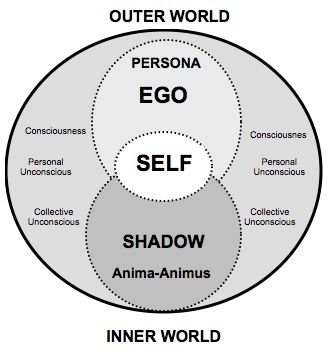
Jung coined the termed ‘individuation’ as being the life time goal of an individual, in place of the less achievable ‘perfection’ in many more classical spiritual paths.
The distinction between the outer and inner nature is a product of dualistic or binary thought, where the two ‘opposites’ create each other.
The brighter the light, the darker the shadow
But we know from physical science that it is impossible to create a ‘dark’ box and it is impossible to create a light of maximum brightness. These two extremes merge into one another somewhere in the middle and that is a good metaphor for the goal of individuation. The light is not worshipped as the only thing that matters, as in the ancient sun god and to some extent modern new age thinkers, and the dark is not feared. The nature of reality is an infinite number of shades of grey.
Carl Jung realised that the repression of the expression of Self, puts away those aspects of consciousness that the individual cannot face and, or, comprehend.
This might be the experience of a trauma as an adult or a child. Whatever the strength of the repressed experience, Jung argued that if allowed to remain in the shadow side of the personality, it would have a negative influence on the personality which not only persists, but expands. This fear eventually becomes greater than the repressed thoughts and feelings and creates a blockage between the conscious and subconscious minds.
The story of Beauty and the Beast is a perfect example of this. The beast has become a completely horrific aspect in the mind of Beauty. She is used to the light and lightness of being and to have some aspect (her maleness ) of her mind shut away is not something she can approach easily. But in the story she over comes her fear of the beast within and eventually she falls in love. At this point the grip of the fear which once held her back from loving, has been broken. The beast turns into the handsome prince he always was.
We all need to discover the prince or princess within us and not shut him or her away in a dark or ivory tower. Sometimes society allows us to do this, sometimes not.
Loki the Trickster
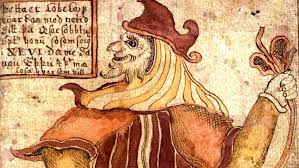
At this moment in time we are reminded by the planets and their place in the spiralling heavens that we have nothing to fear. We need to take the advice from ‘the fool’ – another archetype who Jung termed ‘the Trickster’.
Imagine yourself as the tea pot in the Mad Hatter’s Tea Party in Alice in Wonderland. You are surrounded by rows of plates and cutlery and at each place sits a lunatic character each insistent on their own point of view. If you were that tea pot – sometimes with a dormouse inside and sometimes not – then your task is to remove your lid. Throw your hat into the crowd. Let the light into your dark interior, perhaps to let the dormouse in or out, perhaps just for your own satisfaction of feeling every permutation of what it is to be a tea pot.
There is a modern interviewing technique for candidates to an occupational post. It is to ask rather bizarre questions and record how the candidate responds. One such question is;
What is this? A tea pot is produced and placed on the table.
A conventional mind will answer ‘a tea pot’. An unconventional and open mind will suggest that it is a tool for catching tropical fish underwater, a rain catcher for a leaky log cabin, an echo chamber to aid singers practice as if in a cathedral, a device for pouring liquid concrete into unwanted mouse holes and so on. The obvious answer is obvious, everything else comes from the personal unconscious and sometimes, the shadow self as well.
There is no right answer just the endless horizon of possibilities. When we cross the unreal boundaries drawn by our own minds and, or, social human norms, we cross over into the world of imagination.
Dorothy in The Wizard of Oz experiences individuation by overcoming her fear of the physical world, represented by the characters of the Lion, Scarecrow and Tin Man. These are symbols of the animal, vegetable and mineral kingdoms / emotions, instincts, mind, within the parameters of which we each play out our lives. As humans we have a unique chance to travel the golden road. At the end of that road, if we ever reach it, we realise – that is, it becomes real – that the Wizard in the dark castle of our minds, is just a frail old man who holds no power over us at all.
If you wish to understand how the ‘fairy tales’ of our childhood are not fairy tales at all, it really is not necessary. They work like the ‘patches’ that we download into our computers. We do not need to understand how they work but by absorbing them the threat to your computer has gone. This is why children crave traditional ‘bedtime stories’ that come from the collective repair shop of mankind’s evolution. What are termed ‘fairy stories’ but are more real than anyone can imagine.
Hello yellow brick road.

picture credit: myHighPlains.com
 Matters Blog