T- H- E -A- T- R- E = E- A – R- T- H
We have probably all heard the idea that planet Earth is a place where souls are sent to learn. Most, if not all, take the challenge very seriously. So much so that we do not see the scenery move, the scurrying off stage, the forgetting of lines and the disappearance of properties. Some are even oblivious to the booming commands of the Director.
We innocent players in our own stories, take everything to be real and should be forgiven for that because it is, a very good show.

“All the world is a stage and all the men and women merely players. They have their exits and their entrances and one man in his time plays many parts.”
William Shakespeare ‘As You Like It’
Okay, so we know this quotation. But do we really? In 1599 when this play was probably written, women did not go on the stage in England, not until much later. So why does Shakespeare include women in this metaphor? The simple answer is that he cannot exclude them. Practical reality means he must write them into the script because they exist; even if not on his stage. It’s a weakness in his metaphor; more obvious in it’s day than now.
However, it’s a good metaphor and illustrates the subject of this essay well.
Shakespeare (if he existed) was like many Elizabethan poets and magicians, a master of the imagination as well as expression. Indeed, the line between what is real and not real in his day was much subject to debate.

Magic is no more than the distortion of what we perceive as ‘reality’ revealed unquestionably as ‘unreality’.
But suppose that everything you can possibly think and feel is one part of one great illusion?
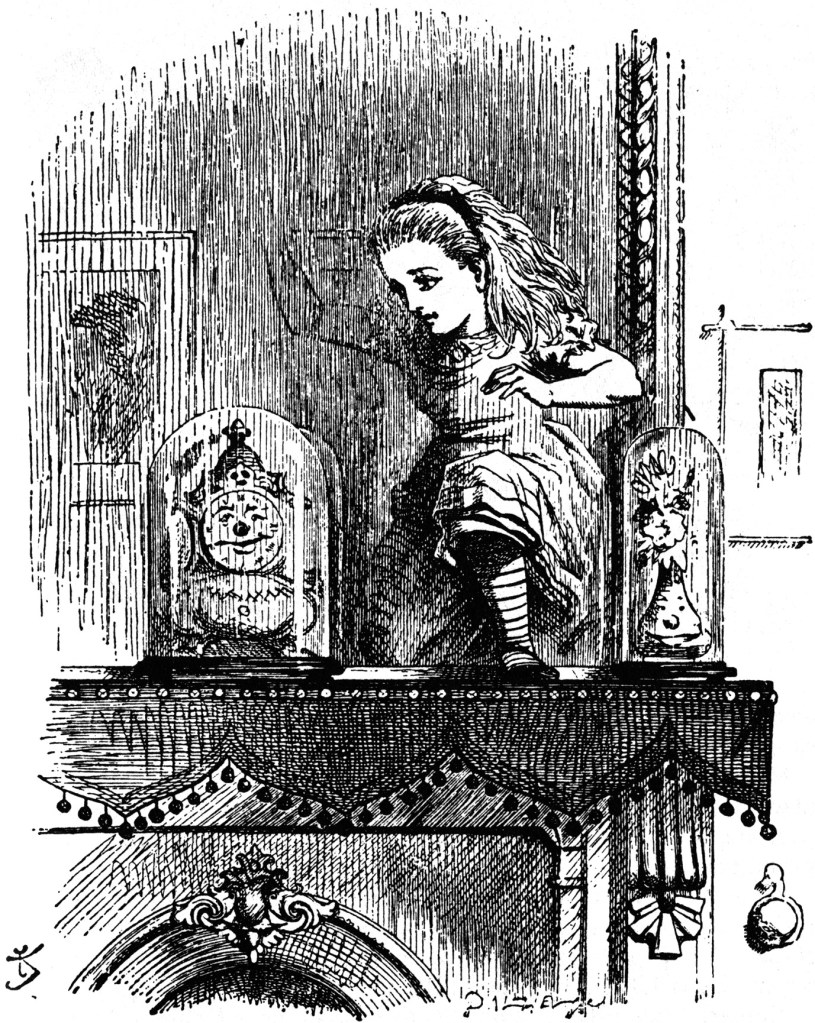
In ‘Alice Through the Looking Glass’ Lewis Carroll takes Alice ‘behind the scenes’ into a reversed and parallel universe. He is playing on the idea that what we imagine is what we see…a philosophy known as ‘Idealism’. Alice enters a theatre of the absurd with great comic effect by stretching the boundaries between reality and illusion.
Greatest enthusiasts for this attitude are young children. They spend their early years in this ‘strange’ world where simple objects become something else. A soft toy such as a Teddy Bear becomes a much-loved companion capable of conversation and comfort at any time of day or night. As a boy I used to move marbles around the living room in massed lines to represent units on a battlefield. The lessons in strategic thinking were real, even though the participants in this search for glory and honour, were made of glass.
Adults may tut at this odd display of credulousness, but what if children are closer to reality than they appear to be?
What if it is adults who are playing in a play?
The human mind is like soft earth rather than rock, ideal for recording and making sense of experience. Perhaps we are like the clay from which God made us. We are made in two parts; one conscious and one sub-conscious. Each of these in turn has the quality of being either dark or light.
We learn a language to describe our experience of ‘being alive’ and fortunately our experience is like others. But what if this is only because we have all stepped into the same imagined reality?
We know that our perception governs much of what we think and feel because each of us describes what we see in a slightly different way. When police record sworn statements from witnesses to a crime, it is remarkable that each describes subtle and even glaring differences in the account of what they saw.
It is as if we have all been programmed differently by our unique experience of ‘the world’. And if we strip ‘the world’ down to its essential features it becomes clear that we use some weird ‘applications’ to deconstruct our experiences.
In music there is a thing called a ‘mind worm’. This is an apt metaphor that most people understand and experience as a series of notes in a rhythmic order (a tune) that they have heard several times and can no longer ‘switch them off’.
There is usually an emotional connection to such a worm in our heads whether musical or otherwise. When we play or ‘act out’ the programme which contains this experience, we obtain a feeling of great pleasure.
For example, the simple experience of going to a cinema, plays through a persons mind a description of the world which excites the audience; whether as horror or beauty or other device of the creators of that film.
Persons who have just sat through a film often emerge from the cinema, into ‘reality’ whilst still imagining themselves as one of the characters in the film. Children are particularly susceptible to this phenomenon and long may it be so for imagination is a safe and enjoyable way to explore an otherwise mysterious and sometimes terrifying Universe.
Adults might consider it their role to bring the imagination of their child ‘down to EARTH’ through scolding their child, but I am suggesting here that children may have got it right. In the twenty-four hours of an adult’s day, much of it may also be without any substance; as is said, ‘a daydream’.
The advertising industry knows this well when it projects a thirty second ‘mind worm’ into the heads of the audience about the desirable qualities of some drink or car or holiday. The advertisers spend money on this process because they know without doubt that their ‘worm’ will bore its way into people’s minds. Such waking dreamers will reach out for a packet of ‘new’ soap powder on the supermarket shelf prompted by their subconscious association between the product and sparkling clean, perfectly ironed laundry.
This is the great theatre in which we act the seven stages of our lives that Shakespeare poetically describes in the rest of this speech.
We might feel that your mind is in control of your life because we do not want to believe it is all fake, a tissue of lies that we have told ourselves since we started the decoding process of biased perception as a baby.
Yes, it’s fun, but these scenes in our lives are but shadows and reflections interpreted by a poorly programmed dreamer in the grip of believing it is not merely playing at being alive.
If you don’t believe me, ask an elephant.