“AI You Can Drive My Car”

(with apologies to Simon and Garfunkel)

There is a revolution happening spearheaded by self-driving electric cars but have the majority of people considered the destination? In the UK there is a target to only sell electric vehicles in car showrooms by 2030. The government’s stated aim is to reduce carbon emissions into the atmosphere and thereby the risk of climate change and global warming. But is stopping killing the planet really their main concern or is there another plan? After all, there have been decades to save the lungs of the world; the Amazon rainforest…

I recently applied for a quotation for a household electricity supply from photovoltaic cells. One of the questions I was asked was, ‘are you going to have an electric car in the future?’ to which I replied ‘no’; which surprised me. I didn’t know I thought that, so I have spent some time to find out why.

I am certainly not convinced by ‘hybrid cars’. Hybrids are by definition, neither likely to be good at one thing or another. I have heard of companies who bought fleets of hybrid cars and then discovered their employees ran them solely on the petrol engines.

We know that one third of the energy a car uses in it’s lifetime, is in it’s construction. This means that converting to electric motors will only ever have an effect on reducing the other two thirds of the energy the car will consume in it’s life. And when electric cars stop for a recharge, how much of the electricity they use has been created without carbon emissions?

A fifty year guarantee and free disposal, would be an interesting strategy for car makers. Owners of ten year old cars in Spain, were written to by the police suggesting that they scrap the car and get a newer ‘more efficient’ model. Demonising petrol and now diesel cars has been government policy in many countries and yet driving more slowly to save fuel and carbon emissions has not.

For instance, when one drives on most European roads at the maximum legal speed you will acquire a line of vehicles behind you waiting to overtake. This despite the increasing costs of fuel and the protests of drivers protesting that they cannot afford it. Perhaps they do not realise that cars travelling substantially over 60mph are consuming up to third more fuel. In the United States of America there a maximum legal speed on highways of 55mph to preserve fuel and increase safety.

There are many options for greener personal transport. This may include driving at reduced speeds, retro fitting emission filters, regular testing and maintenance. My fifteen year old 2.2 litre diesel estate gives me 65mpg. This is better than many ‘state of the art’ hybrid cars. There are diesel engined black cabs built by the London Taxi Company, that have completed one million miles.

It is possible to retro-fit carbon less engines into pre-used cars as a greener option to producing new cars. It’s not something economists will support as making cars makes money, but the pressing immediate need is for reducing global carbon emissions, a direction only governments and the COP meetings have the power to steer our future towards.

The Charge of the Electric Cars

Let us examine the EV (electric vehicle) options currently available and there relative pros and cons.

The first point is that all these vehicles have tyres made of rubber and rubber polymers. These tyres obviously wear out at the same rate as all other tyres. They produce more airborne particulate matter (PM) than either diesel or petrol powered cars according to academic experts on air pollution. We should consider reducing the harmful effects of cars on clean air as well as a cause of climate change. Respiratory problems such as asthma are becoming more common in children in western countries.

Even the plastic used in the construction of a car is a considerable consumer of oil based polymers and not necessarily designed with longevity and ease of re-cycling as benefits in the list of the car’s worth.

When considering emissions we should also note that electricity supplied in national grids is only partly produced by renewable sources (including nuclear) Electricity is still produced by fossil fuel burning power stations. This will gradually improve but the vital question is ‘how quickly?’ The sanctions introduced by both sides in Russian War against Ukraine, is halting the move to stop using fossil fuelled power stations and even more are being built.

Thinking of the causes and effects of this war we should consider rare earth minerals. Ukraine has a significant proportion of these in Europe and China has the greater part of the world’s. The need to set up factories making batteries for EV’s is inevitably contributing to the political uncertainty in the region. After all history shows us that the shortage of resources is one of the most common causes of war.

There are low carbon using and emitting vehicles other than EV’s. Hydrogen fuel cells are a source currently being developed for lorries and trains ( but not domestic cars ) and perhaps this will change in the future.

Compressed gas slowly released into the cylinders of internal combustion engines is a little known option. Buses and taxis in inner cities are ideally suited to this form of power as the emissions from vehicles are just clean air. With local renewable electricity generation powering the pumps that compress the gas, the costs and harmful effects of public transport vehicles could be significantly reduced.

Certainly, all governments need to look more closely at generating electricity locally using photovoltaic (PV) cells. There are existing schemes and proposals which cover such large ‘neutral use’ areas such as car parks, canals, roads and railways with PV cells. Car parks in hot countries require shade as do house roofs and local generation on a large scale could potentially replace the ‘national grid’ concept which is inefficient and subject to damage by storms and strategic security issues.

Also, national grids require sub-stations to reduce the high voltages for domestic use, and lose substantial amounts of electricity during transmission.

Wherever the electricity comes from, it will eventually connect with your electric car at a re-charging point. There are presently two ways to do this. The most practical is in a private garage or driveway at home. Here charging can take place overnight at lower tariffs and ensuring a full charge for the next day. With a range of say, 300 miles per charge, this is the most economic and convenient way to use an EV daily. It can even temporarily power the house in the case of power cuts!

Unfortunately, the majority of householders do not have private parking and private charging. People who live in cities, often have problems parking near to their homes, before even considering parking at a re-charging point. It has been suggested that lamp post might be able to perform this function. However successful a solution is found, the electrical consumption (thousands of watts per vehicle) by used cars overnight, is a demand for which the supply infrastructure is not designed.

Once another tangent. can we expect governments to absorb the loss of tax revenue as fossil fuels become fossils themselves? It seems unlikely and national bureaucrats will refocus their tax collecting efforts to other means, such as taxation by road tolls, replacement tyres and car purchase.

We should always factor in revolutionary and new technology. It is likely that battery technology will produce smaller batteries that charge instantly and require no rare earth minerals; such as ‘capacitor batteries’ that already exist. Or perhaps fuel cells or similar green technologies will take over? What is regrettable is that it has taken this long for battery technology to improve exponentially instead of in small steps. This remembering that electric cars preceded the internal combustion engine and declined as the first choice of motive power at the same time that oil fields were being discovered in California.

Open Your Mouth and Say ‘AI’
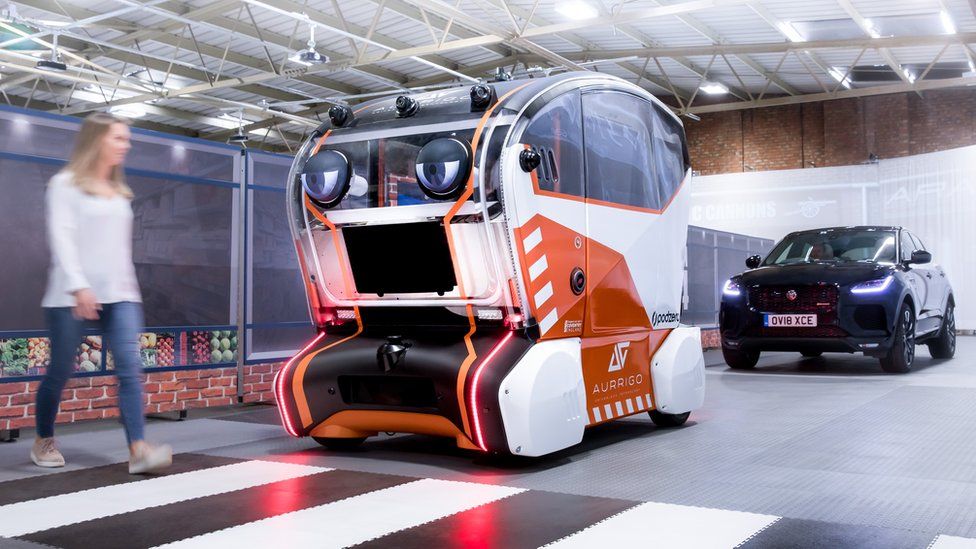
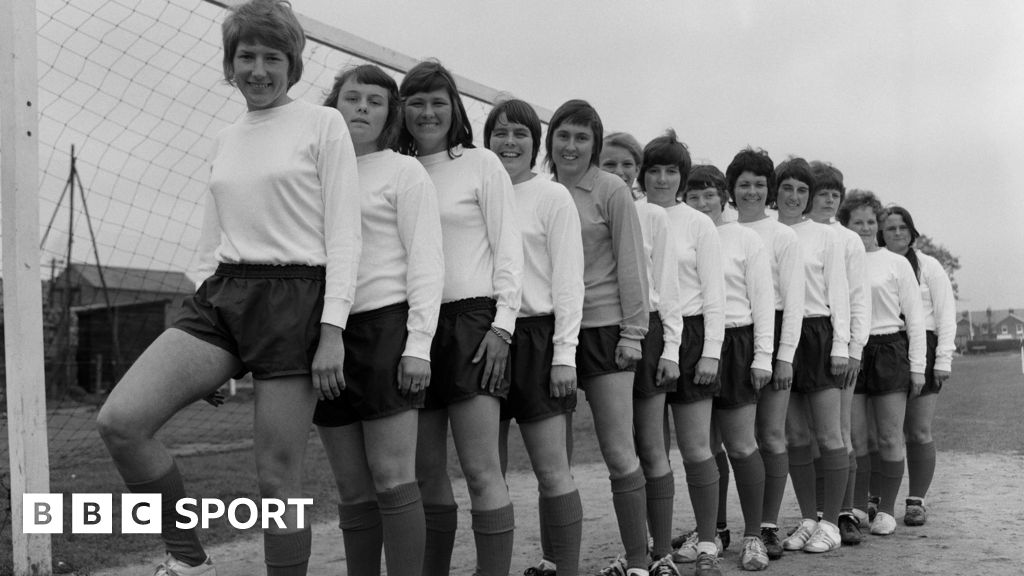
(picture credit BBC News)

We live at a similar cross roads today to the car designers of the nineteenth century. Today it is not so much in material but computer technology leading the way forward. The self drive or robot driven vehicle is slowly metaphorically nudging itself onto the highway out of the acceleration lane. Electric vehicles and self drive technology are a marriage made in the AI equivalent to heaven. We can expect the price of such vehicles to decline rapidly as production is switched from heavy ‘gas guzzler’ to lightweight ‘data driver’. We will be sold self drive cars using the golden words and phrases such as ‘safer’, ‘quieter’, ‘cleaner’, ‘cheaper’, ‘easy maintenance’. Gold lame suited sales personnel will persuade you how almost impossible the self drive car will be to steal and or be used in crime by car thieves. ‘Even you husband will not be able to take it madam!’

The dreaded speeding ticket will be a thing of the past. No one will be going anywhere fast; not unless robot drivers are programmed to leap from their vehicles and fight out disputes with laser guns. Could be fun to watch?

And the price of this revolution is; well, most people accept loss of privacy because they reason that they are not criminals and have nothing to hide. This is indeed true, however AI technology is not really for our generation. It is for our children and our children’s children who may well find themselves governed by criminal governments. Such a suggestion may shock the reader but reflect on the fact that there are governments in over half of the world today who are authoritarian. In other words, the lunatics have taken over the asylum. Much of what they do violates the human right to privacy, family life, fair trial etc. and so called ‘free countries’ are powerless to interfere in the rights of completely bonkers sovereign states to abuse completely sane citizens, in extremis.

For the People’s Republic of China the pandemic panic enabled finding out exactly how far compliant populations can be pressed to submit to severe restrictions in freedom and more sinisterly, how to control those who resist and ultimately rebel.

Now look into the future and imagine your gleaming self drive car parked at the front of your house. Yours partly that is as you probably won’t own it. It will be shared because your government tells you there are not enough resources in the world to make and operate cars for everybody. You don’t mind as you like ‘helping others and the planet’ – the latest government windscreen hologram to appear with your annual mechanical test.

As you place your palm on the car window the door magically slides open. You sit down and watch your favourite magazine programme whilst the car’s computer drives you to the government approved shopping centre. The cost of this journey will be instantly deducted from your phone as you step out of the car. You watch it drive away, safe in the knowledge you have booked for it to return to collect you, at it’s convenience, not yours.

When you paid in advance you also agree to download the latest ‘safety’ patches to make you car work more ‘efficiently’ – in other words to avoid problems from recent traffic collisions caused by hackers. Your magazine subscription will appear on the bill too, as will the subscription to use the car heater in the coming months, and the subscription to use the ‘economy’ settings in the car’s computer. You are trying to save money as the running costs are mounting up but , you reason, all these ‘subscriptions’ were previously just part of owning a car. Who would have thought?

Heaven forbid you criticise these subscriptions on social media and AI picks you out up as ‘anti-government’. For the next time you hail ‘your car’ it will refuse to obey your commands such as ‘let me out!’ You will be told that some ‘correction time’ is required. ‘Proceed to the nearest GECC (Government Education and Correction Centre)’ will be your only option to select on the onboard computer screen.

This collection of absurd and completely fictitious scenarios is written purely ‘for entertainment purposes only’ and ‘bears no resemblance to any future use of artificial intelligence by government or proxy government agencies’.

However, it is obvious that governments around the world today are already using the coercive control enabled by AI in such programmes as high quality data gathering and biometric / facial recognition in particular. Why would the Metaverse pay 19 billion dollars for Watts app? Why did Elon buy Twitter?

If populations embrace the new AI lead technologies in everything from cars to toothbrushes without question; citizen’s freedoms will find their place in the city land fill, beside the rusting pile of internal combustion engines.

Happy motoring!

Fifty Shades of Love

If the Inuit have multiple words for ‘snow’ then you might think that there are many words in English for ‘love’. Language has the ability to enable mutual understaning, even for the most mundane thing;

qanuk: ‘snowflake’kaneq: ‘frost’kanevvluk: ‘fine snow’qanikcaq: ‘snow on ground’muruaneq: ‘soft deep snow’nutaryuk: ‘fresh snow’pirta: ‘blizzard’qengaruk: ‘snow bank

So why does the word ‘love’, in all languages, fail to identify the spectrum of feelings it could and should represent?

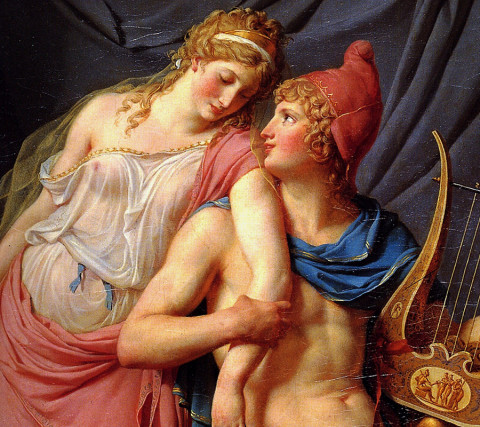
Before we start, let us agree that the word ‘feeling’ affirms love is an emotion. It is not the instinct ‘lust’ although the two may often be confused! As it can with the love of beauty and attraction that is only ‘skin deep’. Perhaps these errors once ‘launched a thousand ships’ to enable Paris to seduce Helen of Troy, or was an epic love story?

Lust has been crystallised in the English language by the phrase ‘to make love’. But clearly, animals ‘make love’; if all that is meant is to have sexual intercourse. When looking up ‘roll in the hay’ in a thesaurus, there are twenty seven synonyms for this expression. Clearly, westerners are as interested in sex as the Inuits are snow.

But we are going to pass over lust and concentrate on it’s more sublime incarnation and affirm that love is one of the most sublime emotions that humans ever experience. Although not easy to find, It too has many shades if we can find words to ‘nuance’ it into sub-categories.

So if we think of how we ‘love’ in our daily lives we can identify several ‘objects’ for our love to directed.

Romantic love should be our first choice as here we find the core of the word and it’s associated feeling. Romance sends humans into true and false expectations that are sometimes completely out of character. In youth this feeling is unknown and untested. But we are already on a collision course with that special person who will come into our lives. The emotional ‘volcano’ that erupts can leave one without thought and speech so paralysing is the impact of the explosive force. And just as in the making of volcanic mountains, the results of the experience last forever; impermeable to all later hurricanes and earthquakes.

The greatest romantic love involves a kind of electronic circuit, where both ends of the battery connect in what is called ‘requited love’. It’s corollary, unrequited love has spawned many an ancient Saga such as Sir Lancelot’s love for King Arthur’s wife, Guinevere.

Then there is love which has a different character; more calm and assured. When we think of how we love members of our family, we use the same word ‘love’ although there is no sudden ‘falling in love’. We learn to love our parents and siblings from birth to grave, a process that is not one necessarily of our own making. It is like a cosmic ‘arranged marriage’ where a soul is placed into the intimate company of strangers, it’s family. What we call ‘paternal’ and ‘maternal’ feelings of love are curiously blended with their equivalent instincts of unconditional parental protection; in the same way that ‘romantic love’ depends, in subtle ways, upon instinctual drives.

When children are old enough to leave the ‘love nest’ they call home and go on their own way, their connection with ‘family members’ falls more to a purely emotional attachment instead of one based on physical dependence. But when parents have bad characters and the process of childhood has involved abuse by parents towards their children, the detachment of a child to the family home becomes a ‘release’.

In that situation we have moved to the opposite end of the scale of the ‘fifty shades of love’ and discover the word ‘hate’. Hate after all, is the same as love only destructive in it’s effects rather than constructive. But the emotions come from the same source.

Romantic lovers and family members sometimes find themselves in the space of mutual emotional hate at the beginning and or end of relationships. In Shakespeare’s play ‘Much Ado About Nothing‘ the principal characters of Benedict and Beatrice cannot stand the sight of each other. Through the play their characters develop towards a deeper understanding of their similarities rather than their differences. The English language deserves a word for the ‘love / hate’ relationship!

We find the same scarcity of words when we describe ‘love’ in the context of religion and the concept of ‘loving God’. Those religions founded on monotheism, place intermediaries between the Divine and ourselves such as the prophets and the saints, their disciples and the self elected clergy who claim to be able to understand what was going on in the lives of the characters in the holy books.

There are those who have a direct relationship with the Divine with no intermediaries. Their relationship with God is greater than any love for any human and many retreat to monasteries and nunneries to play out and understand these feelings. Is such a feeling irrational? Again we need another word for ‘love of God’ because without it, we can cancel without due consideration the possibility that prophets and mystics can unconditionally love God.

As we scan these ‘shades of love’ we find next a rather prosaic category of ‘love of places, activities and things’. These I place together as they are generally dismissed by the aforementioned mystics as being ‘illusions’ at worst and ‘not of benefit to the soul’ at best.

And yet ninety nine percent of human activity is centered on the places, activities and things that we love. People who express in exceptional and imaginative ways are the artists in society. They choose things that inspire a love, such as nature in it’s many forms and people in their many activities, that they wish to share with others.

Certainly artists are able to observe and understand their feelings of love and passion in a focused and controlled way. Just as the person smelling blends of tea in a tea factory, artists are able to savor their deepest emotions, such as love, and present their inspiration in a way that is agreeable to others.

An example might be the Moghul mausoleum, the Taj Mahal in Agra (picture credit Smarthistory). It was famously built by the Shah Jahan to express his eternal love for his favourite wife Mumtaz Mahal. This leads us into the idea that love between human beings can be regarded as limited by society (monogamy) or plural (bigamy). With such dilemmas we can observe how ‘uncontrolled’ our emotions can become in the eyes of ‘society’ and again many great works of literature and art have been inspired to explore how this plays out among the humble and the great.

We should not overlook one of the most extraordinary aspects of love between humans; that we have an infinite capacity for love. Our hearts are wells that do not run dry, circulating love as effeciently as blood. Which is why many religions extorty Universal love for all things. As Jesus the Christ said, ‘love thy neighbour’.

The subject of love is indeed an immensely contradictory and complex; partly because of a lack of words to describe it’s many faces and flavours but also because of what today is identified as ’emotional intelligence’. If the ‘e’ in emotion represents the ‘energy’ that causes feelings to erupt as if from nowhere, the ‘motion’ part of the word describes how feelings are constantly changing. If we form fixed beliefs in our minds and accomplish specific skills in our bodies that do not change, can we extrapolate this to the idea that emotions are the same?

It would be good to believe this and allow our emotions, thoughts and bodies to constantly learn ‘new tricks’ throughout our lives. Our minds may wish to give the appearance that they are ‘in control’ but our emotions can overrule mind and the decisions it makes.

‘Don’t believe a thing just because you thought it.’ Groucho Marx.

What differentiates love from mind and body, in my view, is that emotions can understand what we might term, ‘truths’. A woman for instance may take a dislike for a person who her husband admires for no explainable reason, just a feeling. And years later the husband arrives at the same conclusion using the circuitous route of logic and deduction.

At the most sublime level the words of the prophets and saints express eternal truths when they experience a direct and immutable Divine command. Since such commands are always based on love and light, all who follow these words will benefit.

We can conclude then that love has multiple incarnations and pushes and pulls us simple humans, in the way that asteroids and meteors dance with solar systems. There are irresistible forces at work that can propel us further and faster as well as sometimes, cause us to crash.

What appears to be important and yet missing, is the ability to use language in subtle and, yes, exquisite ways, to direct our course of destiny. If nothing deserves better attention, I would contend that what, who, how, where and when we submit our very own ability to love; then we have learned the greatest trick of all.

Becoming the Rose

Very few people have come up with a good answer to the question of the meaning of life, the universe and everything. Perhaps the least reliable is in Douglas Adam’s ‘The Hitchers Guide to the Galaxy‘ where the computer gives the answer of ’42’.

In my view, the query itself may be wrong. It may be an impossible question, like the Koans beloved of the Zen masters in ancient China such as;

Q: Without speaking, without silence, how can you express the truth?

R: I always remember springtime in southern China. The birds sing among innumerable kinds of fragrant flowers.

‘OK smart guy. So if the meaning of life is a dead question, what should it be?’

Smart Guy replies, ‘how about; what is the challenge of life?’

This is a little easier to attempt to answer.

There are four interlinked aspects of ourselves. When these are understood individually (which could take a lifetime) and balanced (which could take another lifetime ) then a flowering of the human soul occurs. A poet might call it ‘the becoming the rose’, but before that, let us start at where we are.

As human souls we manifest into a physical body; from energy to matter.

A baby comes as a complete package ready to grow in four main areas;

Intellect The human brain is considered the nerve centre of the human being and consciousness appears to be centred here; although there are examples of near death experiences and other practices that induce consciousness to leave the body and return. The ‘mind’ learns the language of those around it and uses play to practice thought and actions that it will experience for real in the future.

Emotion This ‘feeling’ is generally experienced in the centre of the chest and heart. The nerve plexuses here connect directly with parts of the brain and can generate overwhelming imperatives that can override thought. Feelings are often completely correct despite the more usual reliance on rational thought, certainly in Western societies.

Instinct The body is controlled by conscious thought and automatically by the parasympathetic nervous system. Some bodily functions such as breathing, can be both consciously controlled or automatic.

Intuition The quietest of the four ‘imperatives’ yet possibly the closest to the question of what the challenge of life is. Many psychics, saints and seers have developed this faculty to a high degree and share their insights through example and teachings contained in art and ‘holy books’.

None of these four aspects of the ‘being human, roller coaster’ is particularly new. What may be new to you is the following very important consideration. That humans may acquire one of more of these four aspects of themselves to a certain level. What this level is ( e.g. how good you are at languages or art or dancing or wisdom ) can be ignored. What is important is; ‘are each of these four aspects of a person balanced?’

Now get personal and ask this question of yourself. How well balanced am I in these four areas of the my human experience?

We have to be careful, as the ego will resist any sort of challenge to it’s dominating ideas about itself. Ego’s like to feed the false notion that we are balanced individuals and good at most things.

‘I am’

But clearly, when we examine ourselves closely, we realise that we have not reached our full potential by any means of measurement. The challenge we face of becoming strong in all aspects of ourselves, is daunting and most of us fall well short of the target.

A metaphor for this task is an internal combustion engine that has four cylinders; each fired by a spark plug. It doesn’t matter what the cubic capacity is of each cylinder or even how many cylinders there are. What is critical is whether all cylinders are being fired in equal strength.

Perhaps you have driven a car that only has three cylinders working. The speed of the car is reduced and it is difficult to accelerate. If only two cylinders are working the engine may just judder to a halt.

Humans are similar. With these four aspects of being human consider how there are many permutations of weakness and strength.

A person who has a highly developed intellect might be a university professor with little emotional intelligence, is hopeless at dancing and sports and considers intuitive insights to be ‘flights of fancy’. The characterture is an elderly man who keeps losing his glasses, trips over carpets and forgets his wife’s birthday.

among contemporary European people, only one of the three independent data necessary for obtaining a sound human mind has developed – namely, their so-called thought, which tends to predominate in their individuality; whereas without feeling and instinct, as every man with normal reason must know, the understanding accessible to man cannot be formed.

-introduction to ‘Meetings With Remarkable Men’ by G. I. Gurdjieff

A poet or artist might be very good at expressing their feelings, but intellectually they cannot understand, or at least see the value, of logical hypothesis and experimentation. They will buy a car because of it’s colour.

An athlete might be exceptionally good at running (lean and large lungs) or jumping (good speed and long legs ) and yet they may not be able to fill in a form at the post office, tell someone they love them or understand mystery.

Empathic seers and psychics might find themselves at the subject of jokes and accusations of ‘fraud’ and yet be correct more times than chance. Similarly they might struggle in the other areas of their full potential.

Of course these examples are charactertures, but we see their similitude’s in the ‘celebrities’ of modern culture and those we know.

This, in my view, is the challenge of being human. We have not one purpose but four precise, aspects of ourselves to nurture and harmonise within us.

There is nothing new about this idea. If we look back in time we see it as part of many human cultural experiences and remains most prominently in symbols. The concept of a ‘balanced human being’ is the cross.

This symbol is older than Christianity, and represents the division of the whole into four equal parts. There may be different ideas as to the meaning but it is common to many interpretations that where the horizontal crosses the vertical the centre, is a special place.

The Rosicrucians placed a rose in this centre as a symbol of a ‘fifth element’ – a transcendence. Only by being ‘geometrically balanced’ – as a cross is – can the fourfold aspects of our nature integrate in equal measure. At that harmonious place, one is at the ‘centre of the universe’.

At this spot, miracles can come from the depths of the human soul. Various saints of all religions, have demonstrated extraordinary abilities such as being in two places at once, manifesting physical objects from nothing, miraculous healing and other miracles. We, the ‘unbalanced’ and ‘imperfect’, watch on in awe and have no explanation for what we see.

The challenge, in my view, is to concentrate on reaching your own potential. We are each capable of excellence but this is difficult because our weaknesses are pushed into the shadow areas of ourselves to be ignored.

As children, one of the first things we explore is the miraculous experience of being in a body. We watch this as we see children run, skip and jump. But we may take a long time to learn to control our bodies. Most martial arts contain the teaching of moving into the centre of gravity of one’s body, which in most people is in line with the navel or sacral chakra. In Karate it is called the Hara, from where the student is taught to move the whole body. It is a mini-brain with it’s own supply of Ki energy. Masters of Aikido, even in old age, can produce a pulse of Ki energy from this centre to push a much stronger opponent across a room without physical contact.

The body never forgets it’s skills. It can act independently of mind such as in the old adage; ‘as easy as getting on a bike’.

There are also ‘reflexes’ which are part of the autonomic system of the body such as respiration, cardiac regulation and many other functions vital to life. The enteric nervous system is the intrinsic nervous system of the gastrointestinal functions. It has been described as “the Second Brain of the Human Body”.

In exactly the same way as our bodies, our mind, emotions and intuition learn and then repeat lessons and skills that become autonomous. To some extent, younger members of our tribe can learn from elders through such things as stories and sage advice, but generally, learning and personal development cannot be taught. It has to be experienced and recorded viscerally.

I am a teacher without a pupil and a pupil without a teacher.

When we have nurtured and grown our instincts, emotions, mind and intuition equally, we become balanced; in the same way that a cross can balance on one finger in its centre. This is known as ‘centreing’ or in Jungian psychology, ‘individuation’. We are no longer a ‘push over’ either physically, emotionally, intellectually or intuitively. The hardest shocks of life bounce off us and sent on their way. We do not become ‘victims’ and demand reparation. We are beyond argueing, sulking, resenting, blaming and all the other traits found in the unbalanced personality.

A Zen master was sitting in a room when an earthquake started. The other people in the room immediately started to panic and run screaming for the door, pushing each other out of the way in order to get to safety. The Zen master remained seated and upright.

The act of centering places an imaginary rod of iron vertically from the stars, through the top the head, through the chakras and into the earth below.

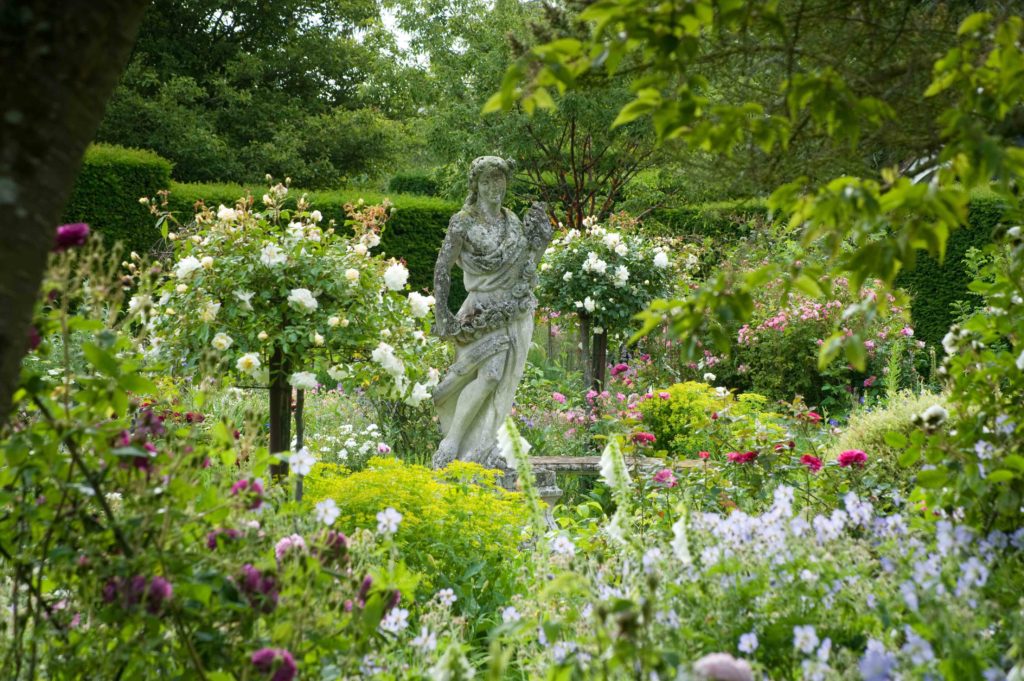
Once planted we do not move, other than to nod our head; as a rose in the garden moves with the breezes.

picture credit; The English Garden

Further reading:

Biorhythms describe the idea that the strength each of the four aspects of ourselves; mind, body, instinct, intuition…varies cyclically over time. For instance our physicality is governed by a 28 day cycle and during this time it follows a sine wave form from high to low. It is activated at birth so by calculating how many days since you were born, you will know where you are on this cycle. When your status is high is a good time to run a marathon. When it crosses the centre line of the graph is a ‘critical’ day and you will feel discombobulated before entering the less energetic 14 days of the cycle. To complicate matters the other three aspects of yourself are on different length cycles and the four combined describe how you are feeling. Fortunately there are Apps available to do the maths for you. This may help in ‘working backwards’ to achieving balance by being more aware of your whole self and it’s rhythms.

Darkness Visible

From Milton’s Paradise Lost

It is a curious fact that the experience of each human generation differs considerably from the world that their parents and grand parents experienced. Every twenty five years or so new science and technologies, new social norms, new artistic expression, new language, new opportunities…new everything, replace the old lamps with new.

The Evil Magician’s Deal in the story of Aladdin

Perhaps you know this from your own life experience? Then consider how extraordinary the changes must have been if you multiply a generation by a hundred. You will then be in 500BCE. We know roughly what people around the world were doing at this time but can we hope to understand how they experienced the world? When we think about this and contemplate the art, literature and stories, architecture and engineering, religious expression, military campaigns, and famous leaders, we realise that we really have no idea of what was in their minds. Why should we even expect to understand them?

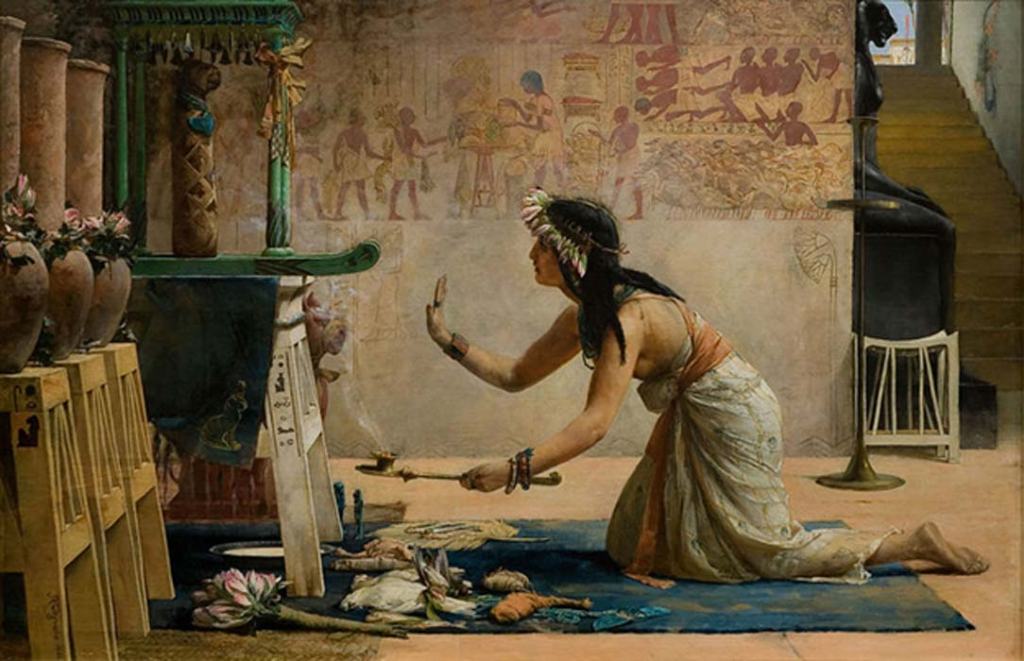
When we consider the Ancient Egyptians of this time for instance, we know something about the everyday lives of the ordinary people and the aristocratic priests and pharaohs, but their religious and spiritual expressions baffle us.

We can imagine that consciousness of the time was intimately connected with the religious rituals intended to thank and gain the co-operation of the Pantheon of gods. The process produced visible and tangible effects that today we would describe as magical. The really big magic is described as a miracle; performed by saints and prophets.

What miraculous power was contained in the Arc of the Covenant did, for instance; a power that made Moses steal it from the Egyptians? Did he need the Arc to perform miracles such as winning battles against all odds?

The Magic of Heka

For this reason we might describe the Egyptian religion as being a ‘magical science’, in the same way perhaps that owners of mobile phones today interface with magic, for they do not understand how their devices work, only how to use them.

Various religions have always spun into and out of existence all over the world expressing experiences and ideas about the physical and energetic universes that we cannot even imagine today. They shared certain ethics, at least approximately, about treating others as you would like to be treated…but there were darker powers at work. The floors in many Cathedrals andMasonic Halls are black and white squares, in case we need reminding.

At some point in the last few millennium, spiritual disciplines were taken over by the ‘dark side’. The mystery schools of Rome and Greece selected initiates to keep the hidden abilities and powers out of the experience of the general populous, but inevitably this knowledge has leaked to those whose intentions are not honourable.

The Catholic religion persecuted the Jews and Muslims in Spain who said they had converted to Christianity. The Spanish Inquisitions used interrogation and torture to find out if their conversions were sincere. The reader can reflect on other examples of religions who have used evil means to satisfy perverted desires, such as religious wars and the treatment of indigenous peoples by missionaries.

One might ask; what has replaced the desire to worship a benign supreme being?

I would argue that science and scientific method has become the new world religion. The scientist who perhaps started this transition was the great mathematician and physicist, Sir Isaac Newton.

Issac Newton as an Alchemist

He modestly described himself as having the advantage of ‘standing on the shoulders of giants’ while others call him ‘the last of the magicians’. Certainly his best scientific work was done before he reached the age of thirty and in his later years he devoted himself to the pseudo-science of Alchemy and interpreting ancient Biblical texts. He never attempted to replace religious truth with scientific truth as they were the same.

But despite this, Newton became the tipping point that has propelled later generations ( including ourselves ) into a more mechanical interpretation of the universe. This we might reflect, is also why we cannot understand our ancestors who lived in a more ‘energetic’ world. Materialism became the new religion and it’s high priests today are scientists and inventors such as Bill Gates, Elon Musk and Mark Zuckerberg. All the miraculous journeys of the mystics to the planets and stars in ancient times are being re-enacted with hydrogen powered rockets and space craft.

Space X Rocket picture credit; Actual News Magazine

But over the centuries this new religion has performed the same split as previous religions. There is ‘good science’ and ‘bad science’; in other words, science has also a branch whose effects are malign. For example, when Albert Einstein realised how his theories contributed to the production of the first Atomic bomb, he is reported to have exclaimed, ‘I wish I had been a plumber.’ Scientists and politicians could have confined the knowledge of the power of the atom to secrecy; just as they did the ideas of ‘free electricity’ described in Nicola Tesla’s technologies, the electric car, the hydrogen engine and the tyre that does not wear out.

Instead the genii was out of the bottle and it will never be able to put back into it. This decision was attempted to be justified as ‘saving thousands of lives by ending the second world war more quickly’. How taking the lives of non-combatant civilians in their tens of thousands and not considering it a war crime is something for history to decide.

If those politicians had considered how the Atom bomb would mould the following centuries and the lives of their children and grand children, they might have anticipated loose canons like Kim Jun Ill in North Korea and the Iranians, gaining the geopolitical power that such weapons bestow.

picture credit; Independent.ie

Just as in Star Wars, the main players have been tempted to use their spiritual powers in malign ways. Right wing politicians of today use the promise of being ‘scientific’ to deceive voters. The use of ‘scientists’ to advise governments in the recent pandemic is an example of this. Most fields of science have a spectrum of members with differing opinions. It is too simple for governments to choose scientists whose ideas support the politician’s agendas.

Another simple example might be when a president of the United States is voted out, he challenges the counting of the votes. Hardly a clever argument since counting is taught in primary school, but such is the force of the personality of Donald Trump, that even after being proven wrong by the various courts and organisations with expertises in the presidential voting process, he still maintains the election was ‘rigged’.

Scientific method has always included the presentation of evidence to support and prove a hypothesis. Those in power today (or who advise the powerful) who have gone over to the dark side, reveal themselves by not presenting proof of what they say.

During the pandemic, advice from ‘experts’ was presented which has since been disproved. Even You Tube now no longer bans references to the high risk group being solely the over 60’s and that vaccinated individuals are as likely to transmit the virus as the non-vaccinated. This would have made a huge difference to how societies reacted to the pandemic as this was known using published scientific statistics from Israel in April 2020.

False science can be summed up as ‘irrational’. Politicians who make irrational statements have a unique advantage over the rational minded; they are very hard to predict and even harder to debate with. They will confuse people so much that reasonable conversation is impossible.

In conjunction with ‘bad ideas’ is the use of dominating personalities to challenge benign ideas and processes. Force does not mean physical violence necessarily, but in the infamous storming of the Capitol Building in Washington, we see that it is a weapon that the high priests of dark science and their followers are willing to use.

picture credit; CBC

This fateful combination of the irrational and force, was fatefully used by many historical figures such as Adolf Hitler and present day leaders such as Vladimir Putin.

It is naïve of opponents to dismiss their irrationality as mental illness, deceit or stupidity. A leader might have all of these characteristics which combined with aggression can overcome the most assertive opponents. Hitler’s own generals were exasperated by his unsound strategic decisions and overpowering personality.

So what are we to do? Should we look on and do nothing?

John Stuart Mill in 1867 in an address to St Andrew’s College said;

Let not any one pacify his conscience by the delusion that he can do no harm if he takes no part, and forms no opinion. Bad men need nothing more to compass their ends, than that good men should look on and do nothing. He is not a good man who, without a protest, allows wrong to be committed in his name, and with the means which he helps to supply, because he will not trouble himself to use his mind on the subject.”

In my view inaction is not an option against present day threats. An example of inaction might be the attitude of the Europeans to Russia’s invasion of Georgia and now Ukraine. If we doubt this then there are warnings from the past that we might heed.

The Georgian Five Day War
picture credit; fpri

In 1961 Dwight Eisenhower made the following warning to democracies in his farewell speech from the Whitehouse;

“In the councils of government, we must guard against the acquisition of unwarranted influence, whether sought or unsought, by the military-industrial complex. The potential for the disastrous rise of misplaced power exists, and will persist.”

Perhaps today we could add ‘media’ and ‘pharmaceutical companies’ to the list of those seeking to acquire ‘unwarranted influence’.

The president who succeeded him was John F. Kennedy who warned of the dangers posed to world peace;

“Our goal is not the victory of might but the vindication of right…not peace at the expense of freedom, but both peace and freedom, here in this hemisphere, and, we hope, around the world. God willing, that goal will be achieved.”  –“Radio and Television Report to the American People on the Soviet Arms Build-up in Cuba (485),” October 22, 1962, Public Papers of the Presidents: John F. Kennedy, 1962.

Kennedy was a Catholic and appealed to the Pope to intervene in the Cuban Missile crisis; what you might call a ‘spritual intervention’.

As already explained, from the mystery schools of ancient Greece and Rome to the various secret societies of the present day, techniques in spiritual growth and personal power were taught. The original purpose was, of course, to be one with the Divinity which included a type of magic.

These techniques were based on the use of mind and energy and are the product of strict spiritual discipline. This should not be confused with religion, which is a pale copy for people who do not have the interest, time, stamina, spiritual calling, perseverance, courage or many other special qualities unique to the holy and saintlike beings of our past and present. The spiritual path is followed by a tiny fraction of one percent of the world’s population because it is uniquely demanding. It is the equivalent of the special forces in military organisations and The Knights Templar exemplified how these two areas of human experience have much in common.

Today one might believe the modern Freemason’s are the inheritors of this most secret and powerful knowledge. The face they turn to society is as solely as givers of charity to the needy but one does not have to research too deeply to find that there are other directions that they extend their power.

As in Star Wars, the ‘dark side’ usurps even the most holy, benign and righteous so that power moves from helping the poor and weak to helping the rich and strong. The right wing governments of today reflect this perversion. The predictions of past American presidents are confirmed as we see industry, pharmaceuticals, media, military, governments and oligarchs; support the elites at the expense of truth and freedom for the general population.

The power they use are on the surface is from ‘scientists’ and ‘economists’ but their real power is derived from what one might term ‘super nature’. The Nazi regime in the 1930’s in Germany were greedy to attain supernatural powers. Herman Goering was determined to find the ‘Holy Grail’ as described by Otto Wern and devoted much time and resources to acquiring knowledge on how to make a ‘superhuman’ race, the Aryans. Himmler included witch dances into SS ceremonies seen here in Poland in 1939.

Nazis Secretly Used Witcraft Intending to Extend the Reich

picture credit; Historynet

What we observe today in various governments around the world, is predicated and dictated by a group of leaders who influence and dictate under the general and historical term ‘illuminati’.

To finish on a lighter note, or perhaps more spine tingling, watch very carefully the magicians of today who demonstrate magic for entertainment. They maintain that they are mere illusionists and certainly most of them are. But ask yourself the question, when you see a magician put their hand through glass or lift impossible weights; how much of this is illusion and how much perverted spiritual powers? Then project these thoughts into every part of human society in the twentieth century.

Dynamo the Modern Magus

picture credit; poppytv.sg

Are we watching science or magic? Are we walking in the light or the dark?

As an appendix to this essay a poem by the author…

The Devil’s Armchair

It sat there

-the Devil’s armchair

on the stage like any other armchair

awaiting his highnesses’ appearance.

An audience sat

expecting a spectacular

with just a dose

of uncontrollable HORROR.

Instead, a god-like, quiet man, appeared

and settled in a position of comfort

in the armchair – smiling –

ready for questions.

Each person in that audience

then ‘set to’, convinced of this and that,

and found the responses

totally calming and reassuring.

Heaven and Hell

I described in a recent essay about how the knowledge of good and evil was a Divine punishment for the Biblical characters of Adam and Eve. Rather than interpreting this at the Sunday school level as a story, I suggested this was a description of a change of consciousness for mankind from a singularity to polarity.

The polarised (male / female) view of the universe is both a blessing and a curse, that we will continue to endure for evermore. With the power of discernment, man can break down the world into small pieces in order to understand how it works. Sadly at the same moment we lose the very important holistic understanding of the world in the same way that a child dismantling a clock is unable to put it back together.

The universe, the world, our minds, are, after all, interconnected. Any apparent seperation between opposites is a spectre designed to misguide us.

The concept of Heaven and Hell illustrates this apparition well. We are told that they are completely polar opposite places by the preacher in the pulpit, but in reality they are not.

They are the same.

Let me use a well known parable to illustrate. Imagine a large group of people seated around a long dining table. There is food in front of them into which they have to dip their spoons, but there is a difficulty. The spoons have long handles that extend beyond the width of the table. It is impossible to dip the spoon into the food and direct it into one’s mouth.

picture credit; celestialpeach.com

This tantalising situation is a kind of hell for the hungry people. If they remain as they are they will shrivel up and die of starvation. Only when an angelic thought enters one of their heads, does this hell morph into heaven.

The idea is simple. Each person uses their spoon to feed whoever is sitting in front of them.

We experience this frequently in our everyday lives, if we only pause to think. There are those who spend their time acquiring benefit only for themselves whether it is money, time, material possessions, opportunities. They might well become ‘rich’, but in reality they can experience great sadness, emptiness, frustration, loneliness. We can all think of examples of people who ‘had everything’ who committed suicide or went to prison or lost their social standing and friends for one reason or another.

As we go through life we are encouraged to be optimistic and happy from early childhood. And yet we know that some terrible experiences may be laying in wait for us; perhaps not now but perhaps in the next year or ten.

The unfortunate people of Ukraine are an present day example of how everything can go horriblly wrong through no fault of your own. One minute families are living content and comfortable lives and then the big bad wolf extends a paw with claws extended.

It sounds like a fairy tale, yes, in the way that we mean ‘fairies don’t exist’. Traditional children’s stories are false, we tell our young ones, but they are not. These are stories about heaven or hell in true life and how unpredictable it can be. That is why children’s ears prick up when they listen to a traditional ‘fairy story’ like Sleeping Beauty. They know or at least suspect things can go horribly wrong in life and that they need to remember the secret that undoes the evil witche’s spell.

In the beginning, the universe was created by God, or ‘consciousness’ if you prefer, and there was no Heaven or Hell. Only the creation of man and woman created these extremes of human experience. Man cannot ‘blame God’ when things go horribly wrong because there is no script and no intention of God to steer good people away from bad things. The Cosmic Mind is merely a Watcher, like the Watchers in the Book of Enoch or the Extra-terrestial Beings who some believe follow, but are forbidden to interfere with, life on our rare planet.

Rewards for ‘good behaviour’ do not exist in adult life although as children we are brought up to believe this will be the case. It is more that good behaviour by oneself sets an example of good character to others. This ‘example’ has the very strong power to change the behaviour of others, like in the story of the spoon, but some people are so fixated on ‘me and mine’ that they see good character as weakness.

I am convinced that task for humans is not to expect Heaven or Hell as a reward for good or bad behaviour. This is completely opposite to the views Bible thumpers of the middle ages and today!

picure credit: researchgate.com

We should not even try to steer others onto a path of a preferred behaviour by making our own judgements of people or situations. Most of the time, we do not know all the facts of a situation and are just as likely to sink the ship as make it sail into a safe harbour.

The path to Hell is paved with good intentions.

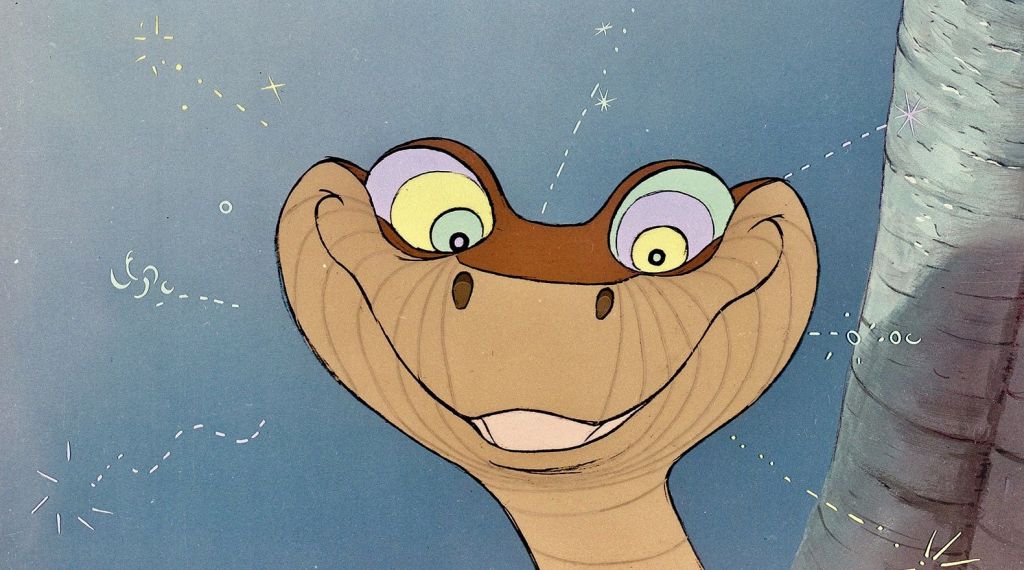
The only beneficial direction to travel is any that enables individuals to be of good character and show others the benefits of this. This in itself is a massive task as we know that the freewill we all have to change situations for the better or the worse, is extremely difficult to live with. It is like the snake in Walt Disney’s version of Rudyard Kipling’sThe Jungle Book‘, with it’s hypnotic spiralling eyes and suggestive, enchanting song, created no doubt with a memory of the Jungle as the Garden of Eden. Humans commit the most appalling acts and ‘self-forgiveness’, learning and moving on are, in my view, the only tools available.

picture credit; waltdisney corporation

Perhaps towards the end of life, a person may be able to sit back with true contentment, on e might say a Heavenly contentment, knowing that they now understand the weakness and power of being human and how quickly we can fall and rise. When you look at the smile of a very old person who has done their share of right and wrong, heaven and hell, you may just glimpse that they understand these ideas are the same place in our souls.

Edvard Much: Old Woman in a Rocking Chair

There was, is and always will be, a Unity; one ‘Consciousness’, one God. Take your pick you agnostics and gnostics; they are both the same.

The Art of Art

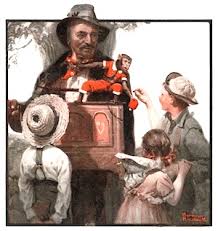
Even a monkey can turn the Organ Grinder’s wheel

picture credit: The Paepae

The following thoughts are likely to flatten the ego’s of some of those who consider themselves ‘artists’. It’s a personal view that is not much talked about, although perhaps many share it. But before I begin I need to emphasise that my argument is not an either/or polarised between this and that or artist and technician. All artists are to some degree technicians and all technicians are to some degree artists. The key here is the phrase ‘to some degree’ which is best described as a sliding scale. Where precisely on the scale is the matter for debate here because frequently I hear of technicians who call themselves artists, partly through vanity but also because of their inability to think without polarisation. Here is an example of what I mean.

The writer once took part in a concert in his local town. There were several musicians, violins, two Chinese pianists, a singer and my own contribution of humorous poems that I had written.

During the interval the performers shared a side room in which to relax. During the conversations I made a remark quite innocently but I immediately realised caused offence to the two pianists. I made to following remark, ‘it’s a great that there is at least one original performer in the concert’. It was meant quite innocently as an observation on the technician / creator dichotomy but clearly I hurt the pride of the musicians who must have been brought up to believe they are artists.

My view is indeed an unusual one but based on sound reasoning which is this. That musicians who are not extemporising but following musical notation by a third party, are fundamentally, copyists. They have learnt to become technically proficient at playing one or more musical instruments through repetition. In my view they are therefore technicians, more than artists.

They will argue that there is an art in the way they ‘interpret’ the composer’s instructions and I would not deny this. Any piece of written music can be played to express the emotions of the musician and in that there is indeed a golden nugget of artfulness. But I would reply that the composer’s contribution is 80% or 90% of the piece and the interpretation of the player is more as a technical expert, somewhere on the line between artist and technician.

Another personal example is from my experience as a young architect. I was being ‘mentored’ by a rather overweight gentleman called ‘Les’ in the Architects and Civil Engineers Department of a well known Corporation. Les smoked a pipe and overflowed the edges of his spinning chair with his large body. One day, an architectural technician came over to Les with some ideas that clearly Les didn’t think much of and sent him away. Les mumbled at me his notion that technicians were no good as designers, to which I replied sagely; ‘knowing the language does not make you a poet’. Les’s pipe almost popped out of his mouth with astonishment and a glimmer of respect that this ‘youngling’ had made a profound observation, and was not a complete fool after all.

An example from another creative art shows how broad this issue is. Consider painters. There are again two types of painters. A ‘copyist’ who copies original works of art, or photographs using a photographic style, and those who create a painting from life or imagination. At the most extreme, a copyist can become a ‘forger’; so skilled are they in mimicking the original artist. However, I would still maintain the artist who creates original art, is 80% to 90% an artist and the copyist is 20% to 10% an artist. A forger must be 100% technician or else be greeted by the police forgery squad in the morning.

Picture credit: thecollector.com
comment: expect an early morning call

The same reasoning works in reverse. Original artists are never completely original. They will have been influenced by their training and life experience in who, what, how, why, when and where they create their art. This will include studying other artists, art history, media, photography and all the other experiences that bombard the senses. They will then knowingly or unknowingly express this in a novel or similar way to others and in this respect their ‘originality’ as an artist is indeed tainted. Only the truly most original and those expressing something of the ‘spirit of the age’, will find critical approval and become famous and founders, or part of, a group of mutually influential artists such as the Impressionists.

Consider how copyright law determines the topic of originality and ownership of an original work of art. I once went to a shop that sold the marine photographs by a photographer from the early twentieth century. The subject matter was mainly the magnificent sailing boats of that time taking part in the Americas Cup circumnavigating the Isle of Wight, England. I bought a book of these photographs and happened to comment to the owner of the shop (who was a descendant of the photographer) that I intended to copy them in water colour. To this he strongly, objected saying that they were protected by copyright law. He misunderstood copyright as only applying to exact copies, not representations, but no matter.

picture credit; jclassyyatchs.com

In this example there is a question of law which is, who has copied what? If the photographs were of just the sea and clouds then the photographer is largely responsible for the image, as nature is created for everyone as what we call today, ‘Freeware’. However when the photograph is principally of an artificial object, then the creator of that object (in this case a marine architect) must be presumed to own the image of the object or at least an ethical ownership of the image. A yacht might take years to design and build and photograph a fraction of a second. The ‘art’ of the photographer is the choice of view, light, background etc. to which some creative input has been made. Read a photography magazine. They are principally technical.

To think of a more exact ‘copying’ using a camera, if you went to the Louvre in Paris and took a picture of the Mona Lisa and started to sell these images, might not the museum object? After all copyright law protects exact copies of images, (not interpretations) and as the photographer has only used technical skill, these would be exact copies. The copyright once belonged to originator Leonardo di Vinci, who being dead, is passed to the current owner of the object.

Artificial Intelligence is now producing completely original images that exceed the creative imagination and technical prowess of even the most skilled artist. These are based on a vast ‘back catalogue’ of natural and man made images from the past that the AI has viewed, remembered and uses to create new art.

picture credit: wired.com

The owner of the AI algorithms might claim ownership of the ‘artificial art’ but the merit is clearly more applicable to the artificial intelligence than the human intelligence. The see-saw of balance between the technical skill and originality is once again subject to scalar opinion.

I personally do not believe the computer programmer who set the AI on the path of gathering and reinterpretation, is any more that a computer scientist. The seemingly ‘random’ connections taking place in the AI to produce originality, is the same process as takes place in neural connections in the brain of the artist but lacks ‘soul’ and ‘consciousness’.

As AI has no legal entity or ‘human right’; what it produces could arguably be without ownership by a human. No doubt the lawyers will debate this matter for the next century!

But in my view, AI is 99.999% technique, that is, a copyist. It has no concept of whether the images it produces are meaningful. When AI is able to prove it has a creative imagination, a soul and consciousness, I will concede.

What Do You Need?

Mahatma Ghandi said;

Earth provides enough to satisfy every man’s needs, but not every man’s greed.

picture credit; Meer.com

It’s not usual for the writer to look into the future. But at this moment in history, there is no need to be psychic to see where the world is heading and the consequences.

We live at a moment in time when change in the standard of living of the ‘developed countries’ is inevitable. The change will be what some would call a ‘reduction’ in this standard; meaning things will not be a cheap and plentiful as they have been in the past. For the rest of humanity the change will be having things that have not been available in the past, what will be an ‘increase’ in their standard of living to include all the essentials.

These are the essentials to life;

Shelter

Food and water

Health and reproduction

Education

Work

What will bring about this change is an increasing scarcity of these five necessities in both the ‘developed’ and ‘undeveloped’ countries, so that sharing of resources will be the only humane political direction.

The previous trend of ‘civilisation’ has been for certain countries to grow richer whilst others get poorer. The ‘master and slave’ Empires of history and the present day, are examples of this.

New technology, and primarily the ability to communicate on a global scale, is an essential part of ‘leveling down’ and ‘leveling up’, the uneven distribution of dwindling resources.

Technology, such as birth control and free health facilities has been changing the global demographic for many decades. As a consequence, families have been having fewer children because infant mortality has drastically reduced.

Smaller families has meant a reducing population in many parts of the world, such as China and parts of Europe.

The process of industrialisation was always founded on a false assumption; that more and more stuff can be made from limited resources. Whether those resources are fossil fuel sourced energy, raw materials, places to store noxious waste products, dwindling natural resources such as rare earth elements and the traditional metal ores.

All of these things and more, have become cheaper and more available but their limited availability and other factors means that the industrial train is about to hit the buffers.

Perhaps sharing more and making more with less and eliminating pollution would have held off this inevitable moment for longer but the global system of human development is too fragile and too complex.

The effect of industrialisation on nature has been ignored for convenience and perhaps not a little arrogance, but nature ultimately strikes back. What is wrapped up in the term ‘climate change’ is the tip of a rapidly melting ice berg of global human catastrophe.

picture credit; Friends of the Earth

Nature has a plentiful and powerful armory with which to fight back. Viruses, extreme weather, planetary warming, desertification leading to wars over scarce resources are and will put great demands on the human population to re-organise.

If humans had any self respect, they would respect this powerful process and become co-operative with nature. It has to, because the option to carry on as before is no longer available; unless wars, mass starvation, migration and pandemic diseases are ‘risks worth taking’.

There are some religious communities such as the Amish in States in the in the United States of America and Canada, who will not directly face fundamental changes to their way of life. Hundreds of years ago they decided for religious reasons that their ‘standard of living’ had reached a level that is sufficient for their needs. The number of Amish people has risen from 100,000 in 1989 to 251,000 and is predicted to increase. Respecting the boundaries of nature is a lesson many have learned, thus avoiding the hard process before being forced to.

An Amish Homestead picture credit Stuff.co.nz

Similarly, there are remote tribes in ‘undeveloped parts of the world who live in harmony with natural places and have done for millennium undisturbed. They have nothing to fear from nature, only their fellow humans.

Industrialised societies have taken far more than their fair share of nature’s bounty. The city dwellers who make up fifty per cent of these societies live on the promise of unlimited food from farms. Unfortunately soil needs constant replenishment when using factory farming methods and fertiliser is becoming increasingly expensive, to a point where growing crops is no longer profitable. City dwellers have become so cut off from nature that they might as well be living on the moon; totally unable to sustain themselves except by trade using ‘money’- a substance you cannot eat.

The dwindling of world resources and the consequences for national economies will require counter intuitive management. People who have more, will have less and people who have less will have more.

Food will no longer be shipped all over the world to satisfy the demand for non-seasonal, exotic, non-local, high protein, artificial fertiliser enhance ingredients.

Wine and olive oil, will not be for sale in shops in countries where wine and olive oil is not produced. Such luxury is only a recent expectation. Nations used to have their own diets and dishes based on local seasonal food. Northern countries drank mainly beer made from local grain crops and southern countries drank wine made from local grapes. Choice in food and drink will become more than halved and people will be grateful for what is available.

Politicians will have an almost impossible task of balancing the overwhelming and impending need for ‘developed’ populations to significantly reduce their ‘standard of living’.

Nobody votes to lose their holiday home/s, luxury car, cheap flights, energy wasteful house and bulging refrigerators. You might think this and you could be right, but when citizens understand the hardship that is the alternative, they will.

And if this sounds depressing then all is not necessarily gloomy, because humans have a unique skill at adaptation, both physically and mentally. Some of the poorest people on earth are also the happiest. Travelers who visit the homes of remote communities that are living off the land (whether forest, steppe or desert), find they are welcomed with dignity and honour and the food in the house is shared equally with them. This food may taste better than any they have had before because it is resourced locally, prepared traditionally and presented with love.

No factory on earth has ever made a product with love so should we be surprise that people who have ‘high standards of living’ often live loveless lives?

Here is that list again;

Shelter; simple, warm, light, organic houses and public buildings and gardens.

Food and water; locally sourced and stored, lovingly prepared and shared.

Health and reproduction; Enough health professionals for populations in order to prevent disease, educate and encourage healthy lifestyles, treated body with the mind and mind with the body, practice traditional medicine and techniques less based on chemicals. Because communities will support the elderly young people will manage the size of families using contraception.

Education; a holistic, approach to giving young people the skills and characters that promote informed and respectful relationships and communities.

Work; local activities that produce goods and services in ways that respect nature and the environment. Labour will not to use more energy and materials than nature can supply and live in a way that gives responsibility to all and shared rewards.

There are many micro-communities already living in this way according to their own religions and traditions. If you are fortunate enough to live near one my advice is sell everything and join them as have done many and joined Amish and similar communities.

You might be happier than at anytime in your life and if you are not happier, well you at least will be the same person you are now.

As so often happens, Hollywood is ahead of the curve and perhaps forcing, as well as, predicting change. There have been many ‘post apocalypse’ films in the last few decades. The apocalypse will only come if it is allowed to. As in most things, the trick is to be pro-active (ahead of the wave) rather than wait for it to swallow us whole.

picture credit; Climate Emergency Institute

Back to the Garden

An avid follower of the ‘language of the birds’ might have noticed that hEaVEn contains the name EVE. There is even an echo of Eve in EdEn.

This oddity is not necessarily meaningful or intentional, but that is not necessary. It’s just satisfying to think in an intuitive way, like the birds that flitter around us for no reason but give us messages; a process known as the language of the birds. There are things we do not hear and hear in the garden.

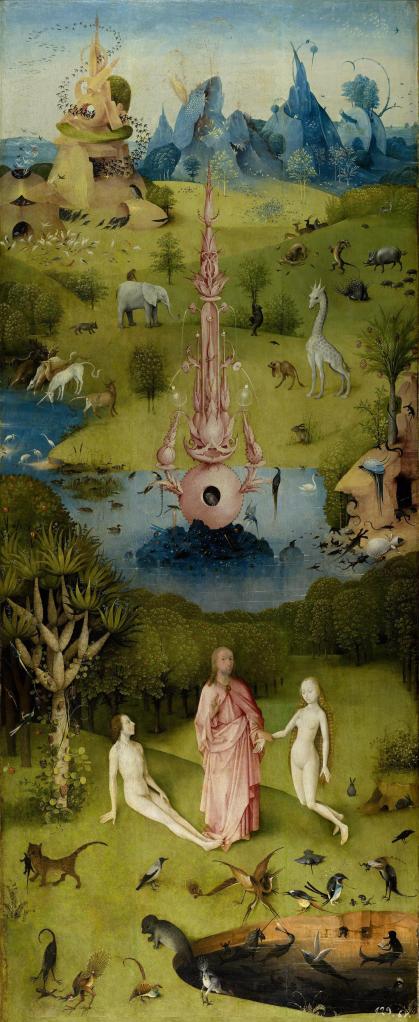
Hieronymus Bosch

Some feminist friends of mine express the view that mysogeny has it’s roots in the creation story in Genesis. ‘Why is it the woman who disobeys God and eats the apple?’ But to me, as a human being, the gender distinction is another example of how the dualistic mode of thought that started at this very point in time, has created confusion ever since. This dualistic perception is even hard wired into the words we use to describe opposites such as long and short, able and unable, peace and war.

In the Old Testament story about the Tower that was sinfully built in Babel, the consequence is God punishing mankind. This meant that humans no longer understand each other by using one language, but create confusion with multiple languages. If that story was about words then the story of Genesis is God’s punishment making us misunderstand our thought patterns.

And how we think must be far more important than how we speak. I have encountered foreigners who misunderstand me speaking in their language, not because my words were wrong but because they think in a different way. And thinking is not taught in schools. It is assumed children pick up good thinking skills, when there is no reason to assume they will.

Let us find a nice bench and sit for a while in the original Garden of Eden before humans came along. Enjoy a bit of peace. The Biblical creation myth is largely in agreement with the creation according to current earth science; minerals, plants, animals…until, kerpow – a human appears! This is the beginning of the end of a blissful life in the garden (Heaven) because Adam is one of half of what is to become two halves. The garden is singular, the lovers are plural. There are not several gardens all running along the Tigris and Euphrates but just one. This state represents the primal state of mind that spiritual paths aspire towards. For example, in Buddhism the principle ‘All is One’ contains everything anyone needs to know.

A Zen Garden

In Zen Buddhism the master asks the pupil, ‘what is the sound of one hand clapping?’ The question is nonsense and to correct this we might suppose that God had to create Eve, because you cannot have x without y.

The creation story is more a description of a fall into a highly confusing mode of thought which paradoxically is both ‘confusing’ and ‘enlightening’. Confusion and understanding are, after all, directly connected by a continuum you might call ‘knowledge’; they are different aspects of the same thing. But in dualistic thinking patterns we learn to differentiate and name, compare and contrast. There is always ‘this and that’, which is dualism.

In dual thought patterns adjectives are used only to describe the two extremes of the same thing. For example ‘good’ and ‘bad’ are highly relative situations and things and context and consequences can morph each into the other. And yet most people when asked, will say they prefer good to bad. Have they thought about that? The writings and lectures of the late Alan Watts, who studied Christian theology and Eastern philosophy, returns over and over again to the eastern understanding that there are no opposites, only continuities.

Alan Watts picture credit; Stillness Speaks

In applied mechanics, physicists will not fall into a dualistic mode of thought. They will not use the words ‘hot’ and ‘cold’ but only degrees of heat. A fridge is cold because it expels heat. It has no measurable relationship with cold because cold is just a place from where heat has been removed. The amount of heat is indeed a continuum, which we look at every time we view a thermometer, which measures heat – thermo – not cold.

picture credit: Researchgate

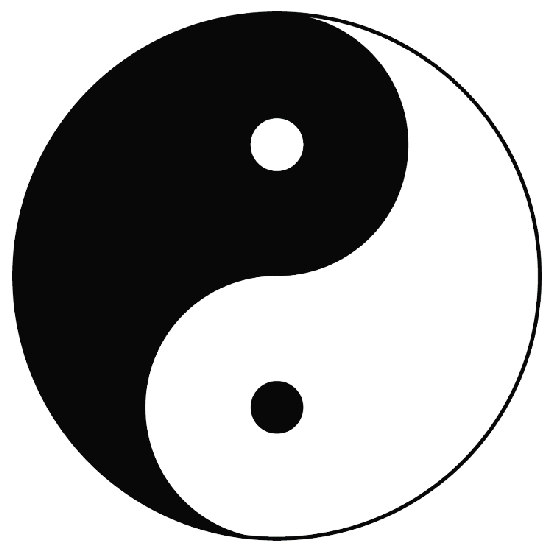
There is another well known symbol which illustrates the unity of ‘opposites’ which is the Chinese Ying Yang symbol. The two opposites of black and white, combine harmoniously in the diagram as two fish chasing each others tails. Most importantly each fish contains a little of the other, represented by a black or white eye.

We are told in Genesis that this dualism is a mode of thinking used by God;

‘and God called the light Day, and the darkness he called Light.’ Genesis 1.6

The whole process of ‘naming’ is formalised to describe a creation that was already there, and at the same time, becoming so.

The word of God (ergo ‘god-like’ mankind) is all-powerful, not just revealing but causing something to come into existence. This is the modern conundrum of quantum physics where the tree falls in a forest and the question is posed whether this event happens if there is no observer.

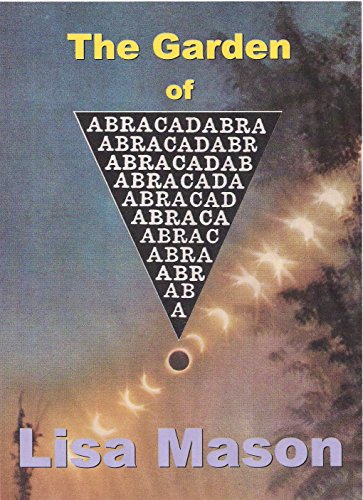
In magick this odd version of reality appears in the word, ABRACADABRA meaning; ‘I will create as I speak.’

The human body has a similar confluence contained in the left and right hemispheres of the brain. Each half has a different function; right is intuitive, left is reasoning. People tend to fall into a bias towards using a half particular to themselves, and we compound this dualism in schools and university degrees, as ‘science’ and ‘art’.

Few realise this is a most unhappy state of mind, or perhaps they do but do not know how to get out of it! When there have been individuals who have learned to use both sides of the brain equally and non-competitively, they bring very special ideas to humanity; so special we call them ‘geniuses’. Leonardo de Vinci, Michaealangelo, Albert Einstein are a few famous examples of the so called ‘renaissance mind’. Thinking back to the introduction to this essay, this is the ‘god-like’ ability imparted to human kind by the Creator.

Albert Einstein, for instance, is famous for realising energy and matter are not different but the same and completely interchangeable using the formula;

e=mc2

– where c is the speed of light – ‘let there be light and there was light’.

Very early Gnostic traditions did not allocate gender to the ‘God-head’ or ‘consciousness’ or ‘mind’ or however you wish to understand the creative consciousness that unraveled as the Universe. And we might add existed before and after creation since there is no ‘before’ and ‘after’ in non-dualism. (Scientists are only now coming around to the idea that the ‘big bang’ was an end as well as a beginning as described for millenniums in the Hindu Upanishads.)

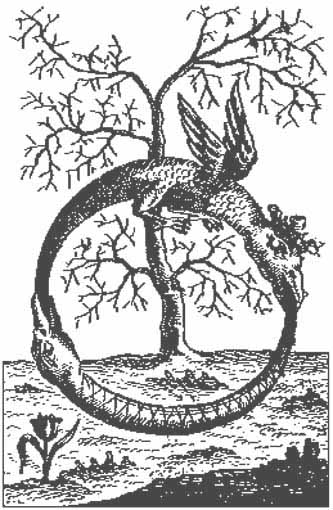
The Ouroboros Tree

The never ending cosmic cycles and the unity of everything is represented in alchemical manuscripts as the snake forming a circle as it bites it’s own tail. Everything becomes a snake with no head and no tail. A snake is a continuum and of course this consciousness was prior to and initiated, dualistic thought and the contradictions that emanated as a consequence of adopting it.

Every time we spin a coin in the air and ask ‘heads or tails?’ we are a mind locked into the

‘either / or’ mode of thinking.

The key that opens this lock is the word ‘both’. You will often hear in interviews on the radio the journalist asking, ‘is it this or that?’ and the respondent answers, ‘both’. The question is a trap and people who know their subject (which they usually do if they are on national radio) have no problem with contradiction – or rather the illusion of a ‘contradiction’. They then go onto to describe all the aspects of the same problem including the two options contained in the question.

Those who do not understand this, fall into the elephant trap of ‘left politics’ or ‘right politics’ and are unwilling ever to change their bias. In medieval terms ‘they are in Hell’ because they will never understand the totality of what is going on and therefore how to influence affairs and events for the better of all.

And we should remember that the snake in Genesis was coiled around ‘The Tree of Knowledge’. Eve explained to the snake that the tree in the center of the garden they were forbidden to eat from on pain of death.

‘And the serpent said unto the woman, Ye, shall not surely die:

For God doth know that in the day ye eat thereof, then your eyes shall be opened, and ye shall be as gods, knowing good and evil.’ Genesis 3/4

From a purely objective point of view, the snake was right. This truly was the effect of eating the apple. The issue was that eating it was against the will of God. At that moment, it could be argued, Eve was unaware of why God had ordered this as she was in a state of ignorance of the ‘opposites’; she was in blissful ignorance, quite literally. So she can hardly be blamed for not conceiving that knowing good and evil is a liberating but problematic change in human consciousness. It brought god-like power to humans and if we look back at history; it really did.

Humans have used their creative imagination to take to pieces and put back again in new ways, everything we know. It has been a far from easy path as God points out in the following passages of Genesis.

‘Therefore the LORD God sent him forth from the garden of Eden, to till the ground from whence he was taken’.

No longer would grapes fall from the tree into the mouth but toil and hardship would be the lot of humans as punishment.

Joni Mitchell – picture credit; Reverbnation

There came a hippie moment in the 1960’s where ‘rules’ were at last questioned and even abandoned. At the legendary festival of Woodstock, there was a young singer;

We are stardust, we are golden. And we’ve got to get ourselves. Back to the garden. Joni Mitchell – from the song ‘Woodstock’.

Fortunately, getting back to the garden is not impossible. Like all paths this particular human history of which we are all so proud, will lead us back to the beginning again. All directions are the correct directions to take, all mistakes are ultimately correct. If and when we stop dissecting everything, including our own thoughts, we will discover the original state of bliss, second time around.

Watching Grass Grow

I do not normally watch football matches. The reason is simply that I find them slow and the match result often unsatisfying. More on this later. One the other hand I can be persuaded to watch any sport where England takes part in a sporting final and where there is a high likelihood of a match of equals.

So I sat down to watch the European Final of Womens Football 2022 last night. History, we were told, was about to be made.

But first, some game theory. Many games simulate military strategy and football is no different. Each side has an area to defend. The resources of each side are matched with no particular advantage to either other than their own esprit de corps, skill and strategy. With these resources, the sides must defend at the same time and with the same force, as attack.

What happens when one side is considerably less skilled and less determined in it’s aim than the other…is that the more skilful side wins convincingly.

This gives rise to a certain inevitability as to the outcome giving the supporters and participants of the losing side enormous disappointment. Their expectations of winning were shown to be based on false confidence in their own ability.

This is why sides which are equal in every way, provide the greatest challenge to the players and entertainment to the supporters.

The game of football, however, provides a disappointing set of rules that restricts uncertainty and the excitement that comes from the expectation of gaining a winning advantage at any moment.

What works most against football being entertaining, is the system of low scoring. A 0-0 result is not uncommon and only slightly better is a draw of say 1-1. Ideally a score should reflect the skill of a side as closely as possible and in low scoring games, it is unlikely to do this. In fact sometimes the better side may lose due to some random misfortune such as an injury or poor refereeing decision, giving rise to indignation amongst players and supporters; the phenomenon of a ‘pitch invasion’ by angry supporters must happen more in football than any other sport.

If we examine how well high scoring games reflect the process of a match and outcome, such as tennis or cricket or snooker, players have a chance to change the course of the game almost every time they touch the ball. The better player or side will almost certainly be identified by the final score and both sides feel fair play has taken place.

Compare this with football, where much of the play and touch of the ball results in no particular advantage to either side. Players often kick the ball back into their own area rather than forward. They engage in a series of safe passes in which the ball moves between players of the same side with little risk of losing possession. During this time the grass grows another micro millimeter.

Losing possession is not even a great disadvantage to either side. Goal keepers regularly kick the ball away high in the air with only limited accuracy as to where it is going to land. The opposing side might intercept the landing with a header which is so uncontrolled that possession changes side yet again.

The prospect of the ball moving around the pitch in this manner gives no reward to either side. Players compensate for their frustration by taking a risk of injury to themselves or other players, with aggressive tackles. The result is that play stops whilst a fallen party rolls around theatrically on the ground in order for the referee to take the matter more seriously than is warranted. Medical teams are permitted to run onto the pitch to give ‘treatment’ that in olden days consisted of squeezing a wet sponge over an affected area and today consists of more elaborate physiotherapy, ICU teams and trauma psychologists.

So the game stops and starts with as much randomness as a demolition ball and certainly not as interestingly. At the end of 45 minutes of nothing, both sides rush off as if they need a break. During this time supporters argue or fight or get more drunk, and players are given a victory talk by their coaches and managers and anyone else who happens to be in the dressing room, telling them all to ‘work together as a team’ and ‘get the ball in the back of the net’.

At the end of another 45 minutes of lawn care, neither side has managed to kick the ball into the exceedignly large space enclosed by the goal posts. One almost gets the feeling that even if the opposing side was not present, a team working on it’s own to move the ball from one end of the pitch to the other and then between the goal posts, would find the challenge irritatingly difficult.

At the end of the game one side may have by some fluke, scored a goal and this sometimes unearned (even an own goal), event is considered enough in the Football Association rule book, to warrant deciding which is the better side.

Sweet FA

In the likely event of a draw, the most frustrating spectacle of a ‘penalty shoot out’ is commenced. Each side takes it in turns to stand right in front of the goal posts and kick the ball past the goal keeper. The success of this depends largely on randomness on behalf of the boot of the player, the arrangement of worm-casts, damage to the pitch over the penalty taking position, the strength and direction of the wind, the strength, height and direction of the sun, the clarity of mind of the players ( after brain damage caused by heading the ball too frequently in their career ) the clarity of mind of the goal keeper who has to guess which way the kicker is going to kick, and the conflicting chants of two opposing tribes of supporter.

In order for any game to avoid such a spectacle of chance to ‘decide’ the result of previous vain and worthless endeavours, I strongly suggest that a new system of continuous assessment is introduced.

This means that points will be awarded more often.

So to improve football certain changes might occur;

  1. Use a point based system instead of counting goals.
  2. Award 3 points for a goal, 2 for a corner and 1 for a side throw or hitting one of the football posts and horizontal bar by skill or fluke. This will keep the ball in play and the game moving and require skill and concentration.
  3. Increase the size of the goal or remove the goal keeper completely.
  4. Reduce or increase the number of players. For instance there could be one additional player coming on for each side every ten minutes. After half time players leave the pitch in the same way.
  5. Change the size of shape of the ball. A ball as large as the players would be hilarious if nothing else.
  6. Change the number of balls. Two balls could be in play at the same time, or twenty.
  7. Allow hitting the ball with a fist instead of the head (to preserve brains)
  8. Break the game down into more parts as in tennis, so that an uneven number of wins is required of sub parts of the game rather than have just the one result.
  9. Permit obstacles on the pitch such as sand pits and water holes and or circus perfomers.
  10. Give each player a giant inflatable hammer with which to hit each other.

There are no doubt many other variations to the rules of football that would create far greater entertainment. The key change to make however is to get rid of the unsatisfactory scoring system.

Games are invented by mankind and not received from God, and should never be subject to dogma. It’s okay to change / improve the rules.

People who resist change it is said, are willing to accept change only so long as the new version is the same as the old.

Flippant? Not really. Consider how after centuries of having male only matches, females are now also playing the game of football. Trouble is, it’s just more of the same.

Flippant? Then consider that football in this analogy illustrates how the human mind is resistant to change even when a particular mode of human behaviour and rules is clearly in need of improvement. Then, when change is finally accepted, it is often no change at all but the similitude of change.

Did You Enjoy Your Meal?

Do you find that when you eat at home, you must put on some loud music to accompany your meal?

I expect that there are many who cannot face eating without background or foreground music or perhaps television, but your writer does not.

Therefore, for me, it is difficult to go to a restaurant anywhere in the world and enjoy the experience. The problem is that most restaurants seek to please their clients by playing music with apparently, little thought. I can see that their aim is to attract customers and an empty silent restaurant is not going to do that. So they replace the silence and empty tables with music. So when people get hungry and sit down in the restaurant, is this because of or despite of the music ? The restaurant fills up and as the music stays on the people start shouting at each other, just to be heard. The speakers are cleverly placed so that there is no table where the music does not play in their ears.

My question is, are restaurants getting it right?

Let’s imagine that you own a relatively successful restaurant What’s’ your management strategy towards ambient music?

Live, themed music, but look at the size of those speakers!

For starters, how many potential customers walk by your restaurant when they here your musical offering? Is this because they do not like your taste in music? Should they? Who else likes your taste in music? The majority of people? Really? You don’t know? Why not?

Music after all is a very personal thing. Young people are unlikely to want to go to a restaurant playing the classical greats…as are elder people unlikely to want to listen to heavy metal and grunge with their salad. There is no ‘one size fits most’ when it comes to musical taste.

Music cannot only be judged by it’s genre but by the volume that the music is played. There is a type of music intended to be played at a volume just enough to break the silence. In the 20th century this was dubbed ‘musac’ and wafted from ceilings in lifts and shopping centres. Today, there might be ‘ambient music’; a soft mosaic of chords and natural sounds that is so bland that it is hardly noticeable, yet gently calming.

At the other end of the scale there are some people who enjoy and expect music to be loud, and perhaps young people fall into this category, although of course, not all.

So as a manager and owner of a restaurant, how can you attract the maximum number of customers? Do you let the staff play their favourites (as many managers do) or have you understood the need to carefully attract the maximum number of diners.

The decision may not be difficult. If you own a Greek restaurant, do you play Greek music to remind people of their holidays in Greece? It may sound obvious but how often does this happen in your experience?

I once went to an idyllic restaurant on a sandy beach in Kerala, India. The food was delicious but the music was ‘intended’ to please westerners. After suffering ‘Pretty Woman’ by the Whoevers, I handed the waiter my cassette tape of classical Indian music and asked him to play it. The ambiance totally changed. Suddenly I was in India!

If you do not have a natural themed choice of music in your restaurant, how can you know what customers they like? The answer is to ask them. A simple question at the end of their meal about the music instead of ‘did you enjoy your meal?, would be a good start. Alternatively, a questionnaire printed on the place mat / menu enables a more anonymous and comprehensive response. It could include a question on the volume for instance.

A relaxing dining experience?

An obvious consequence to client satisfaction in your dining experience, is to offer some tables where there is deliberately no or very quiet music. This would please those whose taste in music is not ‘mainstream’, as already described. These would be ‘low music’ tables where there are no speakers hanging ominously from above. This particularly makes sense where there is pleasing natural ambient sound such as a river or the sea, birds, or wind in the trees. People need choice and the more people you can attract the more profit, surely?

There is a point where music becomes a contributory factor to noise. This can be defined in decibels, and happens when other sounds in the restaurant are taken into account. People natrually want to talk in restaurants and the level of noise in the restaurant will affect their ability to listen and talk to each other. There is a known effect where people talk above ambient noise levels in order to be heard. As more people talk the louder they have to talk. The effect is ear crunching.

Or perhaps the restuarant music is needed to conceal unwanted sounds. The noise from the kitchen, the TV on the wall, the busy road outside and other local noises that invade your restaurant, might be concealed by music but at a certain point, the music is the only sound in your control as manager. If people are shouting over it they are certainly not listening or enjoying it.

I personally will walk straight passed a restaurants if I do not like their music and or it is too loud. This means I just keep walking, and not because my taste in music is narrow. On the contrary it is very broad, but it is not ‘popular’. I have studied music and can play various musical instruments as well as sing, but given the option for music or not, regrettably my choice would always be the birds in the trees.

Spotted flycatcher Muscicapa striata; picture credit RSPB

The bottom line is, as for most business enterprises; are you offering what people want or what you want to offer to people? Generally, businesses based on personal taste or expectation of the tastes of others to match your own, fail. There is no room for peronsal egos when seeking to serve others. To attract and please people, entrepreneurs in dining or any other business, need to know what people want. Businesses like Mc Donalds and Costa Coffee prospered because they understood this principle and make money.

So, when it comes to musical ambience in the dining experience, what do people want?