Dynamic Resources

I want to point out a problem that defies a solution in present international law.

It is about ownership of ‘resources’ by nation states. We know that many disputes have started over this issue so in my view it needs absolute clarity.

The issue is like where we find water. It is either static like in a lake or dynamic, as in a river. Nations acquire rights over lakes and that is simple. But when the resource is moving there are many parties interested to the water, in addition to the owner of the lands over which it passes.

The concept of a nation ‘owning’ both it’s static and dynamic resources, can lead to a loss of those resources to neighbouring states and in some cases, the whole planet.

Picture Credit: British Antartic Survey

The Antarctic Treaty was drawn up and agreed by twelve nations on 1st December 1959. It aims to protect the freedom of scientific investigation by peaceful cooperation. In reality it does a lot more than that. Antarctica is unique in being protected as a shared and protected world resource and the planet is no doubt a better place because of this.

However, global warming is affecting Antarctica. Glacial shelves are breaking off as giant icebergs with increasing size and regularity. Fresh water previously frozen is and will, affect ocean currents which in turn change climates.

Such issues are normally ‘dealt with’ by the government of that country but in this case there is no such responsibility held by a nation state.

This illustrates how the legal concept of ‘it’s in my country so I own everything in it’ sometimes falls short. The rule of thumb works in most countries but clearly not always.

Picture credit: Alliance Photo

When we forensically consider the case of a country ‘owning’ a resource because it is within that country’s boundaries, neighbours and or the whole planet, can be affected. For instance, the rain forests of South America are, or were, regarded as the ‘lungs of the planet’. They absorbed CO2 gas, slowing one of the main causes of climate change. If we examine the attitude of Brazil to it’s rain forest, the Bolsinario government refuses to be advised by non-Brazilian interested parties. It claims the right to destroy the rain forest and all the resources it contains. The rights of the indigenous tribes are also not respected.

If I found a hoard of Roman gold coins in my garden I would have to inform the government of the country I live in, let us say the UK. They might regard the ‘trove’ as a national treasure an take away my right to it’s worth. Or they could give all or part of it’s value to me, depending on the higher national interest. In this case a ‘lesser owner’s’ rights are trumped by a ‘higher owner’s’ rights. This concept could be appropriately upscaled to national and international rights. The latter trumping the former where the international interests serve a higher purpose than short term economic gain. At present this would not work because legal rulings require the threat of sanctions or even physical force if ignored. There are only limited means to do this at present.

Yet there is another perspective achieved when we consider just the dynamic resources of the country; those most like to be problematic. Dynamic resources are not rooted to the soil like trees and minerals. A simple example is water again. A river may often pass through several countries before it discharges into a greater body of water. Who owns this water as it moves? When the river flows at a constant speed and volume, then the concept of owning the water as it crosses ‘your’ country works. When the rainfall drops or a country near the source of the river pollutes it or decides to build a dam, then they are problems. Such a dispute is occurring between Egypt and Ethiopia at the present time as Ethiopia builds a dam to create hydroelectricity from the Blue Nile.

A moving resource should clearly respect the rights of all countries. As it passes though several countries each should have a right to influence it’s management.
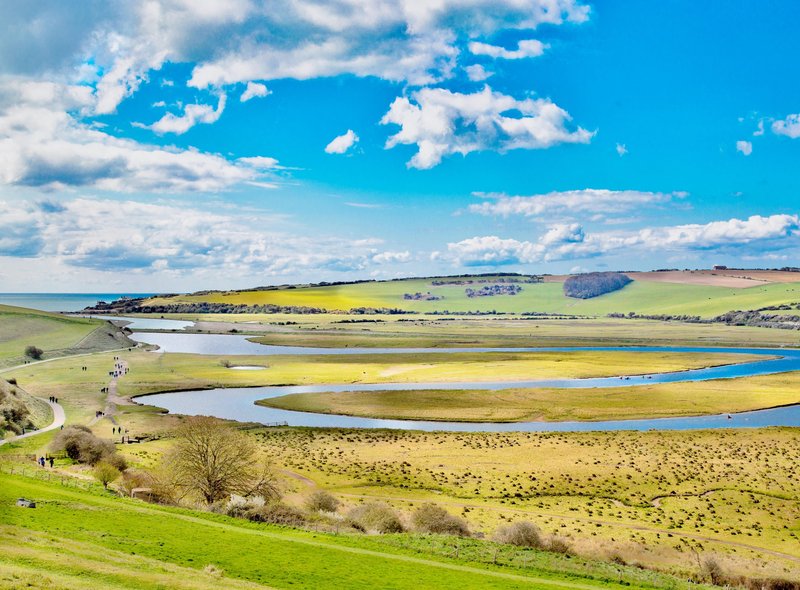
picture credit: Eastbourne Herald The River Cuckmere East Sussex England

Lawyers and Diplomats would clearly have a great deal to think about to formalise this concept But the world should not delay in my view. Every migrating bird, every ice berg, every bee and butterfly is a shared resource capable of influencing the well being of every human being.

The human race is presently facing an era of catastrophes caused by increasing populations desiring finite global resources and climate change. Denial of these facts was a phase in the 1970’s but not anymore.

When we consider how vital dynamic resources are, it is clear that many are jointly owned and enjoyed by all of humanity. In addition, human beings share a right for dynamic resources not to be destroyed or degraded. The concept of one country having a right to pollute water before it enters it’s neighbour’s land, should be trumped by an international law.

picture credit: NASA

Whales travelling through oceans have no concept of the countries they are passing. Why should one particular country, such as Japan, feel it has rights over whether these whales should live or die? If the consensus of the world is that the whales should not die, then an international body should have to power to order their protection.

Such a body could come under the wing of the United Nations. The chamber might find itself debating the right of the Brazilian government to destroy the Amazon rain forest for Brazil’s short term economic gain and the world’s long term loss. The debate would include the unique forna and flaura and the rights of future generations to have access to this DNA bank. The forest contains chemicals with medicinal properties, viruses that should never be released and countless creatures that once lost, will never be replaced. The neighbouring countries to Brazil, could demand their right to not have desert and refugees, wildlife and viruses crossing into their countries. The indigenous people would also be empowered to demand respect of their rights to the dynamic resources of the forest, in addition to their ancestral land rights.

If the resources that are dynamic are given the international status they deserve, there will be fewer international conflicts over ‘me and mine’ and more co-operation or ‘us and ours’.

Laws work when they embody truths the are Universal. If they are applicable in every corner of the Universe at all scales, they are more enduring and relevant than passing political values. The law would be called The Global Treaty of Dynamic Resources 2021.

Such a law and it’s enforcing body, will become even more important when humans begin to explore new planets and space. It might well be expanded to include static resources. The race to mine the moon that we see today, is about commercial rights to resources that are becoming scarce on earth, so called ‘rare earth elements’. Similarly, the filling up of the earth’s upper atmosphere and deep space with satellites, needs strategic guidance to avoid commercial exploitation and associated ‘space wars’.

If humans don’t get this right, then the next phase after the literal ‘carving up’ of our beloved planet, will be the ‘carving up’ of space and a repitition of the resource-driven disputes and wars in history. Even Helen of Troy was a dynamic resource and if a ruling had been made by a respected Greek god, the Trojan wars would never have happened!

One comment made by many of the men and women who have looked down on earth from space is that there are no national boundaries. We are so used to political maps that the real picture has, until now, been hidden by nationlism. Globalism, whether desired or not, will be the next paradigm for planet care, in my view. Without it, shared dynamic resouces will be seized or destroyed by the short term priorities and political ‘gain’ of politicians who rule without a trace of compassion for the people or the planet. You know who they are.

picture creadi: Pinterest

HS2 Where?

Twenty Reasons Why HS2 Might Not Be the Promised Public Transport Option of the Future

There is a project in England called HS2. It stands for High Speed 2 and is a plan to build a high speed rail route between London and Birmingham and then beyond. The stated justification for it by the government is to move the political centre of gravity away from London and nearer to the Northern and Midland cities; the so called ‘power house’.

These cities have conventionally voted for the socialist or Labour Party and HS2 was originally a Labour government idea in 2009. Why it has not been cancelled by the Tories in my view is that there may be some political gain for the Conservative and Unionist Party in making Westminster ‘closer’ to the North. In the last election these cities did largely swing to vote Conservative for, no doubt, many reasons.

One skill that I believe is essential for politicians is ‘problem solving’. There is a science to this subject and the first question to be asked in solving a problem is; what is the problem? As much as this may seem obvious, it is heart breaking to observe how much money is wasted on national projects that turn out not to solve the problem. I am reminded the airport in Spain that has never opened and you can probably think of some ‘vanity projects’ in your local area. ‘Vanity’ may be one reason those in power do not ask the right questions. Or perhaps it is the Dunning-Kruger Effect…

(The Dunning–Kruger effect is a hypothetical cognitive bias stating that people with low ability at a task overestimate their ability), : source Wikipedia

…that makes politicians believe they understand the problem perfectly and have the perfect solution.

An Idiots Guide to Digging a Hole for Yourself
:
credit Reseachgate net

Another common pitfall for ‘problem solvers’ is the temptation not to apply a new solution when the original one does not work. This is known colloquially as to ‘dig a hole for yourself’. Rather than abandon the first location to dig, the blinkered view and or fear of admitting a mistake and or wasting time, money and effort… compels decision makers to keep applying the original problem solving technique. Feedback is rarely sought, dissenters are ridiculed and rational insight is lost in the rush to jump into the deepest hole ever dug…

The HS2 project in my view is a perfect example of this and even the PM used this metaphor…

Boris Johnson has suggested the only answer to the “hole” enveloping HS2 is “to keep digging”. BBC News 31 January 2020

So far three billion pounds has been spent on demolition and railway infrastructure. To change now would mean wasting all of this money and admitting a mistake. To admit to such things is political suicide, and career politicians need to impress upon their voters that they know what they are doing. This is what we see at the moment.

Personally, I would vote for any politician who is prepared to describe the white elephant under construction as just that. Here is my ‘off the cuff’ list of reasons to abandon the project. I am sure the list could be even longer but it hardly seems necessary. It is not all negative. It contains the precise locations where treasure can be found, should the current hole ever be realised to be just full of air.

Here is my list of strategic reasons to abandon HS2;

1.The people who live in the Midlands and North of England desire most to have better rail links between the East Coast and the West Coast of England and connecting the cities in between.

2. The people who live in the Midlands complain that the existing rail service to London is at full capacity and needs upgrading. This could be achieved quickly and relatively cheaply with additional conventional infrastructure and rolling stock.

3. HS2 is planned to go initially North South, adding a link to London which is contrary to stated intention to move the ‘centre of gravity’ of the country. The word ‘London’ is the clue.

4. The country has borrowed a vast quantity of money during of the Covid -19 pandemic. To reduce this burden ( and presumably vulnerability to any future rise in interest rates) it is proposing to reduce aid to the poorest countries in the world. In doing so it risks losing the ‘world leader’ status it aspires to. One obvious alternative is to admit it can no longer afford to pay for HS2.

5. Since the pandemic, people have become used to communicating using the internet. Moving physically between locations has become less important.

6. Trains are old technology. They have been improved as much as they ever can be and now only new technology should replace it.

7. High speed trains are at their most economic on long distances such as found on the continent of Europe, North America or Australia. As any continental traveller will tell you, the UK major cities are relatively close to each other and journeys short in comparison with countries where high speed trains have been a success.

8. Fast, long distance trains are rivalled by aircraft. In Spain, for instance, internal flights are cheaper and quicker than the extensive high speed rail network.

9. Trains are rivalled by new technology such as the Hyperloop. They are likely to become superseded in the next few decades, just as railways took over from canals. Technology and economics are more sustainable drivers than political policies. New technology by-passes the decision making processes of government. In the era of present rapid ‘advances’ in technology governments must work with new technologies in the way that voters do.

10. A large proportion of ‘clean’ electricity is produced by fossil fuel power stations and nuclear power stations. The first is neither clean nor efficient. The nuclear option is becoming more and more expensive (as decommissioning costs are included) and prone to the dual risks of nuclear accident and the problem of the indefinite safe storage of nuclear waste on planet earth.

11. The costs of major infrastructure projects can be reasonably expected to double by the time they are completed. The original estimate for HS2 in 2005 of 37 billion pounds has already doubled to 78.4 billion pounds by 2015! (according to Institute for Government statistics). At this rate of increase it will have doubled again by 2025 and that is only the estimated cost. There are inevitably going to be delays and unforeseen extra costs. This during predicted future decades of Covid 19 austerity.

12. Europe is joined to one nation by the Channel Rail Tunnel. The United Kingdom is connected to twenty seven countries by the Channel Rail Tunnel – and beyond. The train from Berlin to Manchester appeals to a minority who will either meet virtually, go by air or just not choose to do business in the United Kingdom.

The List Extends into the Tactical Reasons to Abandon HS2

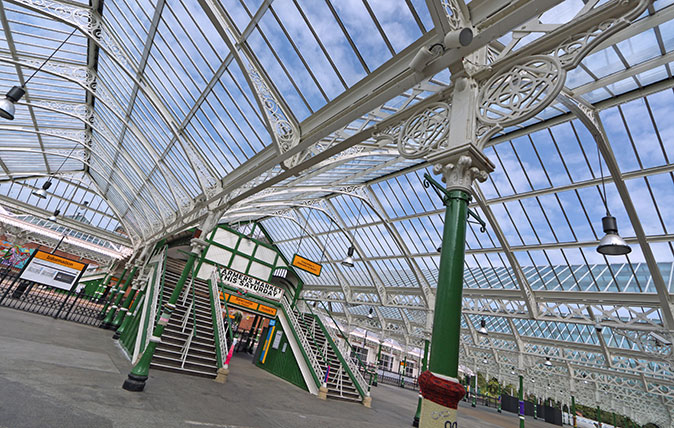
What have the Victorians ever done for us? picture credit Country Life

13. When the Victorians built railway stations, they were able to build their palace-like stations in the centre of towns and cities; just where travellers wanted to arrive! Due to high land values and ethical (archaeology, listed buildings, city centre decay, the housing shortage ) concerns around compulsory purchase, this is no longer practical. Most HS2 stations will be built outside the towns and cities they serve. The connecting transport will take away some or all of the time gained (1hour 21 minutes reduced by 29 minutes) by using a high speed train. An example I experienced many decades ago, was in Brisbane. When you arrive in Brisbane rail station you have to stand and wait for a bus or taxi to get you to the centre of Brisbane. I believe a local train has now reduced this problem but the insanity of these slow ‘connections’ remains.

14. Simple analysis of the problem will reveal there are many means to connect the regions of the UK other than high speed trains. The best and perhaps most cost effective of these, is to improve connectivity using the internet. This has the potential to allow passengers to work during their journey on conventional trains. This will make the speed of the train less important.

15. A new train route will cause considerable loss and damage to the countryside and communities through which it is intended to pass. The least of these is the one hundred ancient woodlands which will be destroyed. At a time when the country has been promised it will be more self sufficient in food, farms will be significantly negatively affected.

16. One hundred ancient woodlands, fauna and flora and in areas of outstanding natural beauty and special scientific interest will be permanently harmed or eradicated at a time when the environment is being prioritised, not least because of climate change.

17. Trains are a less safe means of travel than flying and in the future, the hyperloop. The later will be so safe that the prototype has already been trialled over a short distance by it’s designers and backers, personally. Hyperloop is frictionless so will require a fraction of the amount of energy required to propel an ordinary or high speed train.

18. To fit the broader brief of ‘increasing connectivity’ within England, new trains and routes should be started in the North. Phase One HS2, starts in London and therefore does not benefit those in the North unless they want to go to London.

19. The money spent by the Test and Trace and PPE procurement was approximately 57 billion pounds. This is in the same ball park as the current estimated cost of HS2! If HS2 costs reach 106 billion pounds, then this is the same as the cost of running the National Health Service for a year. Politicians have to be asked why not run the NHS for a year with this money?

20. The High Speed train network will not serve the satellite regions of the United Kingdom; known as Northern Ireland, Wales and Scotland. These areas already resent to control of an England-centric government based in the south of England. In my view this may become the straw that breaks the camel’s back and play into the hands of the Nationalist Parties of each country, the first to fall being Scotland followed by Northern Ireland, then Wales and then Yorkshire – Cornwall?!

I have not included any benefits from a High Speed train network in the United Kingdom.

Such as list should always be included in any rational ‘problem solving’ assessment. My problem is, I can’t see any benefits, except some good publicity photos of dolphin-nosed trains and grinning politicians in high visibility jackets.

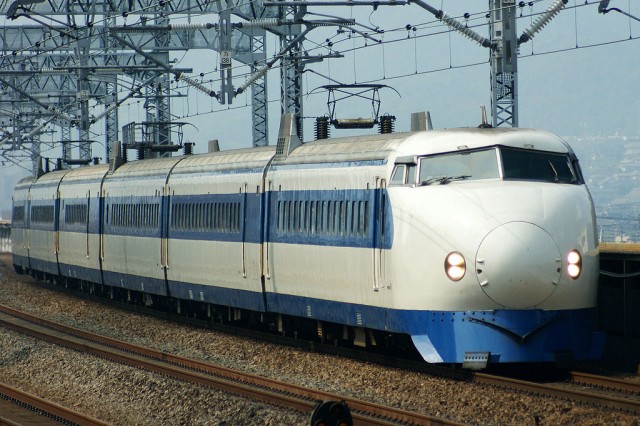
If there ever were benefits, these should have been gleaned after the second world war when the UK’s industrial cities had been demolished. Despite ‘winning’ the war in 1945 the UK was bankrupt. Japan ‘lost’ the war and in the 1970’s built some of the first high speed trains – the famous Skinhansen.

The Right Technology at the Right Time in the Right Place – Shinkansen

Perhaps some would argue that an electric train speeding along the tracks is much greener than the cars on the motorway running parallel. With the proviso that the National Grid is powered by carbon neutral fuel sources, this is true, but certainly by 2040 (as phase 2 is due for completion), cars and lorries are going to be mainly electric or hybrid. Any ‘green’ advantage to all trains is slowly disappearing.

And in the midst of a pandemic and in preparation for the next, is not personal transport going to be preferred to public transport?

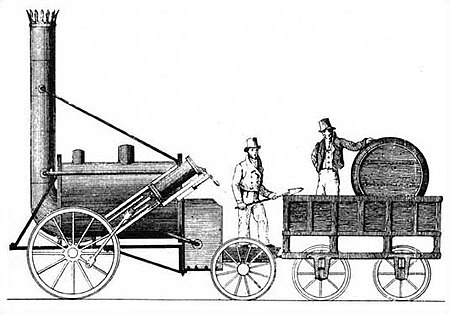
What would Robert Stevenson be thinking if he saw the final phase of his invention being acted out? What would he say about today’s ultra wealthy taking personal travel into the edges of space and is that why he called his invention Rocket?

1829 Rocket – Still the best public transport concept applicable two hundred years later?

The Bill

picture credit: usanewshunt

There is presently being considered in the UK parliament a ‘Police, Crime, Sentencing and Courts Bill’. It is wide ranging in it’s intended effects. So much so that citizens are worried and they are asking questions are;

Are these new legal powers necessary and if so are stricter legal powers the best way to achieve the intended result?

In other words, is shooting the cockerel the best way to have a lie-in?

It is coincidental that the timing of these proposals coincided with a public vigil for a murdered woman, Sarah Everard. Sarah was tragically murdered, allegedly by an off duty police officer, whilst walking home.

The vigil was held in Clapham Common in South London. Unfortunately there were ugly violent scenes when police enforced the Covid regulations, which ban such public events. The confrontation had been foreseen. Prior to the vigil, an organisation called ‘Reclaim These Streets’ approached the police and then the High Court. The High Court told the organisers to sort it out with the police.

The question has to be asked, how ‘negotiations’ failed to find a solution that eliminated the risk of confrontation and violence.

picture credit: thedailymail
comment: how the media encourage dualistic thinking

People with an iota of problem solving sense and mediation skills, will know that if you set up two sides with conflicting agendas, they will always disagree with each other.

The BBC News webpage comments; For almost a year, the ambiguities and omissions within the coronavirus restrictions have left both the police and the public grasping for answers as to what is possible in public. It’s so complex we’ve even seen people fined for walking while holding a cup of tea.

The Covid ‘regulations’ are already a cause for antagonism between the public and the police. The police are having a hard time maintaining public confidence in their impartiality and fairness. The Police are currently lumbered with issuing Enforcement Notices, fines of £200, under the Covid Regulations.

Personally, I can see good reason to remove the police from the enforcement of Covid rules.

Police are principally responsible to protect the public from those breaking criminal law. They stopped being responsible for lost dogs and parking on double yellow lines long ago, so why are they involved with Covid rules?

One possible solution would be to create a new temporary role of ‘Covid Enforcement Officers’. This process of specialist enforcement officers has already been successfully with non-criminal offences, such as parking fines. Police used to issue parking fines decades ago. Then Traffic Wardens were created for this purpose and currently used ‘Parking Enforcement Officers’ have the role.

The Home Office might be able to recruit volunteers to enforce Covid Rules, given the large number of community spirited citizens who have already put their names forward for public service during the emergency. Alternatively, or as well as, the Home Office could pay CEO’s in the full time role. Alternatively or in addition, the Home Office might use the services of those currently paid to ‘furlough’ at home. This at least would be a better use of tax payers money. The role might also be given to a strictly selected portion of those ‘homeless’ and living in hotels at public expense and even released prisoners. Both groups who might well rise to the being awarded public trust and benefit for the rest of their lives for some experience of employment. My point is that there are many avenues to explore before dismissing the role of CEO.

Let us next examine the subject of public protests during the Covid state of emergency. It cannot be denied that where there is a public protest planned over an issue of current high public interest, there is good reason for respecting public feelings. If the government restricts the human right of protest it runs the risk of appearing draconian. When the government and rule of law is perceived by citizens to lose the high moral ground, ‘policing by consent’ becomes difficult to impossible. We see this in Hong Kong and Myanmar at the moment where protest has effectively been made illegal.

The problem for the British government that the vigil in Clapham Common posed, was for a potential ‘mass Covid spreading event’ to take place. This was the fear and Police had a duty to prevent such an outcome. They would be sure to be blamed for not using their powers should there be a subsequent localised outbreak of Covid infection.

The problem solving method used was for both sides to line up against each other like in a medieval battle. Even the High Court ran from this confrontation. All were victims in my view of the process of dualistic thinking or ‘either or’ solutions.

The way I would look at this problem is that it is not only a ‘police’ responsibility. In most problem solving processes, problems will be found to be widely shared. Who might the other stake holders be?

Just of the cuff I would suggest that the problem was owned by the organisers, those attending, the Park Authorities and the by-laws, the National Health Service (local hospitals), Human Rights organisations, the Courts, scientists of the health and social variety, the local MP and London Mayor’s Office, Legislators and the Home Secretary.

The only intervention the government could conceive was a new law, because that is what governments do; a classic case of ‘digging the hole deeper’. This is how they intend to make the present police powers more stringent;

The Bill being proposed wishes to prevent public protest that creates “serious public disorder, serious damage to property or serious disruption to the life of the community”.

The lack of any nuance to this ‘nail – hammer’ thinking was, in my opinion, is woeful. If the complexities of solving a problem are embraced, then solutions are abundant.

For instance in the case of this public vigil by, say one thousand people, it can be be managed to achieve the clearly set out objective…to let people have their moment of remembering peacefully and without disproporthionate harm to themselves or others. After all, if strangers mix inside a supermarkets without creating mass Covid spreading events each day, then a single outdoor event is considerably less risky. Experience of public gatherings outdoors, including when not socially distanced, has shown that mass Covid events do not take place afterwards. This was shown to be the case at recent public protests in the USA such as the Black Lives Matter marches or the infamous storming of Capitol Hill.

Aside from the spread of infection it is hard to see why any peaceful outdoor protest should culminate in;

“serious public disorder, serious damage to property or serious disruption to the life of the community” if managed properly.

There are clear Covid rules of social distancing, mask wearing and hand washing and the attendees would willingly follow such rules as they Sainsbury’s where public disorder is not considered an imminent threat.

A vigil by definition, is a passive affair where people sit or stand with candles and placards to express their feelings of solidarity, sadness and, in this case, discontent that a young woman’s public murder makes many women feel unsafe.

Imagine how a Problem Solving / Protest Management Meeting that I am envisaging, might have taken place. There would be numerous attendees with multiple points of view but with a overlapping and shared desired outcomes. The aim of the meeting will be to express and examine all views in a spirit of co-operation to solve a shared problem. The fruit of such meetings is that solutions can be just as impactive as force, but in a subtle and almost invisible way.

So if you were the Superintendent of Parks, would you not be a good person to involve in how to make this peaceful event as safe as possible whilst supporting the Human Right to protest? You could provide detail maps of the park showing entrances and exits, toilet facilities, how previous public events had been managed, first aid and other emergency considerations (normal for large gatherings), catering etc. etc. in as much detail as you need and that’s just the Park Keeper.

The Fire Service say they could provide sand bags for people to sit on at the required distances…good idea…and safe bins to dispose of used candles. The local press and police might hire a drone to take photographs from above. The police use it to monitor events and the press get some great photograhps. Those attending are told that by staying on their sandbags they images will be spectacular visually, whilst respecting privacy and not spying on indiviuals. Instead of a grid, an local artist might design a shape for the sandbags and candle holders, like a flower of rememberance. You get the idea. It’s soft management designed to delight not draw battle lines.

The Covid Enforcement Officers might have produced some posters which will be clearly displayed at the entrances to the Vigil Arena, reminding attendees of the Covid safety rules and the fines for infringement.

I could list the inputs of each party but you get the picture. Towards the end of the meeting the person representing the local police, shares that there is intelligence that the an anarchist organisation are planning to attend. There is a history of them creating public disorder and damage to property. A few mug shots are shared.

Are These People Mourners or Political Activits?

The Police therefore commit to having 200 riot trained officers on hand but out of view, in case of “serious public disorder, serious damage to property or serious disruption to the life of the community”. They confirm that there are existing laws under the Public Order Act, Criminal Damage Act and Breach of the Peace to make arrests and allow the vigil to continue peacefully.

Dame Cressida Dick, Metropolitan Police Commissioner, is at the meeting and says that she intends to take part in the Vigil. Everyone applauds. Apparently, several other celebrities and leaders of Human Rights and Women Safety organisations are also going to take part. There is decided to be a VIP area next to the area designated for the Press.

In this hypothetical scenario the event takes place and the Anarchist ‘rent-a-mob’ do make an appearance. They are ‘kettled’ away from the vigil into an area that the Park Superintendent recommended which is surrounded on three sides by high fences. Flood lights had been secretly positioned their and their switching on allows for CCTV surveillance to begin and the press to get some good pictures. The police keep them there until the vigil has ended and the park is clear. Two anarchists are arrested are, both for previous offences using outstanding warrants.

My conclusion is that any public protest with warranted public interest and sympathy, should be allowed to take place under Covid regulations, and the Regulations should be amended to permit this. It is for the committee of interested parties to decide what level of public interest and support exists, not the courts or the police.

In summary, when the only parties involved are cast as protagonist and enforcer, the result will tend towards the violent scenes sadly witnessed on Clapham Common. Giving the enforcers more powers to enforce is no solution, and leads to the very thing purported to avoid, that is;

“serious public disorder, serious damage to property or serious disruption to the life of the community”.

So in answer to the question at the top of this essay which was;

Are these new legal powers necessary and if so are they the best way to achieve the intended result?

…my answer is no. The existing laws were sufficient for the nine arrests made at this vigil. Next time, organisers should seek the help of the ‘partnership approach’ to public protest event planning. Use it or ignore it at your peril.

Who Orders the New Order?

<p value="<amp-fit-text layout="fixed-height" min-font-size="6" max-font-size="72" height="80"><amp-fit-text layout="fixed-height" min-font-size="6" max-font-size="72" height="80"></amp-fit-text>

A ‘normal’ state of affairs in a society is always a vague concept. We know that what is ‘normal’ in one year or decade, will not necessarily so in the next. Changes in technology, education, religion, health, cultural diversity, incomes and expenditure, world events such as weather patterns, personal expectations and many other factors, influence how societies morph. In this essay, I am going to use one of these, education, as an example of how ‘normals’ become established and how they can change for the benefit of all.

A common cliché is the ‘new normal’ – as if this makes anything clearer – which it does not. By definition a ‘normal’ state of affairs has been in place and unchanged for a substantial period of time. If it had not then it would be just ‘new’. Normal should appeal to persons of a ‘conservative’ outlook; they resist change on principle, even if the change is for the better.

Taking the long term view of the current changes in Western societies, it is likely that the next ‘normal’ will be very different to anything in the past.

Whether that is a ‘New World Order’ as politicians have been predicting for the last hundred years or more, remains to be seen.

If we can adapt our expectations and thoughts to a ‘new order’ that has been voted for and accepted by society, then there will be more gains than loses for everyone. If the control comes from anywhere else, then it will be impossible to predict what that strategic outcome will be. It is most likely however that that objective will not be in the best interests of the people.

People living in countries where they still have the power to influence those who govern them, must first determine what it is they want. History informs us that one of the most basic rights is the have an the same opportunity at success as our neighbours. Inequality of opportunity creates disparity at all kinds of levels, no just wealth. Anyone who does not succeed following this rule has only themselves to blame if they do not gain as much as their neighbour. The lazy, inept, greedy, fantasised and any other human weakness you care to name, these people will achieve few privileges but will know they only have themselves to blame.

The attempt at an alternative means of assessing pupils’ grades failed in my view because it was not sufficiently a radical change. Today Universities think they need to select bright students when in fact they just need fee paying students.

The ‘merit’ system of the mid 1900’s, assumed that Universities should offer free places to the brightest students. This was generally 4% of the brightest students each year. Society paid, but gained in the long term because it gave a level playing field of opportunity to young people from all social backgrounds. When students left University they entered society as future managers and leaders.

Since the Tony Blair government stated a new aim of half of all young people gaining degrees, the whole game changed.

Surely such an aim produces too many chiefs and not enough Indians? Today young people with degrees have found it challenging to find work, let alone one that offers them to fulfil their personal potential.

Degrees issued to so many people, lose their inherent value, simply because of the law of supply and demand. Employers are now are looking for candidates who have a degree and something else.

The whole process of gaining good A-levels in order to be accepted by a University appears to me to be of little relevance.

If Universities took a fresh look at what they offer in the current ‘Covid’ restricted environment, they might become more radically innovative. The traditional University campus and it’s associated support activities all have to be located in buildings. The students expect some sort of accommodation and transport facilities such as parking for cars and bicycles.

It is not surprising that Universities need large incomes from fees and government. Yet, the introduction of ‘remote tuition’ – a product the Open University in the United Kingdom has offered for decades – is a ground changer.

If Universities moved out of campuses where the whole Universities culture is no longer needed, fees could be drastically reduced. With less travelling by staff and students, there is a saving to the environment and days for work and study. Other benefits will be easier child care and part time working.

Universities will be not be limited on offering places for courses because they will not be counting seats in lecture theatres. There might be a three hundred on a course that in the ‘old normal’ was limited to say, thirty.

Why should a place in University be decided by how well a student performs in examinations? They might have high potential in the work place but not shine at academic subjects and in the examination theatre. They might have a less than perfect understanding of a language, such as must be common in foreign students, and yet have high potential once that weakness was allowed to be overcome. I knew a Ukrainian woman who spoke Russian and studied Law in an English University for which I give huge respect.

There are many other physical and mental ‘disabilities’ which students encounter temporarily or permanently which Universities should be the first to respect. Offering places purely on academic success, is in no way respectful of what a person can achieve if given the chance they deserve. Most employers in the ‘new order’ and not going to discriminate irrationally simply because it is against the law of the land. Remote studying suits such students very well as they can take the time they need at the pace they need.

What I am suggesting then is a revolution in academia where they students decide which courses they want to purchase independent of their previous academic performance. If the student is to be a ‘customer’ then like customers, they hold the power to get what they aspire to.

When I went to University I was awarded a place on how well I performed in interview and my rather poor A-level results ignored. I like to think I was assessed on my human potential rather than how well I remembered facts.

I have used the University admission system as an example of how the ‘normal’ in any organisation can be changed. Most importantly this change enables everyone to have an equal bite of the apple, independent of what sticks and carrots life has presented them with in their lives so far. It is true to say that ‘life is never fair’ but that is a reason to try and make it fair, not to give in.

The changes in societies currently taking place across most of the world can be blamed for personal failure but equally for personal survival and success. Those who are not brought down should be those who are most willing to throw the ‘rule book’ out of the window. Comfortable lifestyles from privilege and convention, one would like to think are most at risk.

The Puppet That Pulls the Strings

One of the seven principles of Hermetic philosophy, is the law of cause and effect. Sir Isaac Newton was strongly influenced in his development and application of the scientific method, by this law. It appears in one of his universal laws of thermodynamics as ‘to every action there is an equal and opposite reaction’.

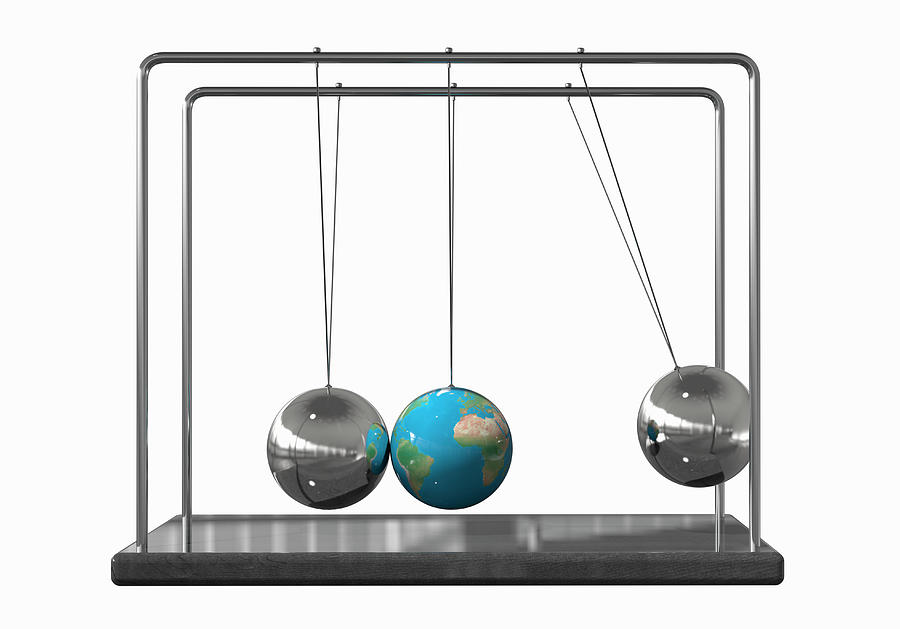
Can life be reduced to a sort of cosmic Newton’s Cradle, where impact at one end of a line of suspended spheres, sends kinetic energy invisibly through the line and appears miraculously at the other?

globe-as-ball-on-newtons-cradle

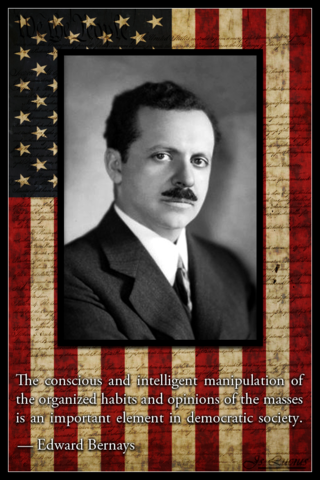
Surprisingly, in some respects, it can. When social groups are examined on a large scale, one psychologist found that they are highly susceptible to manipulation, ethically or not. His name was Edward Bernays and he was the nephew of Sigmund Freud.

Edward Bernays: would you buy a second hand car from this man?

Edward Bernays

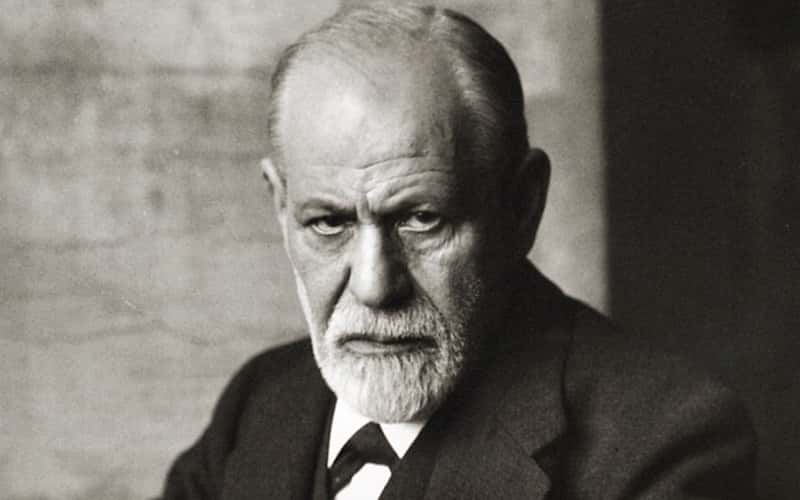
Sigmund Freud – are you happy?

sigmund-freud_800

Freud wrote a book entitled ‘Group Psychology and the Analysis of the Ego‘. In this he examined how individuality and consciousness of the ‘I’ can be subsumed when a person identifies with a group. The larger ‘group’ consciousness becomes dominant to the extent that individual’s will acts in a way that they would not on their own.

Examples are everywhere, such as the group identity of the supporters of a football team. They will dress in the colours of their team and occupy a part of the stands where they can appear as a powerful group both visually and through by tribal chants. The power gained by the players when they score goals and win, is shared through this identification by the supporters. A normally disempowered ‘ordinary’ man will feed off the power gained by the group, causing extreme elation.

At it’s most benign this effect can be used in sports, advertising and public relations. At it’s most dangerous, it can be used in political propaganda to influence the minds of the masses to behave in accordance with the aims of a small group.

Examine the the governments of countries and institutions and you may discover a sleeping monster. On a whim, leaders are fully capable of influencing the mental processes and social patterns of the citizens of that country, without them being aware.
The roots of how this is possible lie in our ancestors, who organised themselves in tribes and hunting groups in and be more successful; especially when hunting large animals such as Mammoths. Although modern man has morphed away from this psychology into separate individuality, there are times when we regress.

Individuals will identify readily with various social classifications that can be exploited to divide the populace. Examples are race, class / cast, politics, education, religion, sexuality etc. The motives for doing this might be as ordinary as making them choose a particular type of soap bar, or as extraordinary as bringing them out onto the streets to protest and or riot.

Edward Bernays was interested in how governments could rise or indeed fall by this phenomena. He wrote in his book Propaganda;

If we understand the mechanism and motives of the group mind, is it not possible to control and regiment the masses according to our will without their knowing it?

and…

They systematic study of mass psychology revealed…the potentialities of invisible government of society by manipulation of the motives which actuate man in the group.

Sigmund Freud attempted to explain why people engage in group identification. He proposed the idea that the thoughts and feelings of an individual are in some way compensatory for suppressed desires.

‘A thing may be desired not for it’s intrinsic worth of usefulness, but because he has unconsciously come to see in it the symbol of something else, the desire for which he is ashamed to admit to himself.’

In other words, our actions are spurred on by thoughts that come from our shadow selves, rather than for any conscious, considered reasoning. The conscious mind in most people, has a conscience which prevents negative behaviour through the emotion of guilt.

Whatever it is you are thinking, don’t do it!

sleeping monster

But unconsciously there may be ‘commanding’ thoughts which dominate decisions and actions. In this way we are like children who have not learnt to filter information coming from the outside world. We just absorb impressions and later act out what is good or not. In this way a government could move it’s people to adopt ideas such as the mass slaughter of a minority population, which would be abhorrent to the conscious mind but unconsciously fulfil unexpressed desires.

It is extraordinary to think that these theories were created at the end of the nineteenth century. If proof was needed, the next century provided glaring examples such as the rise of the Nazi Party in Germany and the genocides in Rwanda, Cambodia and other countries.

Joseph Goebbels: Wimp turned bully                 picture credit: BBC.com

Goebbels

The leaders of the Third Reich used propaganda ingeniously. Joseph Goebbels produced films as a key means of engeneering the minds and thereby, opinions, of the population. He understood that in cinemas and theatres audiences can drop their individual critical faculties. They connect unconsciously with powerful messages that feed off repressed emotions and ideas, such as in this case the ‘problem’ of the Jews.

In Rwanda, the radio became a powerful tool for government propaganda which described the minority tribe as ‘cockroaches’ who needed to be eliminated. The old instincts of tribal mutual hatred, suppressed through the adoption of modern social norms, were allowed to become dominate and so powerful that neighbour would kill neighbour with a machete.

Freud wrote in his book Group Psychology and the Analysis of the Ego;

‘A group is extraordinarily credulous and open to influence, it has no critical faculty.’

recruiting in WW1

The actions of the young men in the First World War is another clear example. Thousands signed up without hesitation to enlist in a war that would ‘be over by Christmas’. With hindsight this uncritical and unfeeling mass psychopathy across Europe and beyond, was absurd. Even the mitigating influence of the closely related European royal families of that time, were sucked into the mass psychosis of hatred and fear.

If we take these ideas and fast forward to the present day, many suggest that there is a small group focused global social manipulation, that has had over one hundred years to perfect it’s dark arts.

The, once hidden, now overt aim is to establish a world government and a disempowerment of it’s citizens through draconian laws and the use of new technologies such as artificial intelligence, mass surveillance, cyber robotics and enforced compliance with the State through removal of individual choice.

To achieve this requires deceit on a global scale. The internet and international media is the modern propaganda tool to achieve what one hundred years ago was unthinkable by peaceful means.

Does a secular society fear dying more than a devout society?

fear of dying

The repressed fear which is being exploited in 2020, is the fear of dying. Each person feels this fear whether they admit it or not. Death is something not understood today. It makes those left behind uncomfortable and deaths of loved ones are dealt with expediently. It is taboo to discuss death in anything but the most trivial way, with meaningless platitudes such as ‘he passed away’.

Death by natural causes is far more socially and politically acceptable than death by warfare. The appearance of a new virus, whether by fair means or foul, is something all governments expect and plan for. The Covid 19 virus was foreseen and plans were in place to use it as a means to suppress and perhaps cull populations. The smartest way to disempower people is to ruin the black economies and other economic enterprises that are not global. Then introduce technology based solutions that remove the last vestiges of personal choice, such as the cash-less society which has been happening in China.

You might have expected the citizens of Communist societies to adapt readily to strict government controls and sure enough, the Chinese leadership spearheaded the practice of the ‘lock down’ with ruthless efficiency. The Western societies had little choice but to follow the same solution even though it is opposite to their social freedoms.

Whilst isolation is clearly the correct way to deal with an individual case of viral infection, there is a logical argument that not all citizens need to be locked down at once. This was done to protect inadequate health services, not individuals.
Freedom is a hard won prize, but when the option is presented as ‘death’, freedoms have been handed over without a fight.

picture credit: CNN.com

statue of liberty

This is how I personally see the end of 2020 and most of 2021. We will see a ramping up of the ‘problems’ substantiated by rising lines on graphs. 

This will occur as the vast quantities of government ‘free’ money will begin to run dry. The problems of unemployment have only been postponed, not solved. The consequence will be an impossible situation for previously law abiding families. We can expect to see large scale public unrest driven initially by hunger. Looting and civil urban warfare, even in countries that have not armed their citizens in the way the United States has, will become a problem. The governments of the world will claim to have little choice other than to take away personal freedoms even more.

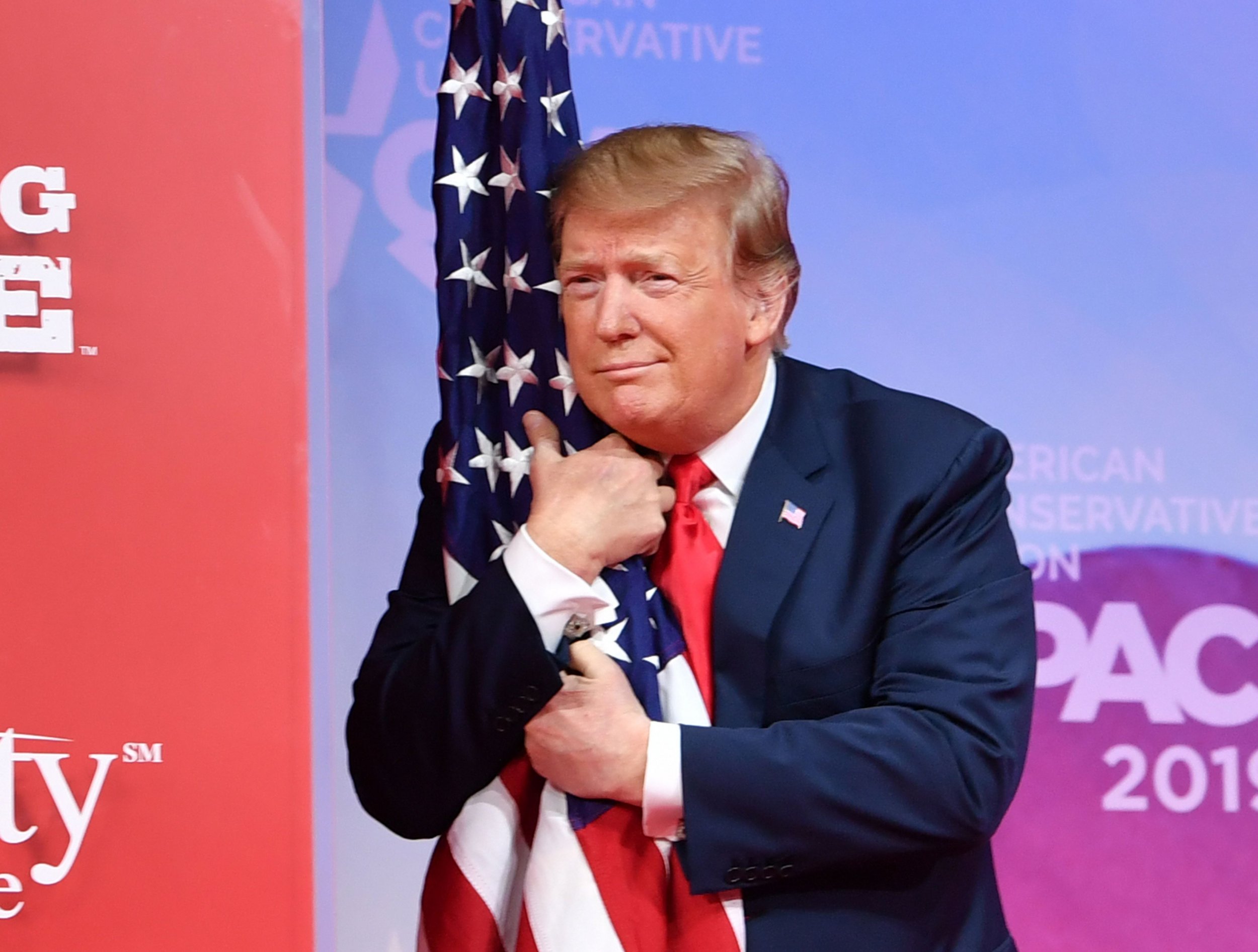
The United States runs an extra risk as it approaches it’s elections in November 2020. President Trump is also about to hit the railway buffers and he will bend the rules of democracy to remain in power, in the way he has shown America he can many times already. In doing so, citizens aware of the threat to their democracy and using their rights under the Founding Fathers Constitution may legally form militias and take on the government forces.

Would you buy a second hand car from this man?                     picture credit Newsweek.com

donald-trump-2020-election

Whoever is controlling the puppet that you are, will be pulling your strings to make you jump as they want, not as you want. All you can do is pull back on the strings, and collectively that could be powerful.

Individuals will identify readily with various social classifications that can be exploited to divide the populace. Examples are Race, Class, Politics, Education, Religion, Sexuality etc. The motives for doing this might be as ordinary as making them choose a particular type of soap bar, or as extraordinary as bringing them out onto the streets to protest and or riot.

Did Condaleezza Rice start Black Lives Matter? Probably not.                              picture credit: AZ quotes

Obama on democracy

Edward Bernays was interested in how governments could rise or indeed fall by social manipulation. He wrote in his book ‘Propaganda’;

‘If we understand the mechanism and motives of the group mind, is it not possible to control and regiment the masses according to our will without their knowing it?’

and…

‘The systematic study of mass psychology revealed…the potentialities of invisible government of society by manipulation of the motives which actuate many in the group’.

If we take these ideas and fast forward to the present day, many suggest that there is a small group focused global social manipulation, that has had over one hundred years to perfect it’s dark arts.

The, once hidden, now overt aim, is to establish a world government and a disempowerment of it’s citizens through draconian laws and the use of new technologies such as artificial intelligence, mass surveillance, cyber robotics and enforced compliance with the State through removal of individual choice.

To achieve this requires deceit on a global scale. The internet and international media is the modern propaganda tool to achieve what one hundred years ago was unthinkable by peaceful means.

picture credit: Houston Museum of Science, Death by Natural Causes Exhibit

Death

Previous pandemics have wiped out half the populations of each town and village. When that is happens today, there is indeed a problem deserving the solution being offered.

Whoever is controlling the puppet that you are, is pulling your strings. Now is the time to start pulling back. You might be surprised to find out who is on the other end of the string!

White Lies Matter

When I was a boy I had an aunt who had been a Baptist missionary in, what was then, the Belgium Congo and is now the Democratic Republic of Congo.

This gives you a clue that this was the 1950’s and Africa was still largely in the hands of European countries. She and her husband were captured and managed to escape prison and return to England. I remember her telling me once, that ‘black people are not as intelligent as white people’. Fortunately I had never seen a black person at that age. But it was one of many ‘white lies’ I have heard.

I use this anecdote to show how the morality of generations evolve and change. After the second world war and the fight against fascism, opinions of others based on their race, religion, disability, sexuality were liberalised. The Nazis and to some extent Victorians, believed in eugenics and the creation of a ‘master race’ – completely opposite of what today we call ‘respect for diversity’.

My own skin colour I will not reveal here, as it changes with my exposure to the sun and is therefore of little relevance, and my race is – human.

The permission to abuse another human being, on account of their perceived inferiority must go back to ancient Sumer, Abyssinia, Egypt, Greece and Rome. Throughout the Middle East and the Classical world, people were either royal, free or slaves. This was a ‘perfectly normal’ set up and no doubt solved the problem of what to do with prisoners from conquered lands, as well as deciding who was going to do the washing up.

A Chain Gang in Ancient Rome

B Ancient-Rome-Roman-Slave-1024x682

When Europe adopted Greek and Roman classicism in the Renaissance they stole and copied statues of gods and Emperors; more as decorative pieces of sculpture, rather than because they admired the shameful behaviour of minor gods and Emperors.

But this model undoubtedly had an effect on the human consciences. How else could slavery have remained legal until the eighteenth century? When Europe was exploiting the West Indies and needed slave labour, Africa was convenient for it’s ships to pick up more slaves, and yes, sometimes from Africans ready to sell their enemies.

In those times much of the riches of the Western cultures came from the sweat, blood and tears of slaves. We know this, so – have we changed?

I personally think that we have, but not totally. I see people from all over the world living and working in European cities. There are high achievers and low achievers in any society, depending on how you measure ‘achievement’. But more importantly, people all over the world today are better fed, more likely to survive birth, and more likely to be educated and have access to health care. There are obviously exceptions to all of these but I am describing a trend. There are graphs produced by physicians and social scientists like the late Swedish academic Hans Rosling, that tell us this.

There is room for everyone on the planet according to the Professor

B hans rosling

But the devil is, as always, in the detail. Racism endures in the minds of people of all races. There is a saying ‘birds of a feather stick together’ and as a description of human social behaviour, this remains largely, true.

The European collective unconscious has a lot of skeletons in it’s museum vaults and these continue to rattle to the present day.

Clearly, national institutions continue to exert power that is prejudicial towards it’s citizens on account of race, religion, gender, sexuality, disability – despite the introduction of many laws, certainly in Europe, to correct this.

Personally I do not think new laws change societies of themselves, there has to be more. Even after the late Martin Luther King Jnr. gave his inspirational speeches in the 1960’s; sixty years later there are still statues of slave traders in European cities and military bases in the southern states of the USA named after confederate generals.

Head of Martin Luther King Junior in MLK Park, Buffalo, New York State

B Head in MLK Park

Whilst it is correct to record and preserve the facts of history and heritage, much of what our forefathers thought was ‘acceptable’ is nothing to be proud of today. Museums and history books must be  trusted and treasured so that they enable future generations to learn from the past. This will, at best, inspire an imperative to practice compassion towards one another today, because we got it wrong in past.

Therefore it is clearly the responsibility of those with the power to do so, to make regular assessments of local and national institutions and weed out any ‘honouring’ of the past, of which we should be ashamed, without hiding truth.

The African Americans and many allies, are presently leading the charge against their prejudicial treatment, but the lesson has global implications.

There is not a single human being on the planet including myself, who would not benefit from keeping a constant check on personal behaviours towards others that reveals some irrational prejudice, and immediately correct it.

Some argue that doing nothing is also acting with prejudice and perhaps they are right. Laws can be broken by act or omission, so can our personal integrity. The saying goes something like; ‘evil thrives when the good guys do nothing’.

And it is a fact that people of all colours, creed, tribe and what ever distinction you choose, have done nothing for a very long time. The history of post colonial Africa contains many shameful periods of genocide.

For example, in the Democratic Republic of Congo between 1997 and 2003, five million people were killed. If you read an article in the Guardian Newspaper website entitled ‘Wars Will Never Stop’ it quotes a young fighter who was dying in hospital of his shocking injuries from a local skirmish with a rival faction of his rebel group;

I was just a foot soldier so I don’t really know why we were fighting,” he said. “There are lots of reasons I think …. I don’t think the wars here will ever stop. They will probably get worse.”

The question has to be asked, where were the protests of outrage from people of African heritage in their adopted countries all over the world?

Who did nothing when 800,000 people were slaughtered in Rwanda in just one hundred days in 1994?

Rwandan Genocide

B rwanda-genocide

 We all have to be careful that they are not being stirred up and manipulated for political reasons. In Rwanda the principle tool for the stirring up of hatred was the public radio.

All societies have to guard against the publication of false information or the abscence of true information. For instance, it is curious that the size of the problem of ‘deaths in police custody’ is not published, despite a law in the United States of America requiring them to be so. The Death in Custody Reporting Act of 2013 went into effect in December 2014, but official figures have never been made public. The reason is either that these figures will prompt national outrage and shame, or lead to a conclusion that the problem is much smaller than it is being made to seem.

Clearly, one death is too many, but national figures covering 500,000,000 people have to be published openly, especially when feelings are running high as they are now.

The core problem is contained in the hearts of those who nurture hatred towards other human beings, for whatever reason. It does not matter if the hatred is black against black or white against black or black against white or white against white. The issue, in my view, is not an identification with a race or class, or creed, but the level of willingness of each human being to allow their love for all of humanity, to rise above everything else.

‘Hate cannot drive out hate, only love can do that.’  Dr. Martin Luther King Junior

The Tunnel at the End of the Light


There used to be a car, in the 1950’s called the Ford Popular, endearingly known as the ‘Ford Pop’.

If the model T industrialised the manufacture or cars, it was still only affordable for the middle classes of America.

But the Ford ‘Pop’ bridged that class divide and provided a ‘people’s car’. Germany had done this in the 1940’s with the Volks Wagon Beetle, but Britain took a while to catch up due to a short ‘intermission’ called the second World War.

The greatest car ever built – Ford Popular 1954

picture credit: carandclassic.co.uk

Light Ford Pop 103e 1954 carandclassic

What do you expect from a people’s car? Certainly it is not going to have a chilled drinks cabinet and cigar lighter. Everything was basic, functional and appealing to the common denominator of public taste, availalbe in black, black or black. It was, naturally, very popular and it transported families in comfort from city to beauty spot in large numbers. If you wanted anything other than a can of baked beans, you had to get a pay rise.

Fast forward to today and you can draw a parallel between the dumbing down from ‘the good life ‘ for a few, to ‘dull and ordinary’ for all. The middle classes in both the UK and USA lost their grip on political dominance, because the workers have come out in larger numbers to vote.

In the last decades of the 20th century, politics was complicated. Whilst you didn’t need a degree in political science to understand what was going on – it helped. The whole process of electing representatives on multiple – often contradictory – manifestos, parliamentary debate, Sovereignty, national priorities, international relationships and above all, law amending and making – was baffling to most. So it was left to the ‘Toffs’ from elite universities to speak down to voters in election campaigns to make promises everyone could understand – even if they were expected to forget them later.

Enter the internet in the 21st Century. Whilst you could write the equivalent length of Nelson’s Column on how this availability of information has changed societies across the world, there must be changes.

The most obvious of these is, in my view, the ‘citizen scientist’. In a stealth move worthy of the Great Harry Houdini, ordinary people who never understood science at school, are suddenly ‘on to it’.

If we  regard science as a way of thinking logically about anything – using the ‘scientific method’ to prove or disprove propositions – then everything is up for change and challenge.

Call a friend?

Light NHS Direct

Suddenly people were empowered to not believe their medical Doctors. You look up your symptoms on the internet and then go and tell your Doctor what the problem is how you want to be cured providing it does not involve vaccination. The UK National Health Service even encourages this by creating NHS call centres. The staff follow algorithms in the same way G.P.’s do – perhaps even quicker and certainly without having to catch another disease in the Waiting Room.

The same process has crept into most other areas of professional expertise; people design their own houses, people cook and bake, people make art, play musical instruments, make astrological predictions, indulge in puppy care and kitten care – you name it people do it – and the walls of Jericho surrounding the professional classes have fallen.

Great, you might think. This is democracy at it’s best. People power!

The problem is the obvious one and why even Socrates, warned against empowering the masses.

The problem is that people do not access and use information, knowledge and wisdom in the way that professionals have been painstakingly trained to do. As always it remains true that, things are more complicated than they seem.

It is easy to reduce areas of knowledge to ten ‘top tips’ – how to build your own house- and make it look easy. Speak to anyone who has built their own house and they will describe the most stressful time of their lives, going over time and over budget and still the roof leaks.

Socrates warned that ordinary people did not have the education to be trusted in such things as – voting. Perhaps this is one reason why women in the UK at the turn of the 19th century were still denied a university education and a vote – why this particular prejudice was suffered for so long.

Even with a university education, young men and women in the twenty first century are finding it hard to get a job. When the Blair government in the UK declared an aim to give a top class education to fifty per cent of young people, the ideal appeared noble. But the reality was that ‘degrees’ became so common that they were no longer the doorway into top jobs.

Worse still, with the introduction of University fees in the UK, young people were enslaved into a life time of paying off a high interest debt – all on the promise of ‘earning more’. And governments too are unlikely to get their ‘pound of flesh’ from the deal. Grants to the few worked better in my view.

In primary schools the children of the first decade of the twenty first century were told how clever they are and one day they might be Prime Minister. It was of course a lie told be people who had only become teachers who took holidays at home.

Only a few people ever become Prime Minister- as if we need telling.

The president of the United States for instance, has been described by psychologists as ‘adolescent’. Although he boasts of a ‘very, very, good education indeed’ – he didn’t listen in school and learnt very little. Add to being academically dumb, other short comings which doubters love to list, then you have a candidate appealing to those who are fed up with being talked down to because they are ‘very, very good people indeed’. Fortunately in America there are plenty of these in the southern states.

Trump uses short phrases to plug home a message easy to understand and remember for the masses;

Make America Great!’ ‘America First!’

Johnson does the same; ‘No Deal Brexit!’ ‘Project Fear!’

Their close advisers are no longer civil servants or even elected politicians. They are media savvy individuals who know how to change how voters and party members think. In the UK now there is not even a deputy Prime Minister the PM can discuss strategy with. Instead their is an unelected ‘close adviser’ to whom the PM remains loyal – at least until Brexit is over – despite protests from his own party back benchers.

But the patients have not completely taken over the Mental Health Institution. There is today a swing back towards trusting the middle class professionals. Self build houses leak, Mr Kipling’s cakes taste better, art is not easy. But particularly at this time of crisis, people have seen the highly trained men and women in the health services, battling away for little personal reward and realise, ‘I could not do that’.

Suddenly, the science of Virology is laid out like a patient etherised upon a table, and no one except the professionals understands.

picture credit newseu.cgtn.com

light Neweu cgtn Virology Lab

Because it’s difficult to ‘do the right thing’, science is emerging as a wise advisor to governments. When Boris Johnson gives press briefings he is flanked by non-elected scientists who give ‘advice’. This appears to be a correct and ethical process until you realise that there as many views on a subject as there are scientists. Scientists often disagree with each other’s ‘version of the facts’. They will say that more studies are needed, larger samples, more vigorous methodologies, new measuring instruments and technologies – innovation and discovery!

(A particularly cynical pundit will suggest that governments are setting up someone to blame, when the strategy is seen to have killed thousands because the government policy was late and or wrong.)

This dark secret of science is not so dark and we should demand to know it. Should President Harry Truman have been persuaded to build the Atomic bomb – ending one war and starting a cold one that sits like a dripping glacier, to the present day?

picture credit: atomicheritage.org

Is that a nuclear weapon or are you just pleased to see me?

Light Harry Truman atomicheritage org

Who voted for the Atomic bomb? Certainly plenty of people protested against it in hindsight but knowledge, once out of Pandora’s Box, never wants to get back in.

Suddenly ‘the people’ see the scientists as doubtful holders of solutions to problems. Science has mucked things up just as often as it has created a better world.

And if you can’t trust the scientists surely you have to trust the politicians? Unfortunately there are as many political view points are there are sea gulls behind a fishing boat and the only thing you can be sure about is the direction of the boat.

So societies trundle into the twentieth century lead on by TV and radio personalities with regional accents – commoners who you can understand. Everything has been reduced to guessing games that requires no skill because the people tried science and it was even more difficult than at school.

If our politicians are also guessing their way along – without scripts, experience and the wrong pick of scientific views – is this the end of the light?

picture credit: author – unfortunately God moved.

Light through clouds

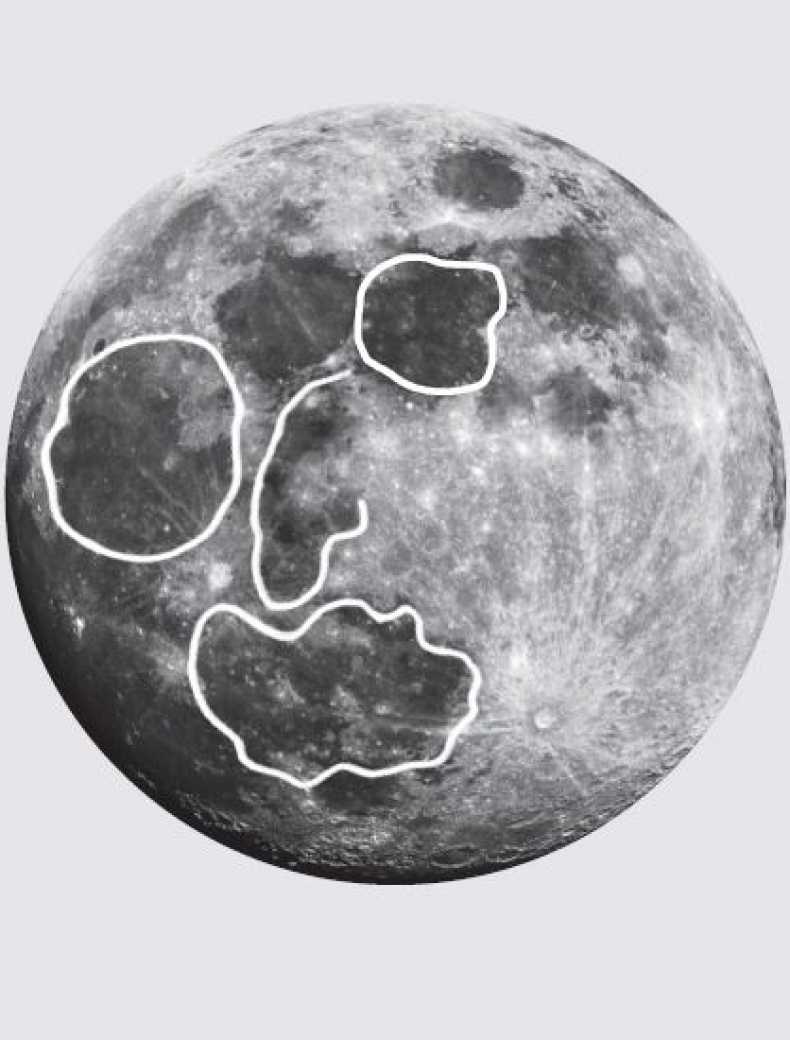
The Man in the Moon

The Anthropomorphic Universe

Who believes in the man in the moon?

man-in-moon-crop

For centuries, so called sophisticated societies have continued traditions, superstitions, folk tales and festivals inherited from rural ancestors. Much will certainly have been lost, as modern man’s connections with nature have been severed. But mothers still point out the face in the moon to their children who stand open mouthed at the mystery. Our companion animals are named and loved as if they were our children who never grow up; Peter Pan style.

Even the star map itself is full of the figures of gods and animals, a continuous tradition going back to the Ancient Egyptians and Sumeria.

Many cultures across time and the world have seen animal and human faces in rock formations and considered the effect significant.

rock as a face

Modern urban man likes to think that these are all in the realm of ‘myth’ – that is, stories that have no meaning any longer.

When I was in Japan with my Japanese girlfriend many years ago, she took me to her grandmother’s beautiful traditional home. In one room was a Shinto shrine. Megumi knelt before this shrine to pray and invited me to join her. I politely declined thinking myself a monotheist and forbidden to worship idols. But I now realise that Shinto is a religion of worship of nature and not idols. Each tree, rock, flower; is seen as a manifestation of living spirit just as we are manifestations of living spirit.

Shinto Shrine

In Pagan Britain before the Roman invasions, people lived by the cyclic laws of nature. Natural features, fauna and flora were also a living presence on the physical and spiritual planes. Such living things acquired names and often magical properties. To kill or take away was done with a blessing for the spirit which was being released.

Now that scientists have persuaded us from viewing the world as sentient, we are expected to consider industrial methods of rearing and killing animals and plants as a necessary evil. But if you want to know the truth, ask a cow in line to enter the red doors of the abortoir.

Such practices which many now view as abhorrent, are likely to become questioned more in the future because modern man is on the brink of extinction.

So brutally has the scientific materialism ethical view damaged the world and it’s creatures that ecosystems are being destroyed faster and in greater areas than ever before.

Already people in so called ‘civilised’ societies are realising that there is only one way to live with a rain forest and that is to live in it. The indigenous people of the Amazon basin have practised a closeness to nature that has retained the forest in it’s glory for many generations. This generation however is having to watch as loggers, farmers and prospectors rape the mother who has protected and fed them. Nature hits back by releasing viruses in the populations of city dwellers – but need it come to this? Perhaps mankind will come to realise that all nature is sentient, before it is too late.

Walt Disney hit on an idea to make cartoon stories using talking animals. As ludicrous as this may have seemed to his contemporaries, who were making films about humans, Walt Disney was digging into the gold mine of imagination.

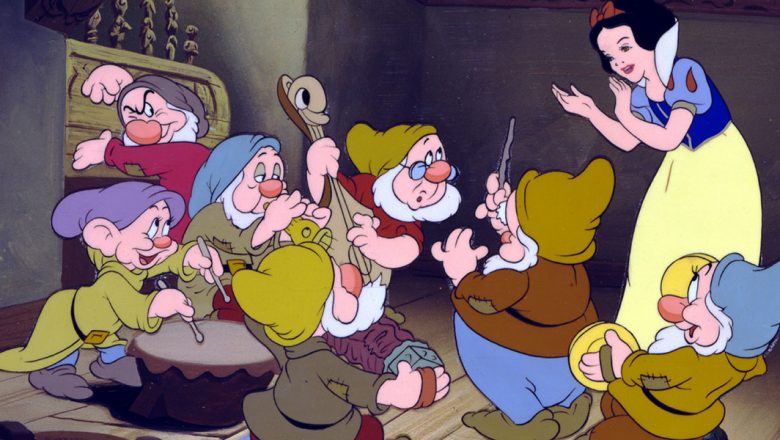
Despite or perhaps because of being ‘sophisticated’ children in particular needed to view the world in the old way of our rural ancestors. Stories in which animal and magical characters could speak and interact with each other like humans – gripped the imagination. Science may not like it, but humans are complex and deep in their needs and this foaming ocean of stories such as the Cinderella and Snow White and the Seven Dwarfs, are archetypal stories for thousands of years ago (Isis and Osiris if you are curious).

Snow white

Modern men, women and children naturally engage with nature. We have a deep physical and psychological need to be nourished by nature and allowed to bloom, as flowers do.

There is a young gecko in my bathroom whom I have seen a couple of times now. He looks at me and does not move and I look at him. Yesterday I named him, BR, which stands for ‘bathroom’. We have a relationship – of sorts.

Humour aside, this is the direction that humans in the 21st century must go if they wish to maintain their present numbers. They have to understand the sanctity of all life, whether it is in rocks, vegetation or animals.

Practises such as ‘whaling for scientific purposes’ should be and will be seen as relics of a shameful past when scientific materialism ruled the brain waves.

header-illegal-whaling

There have been extraordinary studies between humans and primates already, from which lessons are still to be understood. Chimpanzees have been taught to use tokens to buy food in one study. This is remarkable in itself until it was found that they also understood many more principles of economics, like ‘best price’.

I predict that in the next twenty years man will be speaking with marine mammals as fluently as Google Translate serves us today. These steps are more important than interplanetary exploration at the moment in my view, because they will lead modern man into an honourable way of relating with nature, as did our forefathers.

Once this is accomplished, the further step will be to communicate with sentient beings who are not of this planet. If the E.T’s observe that humans are not responsible enough to inhabit a planet without damaging it, they may introduce themselves first.

And if that thought fills you with dread, then you have been the victim of a misrepresentation of alien beings through propaganda. Be assured that they will not use violence to persuade. Such methods for them and perhaps one day for us – are history.


Lock Down

The following essay is an examination of how the theory of one area of social problem solving, is similar to and can inform another.

There are elements in common between those who look after our health and those who try to keep crime off the streets. These are the four strategic similarities;

Problems can be prevented

Problems can be analysed

Causes can be detected

Causes can be treated

Corona virus is not new. SARS and then MARS are two recent examples, but throughout history humans have been literally, plagued by them. Each time they come and go, there are lessons to learn. These will help preparation for the next.

This may involve warehousing hospital supplies for instance. The span of time between outbreaks will help to inform the ‘use by’ dates on perishable items. Typical examples would be testing kits, ventilators, hand sanitiser, personal protective equipment, software and even signage.

South Korea has performed particularly well in dealing with the current corona virus pandemic. It puts this down to four key strategies, which are the same as those above;

Prepare

Test

Trace

Isolate

Having the means to deal with the next outbreak at the very earliest opportunity is essential. Countries that have experienced denial of a problem by it’s leaders, or have lacked equipment or funding (e.g.. for research ) are going to lose more citizens than those countries which have prepared.

The old adage ‘a stitch in time saves nine (stitches)‘ is wisdom from the past that we ignore at our peril.

Any police chief trying to reduce crime will be familiar with the principles of crime prevention. Simple and best value strategies for dealing with say, burglary can save the tax payer vast quantities of money needed to put one burglar behind prison bars. Ten pounds spent on preventing burglaries, might save a one hundred thousand pound court case.

Over the last few decades police have moved from the universal production of posters such as the ‘lock it or lose it!’ campaign and ‘watch out there is a thief about!’ to targeted prevention and detection.

It is clear that sending a crime prevention message that may or may not be highly relevant to a community is wasteful. It also raises an unwarranted anxiety of being a victim of crime within low risk areas of the country.

Instead police started analysing their computers and finding patterns. They were interested in where, when and how a particular crime was occurring – long before they asked the question ‘who was doing it’. This built up intelligence which is invaluable to inform the prevention of crime. For instance, if thieves were breaking into cars in town centre car parks, the analysts identified which car parks were most targeted, which parking spaces were being targeted, what time of day and day of the week etc. This might identify an area in a car park where they was a good escape route and poor lighting, no CCTV coverage and little footfall. All of these could be rectified by car park managers on advice from the police. The public would pay nothing and the car park manager would see a rise in the use of the car park and revenue.

The South Koreans were also good at identifying where corona virus victims were. Instead of fighting what Donald Trump and Boris Johnson called ‘the invisible enemy’, the Koreans analysed information from personal smart phone locations cross referenced to recent entry and exit of foreign countries. With this information they were able to target their testing and identifying ‘hot spots’ where transmission of the virus was likely to happen and or happening. They even used police detectives to trace individuals and their movements.

Police call this ‘detection’. It is the natural follow on from the initial process of finding out as much as possible because the problem is hidden, not invisible.

By targeting resources in this way there are two benefits. The first is that it is cheaper. This may sound callous but in fact cost can be a huge inhibitor to action.

The second advantage of targeting action, is that businesses can carry on, if only in a limited way. One tactic for instance would be for elderly high risk victims to be placed in isolation while low risk younger people to maintain the economy and public services.

Prevention and Detection are really two parts of the same process of ‘reduction’ whether you are considering health or crime. They exist on a spectrum between the two extremes. At each end of the spectrum, detection contains some prevention and prevention contains some detection. As an example, the final result of the criminal justice process is to put an offender in prison. One of the possible outcomes of this is hoped to be preventing that individual ever doing the same thing again. They usually do, but sometimes it works.

picture credit: detroitjournalism.cog

lock down detroitjournalism

It has been suggested that the present pandemic has been dealt with in a manner in which the cure is worse than the disease. The ‘lock down’ approach to entire populations has ramifications that will lead to huge public debt and austerity.

The question has to be asked, ‘is lock down the only way to deal with the pandemic? The answer is no, because the South Koreans didn’t have to go that far.

Their strategy meant that they did not need to lock down their populations, eliminating in part at least, mental and physical health problems resulting from isolation and economic austerity in the future. Although it was clearly not ‘business as usual’ it was a working compromise between the needs of people to maintain health and an income and the need to eradicate the virus as quickly and with the least cost of money and life.

By targeting their treatments to areas of the population in most need, they have provided a model that the rest of the world would do well to study and copy. Lessons learned should already be being digested and fed into the strategy for Covid 20, which we can expect is already hanging in a cave somewhere in the world.

When the Covid 19 strain was first detected in China the world watched. As a top down organised country China had more tools at it’s disposal than democracy’s, but the principles are the same. What the rest of the world might have also taken seriously is asking the question, ‘are we next?’ Governments might have looked to the World Health Organisation for an answer. For many weeks the WHO did not declare a pandemic was happening. What world leaders needed to know was when it would happen i.e. be proactive not reactive.

In the United Kingdom the medical journal The Lancet included an article on how the outbreak in China will become a pandemic. This was in January 2020. In February the country had a chance to prepare. It did not. At the end of March personal protective equipment, ventilators and testing kits are still being ‘rolled out’ – as the government puts it. New cases are doubling every three to four days. The government of course denies being slow in preparing for the pandemic and points to the fifty new hospitals they have built. But hospitals are for the treatment of victims, not preventing people becoming victims. The resources are sent to the results of a pandemic not preventing one.

The vital point here is ‘timing’. There are three possible outcomes from deciding when to take action.

The first is that measures are put in place too early. Ministers in the UK expressed concern that fatigue sets into the population if protective measures are introduced too early. They wanted to time maximum protective measures with maximum victims. There was an assumption that the patience of people to avoid their death or of loved ones, is limited. It could be argued that as more fatalities occur the more concentrated minds become.

The second possibility is that exactly the right moment is chosen. This is ideal but is best judged in retrospect, ‘wise after the event’.

The third possibility is that measures are put in place too late. In this case there will be the highest number of human deaths and the most expenditure of money.

Of these, the first two are proactive and in my view produce the best results.

Reacting to problems is to undertake stitching nine stitches instead of one.

Getting the warnings right, is where you might expect the World Health Organisation is the expert. Viruses are not new and statisticians and virologists can get together and draw up predictive curves. They should be good at this even if each country is different.

The tragedy is that politicians are self selected for their political ideals and personal appeal. They may not have the abilities to assess a situation and give precise direction at the appropriate time. They may not listen to their advisors and or may just use the advice to avert personal responsibility.

These principles of proactive and reactive management and decision making are as true for dealing with crime as for health. They are so universal that they can even be applied to playing a game of football, which is why clubs employ statisticians to analyse games in minute detail, as they progress and after.

There is nothing in life for which we are not equipped. The only real challenge is overcoming our own shortcomings.

The Good Life

There is a remarkable pair of photographs on the BBC website today. They show satellite images of eastern China, Hong Kong and Japan. The images are filtered to show the intensity of air pollution. The January 2020 image shows ‘business as usual’ and the principal cities and urban conurbations are highly coloured from yellow to high risk, red. The February 2020 image shows no coloured areas at all! The air is clean because production in the factories has stopped. Ironic that such a gift to the populations, of sunshine and clean air occurs when millions are in quarantine.

The message we can draw is not how contagious viruses are – we know that. No, the message so plain to see is ‘slow down and stop!’

slow-down poster

The industrial tenets of, ‘more and faster’ for profit and a promise of prosperity for all, are also familiar to us. Humans deserve a good life so the growth of benefits from industrialisation, cannot be denied. Over one hundred and fifty years ago people started to leave the land and live in cities. This process means that now about half the populations of most countries live in cities.

In response industrial production is speeding up, as robots and AI are literally taking over from humans. The only question is; at what point is ‘a good life’ reached?

A casual observer in a modern metropolis, might perceive a collective sadness in the faces of passers by – anxious to reach their individual destinations. If asked if their life is a ‘good life’ – I wonder how they would reply?

picture credit: WithPause.com

Snail credit With Pause

When I was a student in London in the mid-70’s, I took part in a ‘slow walk’. A collection of willing volunteers met at the north end of Hammersmith Bridge and lined up across the wide pavement. We set of in a bunch like marathon runners, only it took us three or four hours to reach the south side of the bridge – a distance of maybe three hundred metres.

Slow walking took discipline at first, but soon became strangely normal. My mind felt completely relaxed. I might as well have been in meditation – in fact, I was.

picture credit: Londr.com

hare and tortoise credit Londnr

That was part of my ‘good life’ when I had time to be fast or slow and chose the latter. There are in the present day, many experiences of ‘slow living’ available as an alternative to the human ‘race’. There is slow food, slow travel, slow cities, slow schools, slow books, slow living and slow money. See www.slowmovement.com and tell your friends!

In 2020 humanity is crossing the threshold where too much – too fast – too wrong – is damaging the planet and as a consequence, ourselves. Whether it is air pollution, sea level rising, food shortages, water shortages – industrialisation is ‘biting back’ the hands that turn the handle.

Sloww-Slow-Living-Synonyms-Infographic

This latest virus Covid 19, is amongst other things, a firm message for humans to ‘slow down and stop!’ Perhaps those confined to a room for two weeks, will draw a positive from the experience. ‘Not doing’ can alter expectations significantly. If ones normal expectations are unrealistic then the distress that comes from failure to satisfy those expectations, will never be encountered. Success or shall we say, contentment, comes from watching a spider cross a floor or a raindrop slide down the window; experiences usually never observed and enjoyed.

We will inevitably all discover that less and slower is more!

Somewhere between the extremes of fast and slow, is where humans can find the ‘good life’ they seek. How close to ‘slow’ do you dare to go?