Defence?

It’s all violence

At some point in it’s evolution, humanity has to decide whether to accept violence or not.

At present, it appears we accept violence within certain rules. We say that if you did not initiate the violence, then you can be violent towards the aggressor, to any degree. This is called ‘self defence’ and few can think of an alternative. But why should defence be more morally right than attack? Can either be justified? What is the difference, morally?

Suppose you were a citizen of the United States of America and you own a gun and know how to use it. You are woken in the middle of the night by a noise downstairs. You arm yourself and go down to investigate. You see a dark figure and shoot. At this moment you believe you are acting in self defence, as is your right. You switch on the lights and to your horror you see the body of your teenage son lying on the floor. He was creeping back into the house after a secret night drinking with his friends. This is not fiction. This happens.

Just because the law enables a gun to be the solution to your ‘problem’, was this the only solution? Were there other more proportionate actions you could have taken? Yes, you could have switched on the light before you shot at a higher risk to your own life, or you could have called the police. You could have just done nothing. Each approach is problematic but only one invites heart break.

I lived in a country where only specialist police carry guns, England. Good peace keepers should be skilled at talking down a potentially violent situation. It’s a technique and can be learnt. Now many officers carry a Taser non-lethal gun as well as non-lethal CS gas. Non-lethal is a practical half way to non-violence.

Between attack and defence there are a thousand grey variations. The best option is always somewhere between total war and total defence; not either or. Ultimately they both are characteristics of the same thing; violence.

Fortunately most sovereign countries do not attack each other and a state of peace exists. But we know that peace is a fragile situation, where historical, economic and political rivalry bubbles away under the surface like a dormant volcano. Violence has to be contained for peace to exist and this is created using ‘deterrence’. Joining forces with another group of nations is one method of deterring attack. Not being a threat is another and here we realise that it is impossible to deter another nation without them being scared of you. Russia is presently in this conundrum with it’s relationship to NATO countries.

We watched as Russia reached a tipping point and claimed that Ukraine had a Fascist army. Historically, the communists (Soviet Union) and fascists (Nazi Germany) were enemies and this history still clearly carries some import as ‘justification’. By fighting ‘fascists’ Putin possibly feels he has his predecessors moral high ground on his shoulder. Coupled with a perceived threat from an expanding NATO and Ukraine moving towards joining the European Union; Putin is clever though and he does not use the word ‘war’ or ‘attack’. He insists he is acting in ‘self defence’ to NATO’s growing threat and his military action is just a ‘special operation’.

Words are master deceivers and suit Putin well. Because two words, ‘attack’ and ‘defence’ are the same thing; a resort to violence is claimed to be justified.

Zionist politicians in Israel have more or less done the same thing. They have an historical antagonism towards the people of Palestine whom they have been squeezed into smaller and smaller enclaves. Any similarity between this and the Warsaw Ghetto in the Second World War is of course, purely coincidental. The question is whether Palestinian or Isaraeli fighters are defending their country by attacking their neighbour. Defence quickly escalates into violent action that can get wildly out of control. The question of ‘proportionate’ use of violence (an eye for an eye) is the current debate.

So how can non-violence ever replace violence? The answer is it probably can’t whilst humans are attached to a materialistic and territorial lifestyle which they guard with weapons. In this respect humans are less sophisticated morally than most animals who rarely fight their own species to the death.

We learn to deal with violent conflict as children in the school playground. When we become adults we are expected to rise above violence as a solution to problems.

Two boys start fighting in the playground. A huddle of eager spectators quickly forms around them. These bystanders are too immature to try to pull the boys apart and instead encourage them. A stronger third party with moral responsibility for order is required; a teacher.

The teacher breaks up the mob and marches the two boys off to the headmasters office.

‘He started it!’ is a common defence from children. Their false logic is that when attacked there is no other response than a defensive counter attack. There is usually an option to run.

If we change the scale of our example, to that of governments and countries, you will find that ‘he started it!’ is also used as a justification for the use of violence by sovereign states. Only a third party intervention from a body with higher moral and political authority has the power to stop and settle wars. After the horrors of the second world war the League of Nations and subsequently United Nations was created to step into this role. The objective voice of world opinion should, in theory, make the warring parties ‘see sense’ and the more mature aim of seeking a peaceful resolution.

The United Nations and the United States of America, could go to the preesnt Israeli Zionist government and point out that killing innocent women and children in Gaza is morally unjustifiable. Putin could be hauled into the headteacher’s office by the United Nations, but has not.
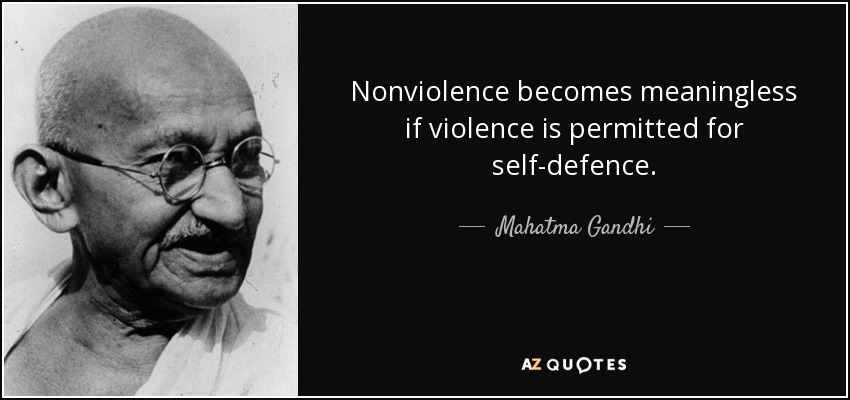
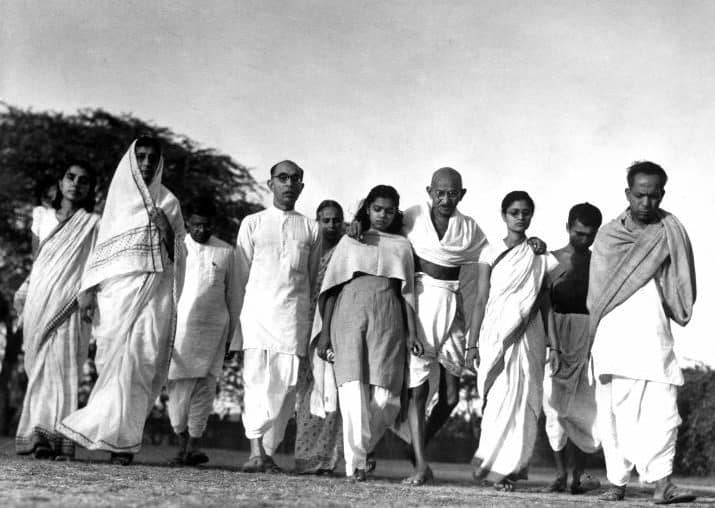
Mahatma Gandhi lead a nation using moral authority based on non-violence. He wanted the British to leave India and for Indian people to govern themselves. His tactics using moral discipline, diplomacy and example turned out to be more powerful than the military might of the British Raj.

War was described by Carl von Clausewitz as ‘ the extension of politics by other means.’ Personally, I would be more precise and describe war as the extension of politics by violent means. This creates the logical possibility that peace is the extension of politics by peaceful means.

Of course, peace is an abstract idea and never completely exists but there is a place close to total peace which might be reached using skilled, non-lethal force.

To use a personal example, when I was a boy at school, I never sought to fight. When I was inevitably confronted aggressively, I stepped forward, put my leg behind the thigh of the aggressor and pushed him to the ground. Yes, it was violent but it only hurt a bully’s pride.

This was the extension of politics by peaceful means, meaning no one was hurt. Later in life I came across Aikido. This an unusual martial art in that it enables winning a fight without confrontation. For this reason it requires no strength and is ideal for women and the elderly.
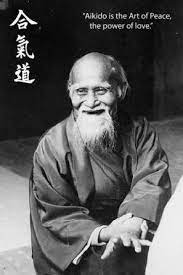
An interesting example was given me by one of the teachers. He was on an ice-rink when he felt a hand going into his pocket and pulling out his wallet. Instinctively he grabbed the wrist of the thief and continued the forward movement of the pickpocket’s body. The result was to send him rapidly across the ice rink. In Aikido, the art is to avoid conflict using simple non-aggressive moves that eventually tire out or restrain the opponent until help arrives or submission.

City dwellers would do well to learn the tactics of pickpockets even if they do not feel able to defend themselves physically. Usually they work in teams in crowded places and choose victims carefully. This is done by the ‘spotter’. Then the thief moves in using much the tactics of the illusionist in a theatre to distract and act deftly. Then a third party intervenes by preventing escape or creating another distraction.

Governments would do well to learn from these examples at a micro scale of conflict. Having a clear aim is vital to managing any violent unsolicited action. The method of conducting the conflict and ending it with minimum force and casualties for both attacker and defender and vital. Fast and deft military moves have time and time again proved their worth on battle fields.

When Napoleon wanted to teach the Zhar of Russia a lesson for breaking their pact of unity in 1812, he formed an army and headed for Moscow. Contrary to most other opponents Napoleon had fought, the Russians did not line up and wait to be shot or cut down by flanking cavalry. Instead they conducted an extraordinary retreat, burning everything in their wake. Only when Napoleon reached Moscow did they choose their moment to swiftly counter attack. Napoleon’s army fled in disarray and only 5% of the original army returned to France.

Sun Zhu in his famous book on military tactics said, ‘engage with the ordinary, win with the extraordinary’. A little side stepping and originality can nimbly avoid a cataclysmic confrontation like Ukraine v Russia. ‘Give some ground,’ is one solution.

Special forces, such as the British Commando’s came to the forefront of military tactics in the Second World War, where small teams of four men used guerilla tactics against an unprepared enemy. Casualties for the attacking side were minimal compared to strategic gain.

Ultimately the choice is not whether to attack or defend but to avoid unecessary violence by what ever means possible. There are always alternatives that require imagination and focused problem solving techniques in exactly the same way the animals avoid killing their own species. There is no ‘perfect’ state of non-aggression where humans in their present terratorial state of consciousness are concerned. Perhaps in the future, peace will break out and violence will never be the preferred problem solving option. In the words of , ‘what if there was a war and nobody came.’

“Ah! There is the rub.”

Solutions Without Answers

Give a fool a hammer and the problem is a nail

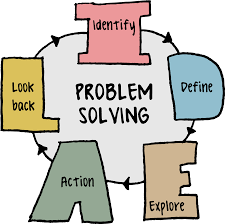
Surely, your leaders and politicians must excel in one thing above all others; problem solving. I suggest this because all aspects of life are eventually about solving problems. It does not matter if you are trying to look after a home or a country, the principles of good management using skilled problem solving, are the same.

Astoundingly, the study of ‘problem solving’ is not freely available. In the academic world it is assumed that the skills learnt in schools and places of higher education are transferable to the ‘real world’. Well in my experience, I can say that most of those skills are not transferable, which is a problem in itself. Theory and practice should be salt and pepper, but they are not.

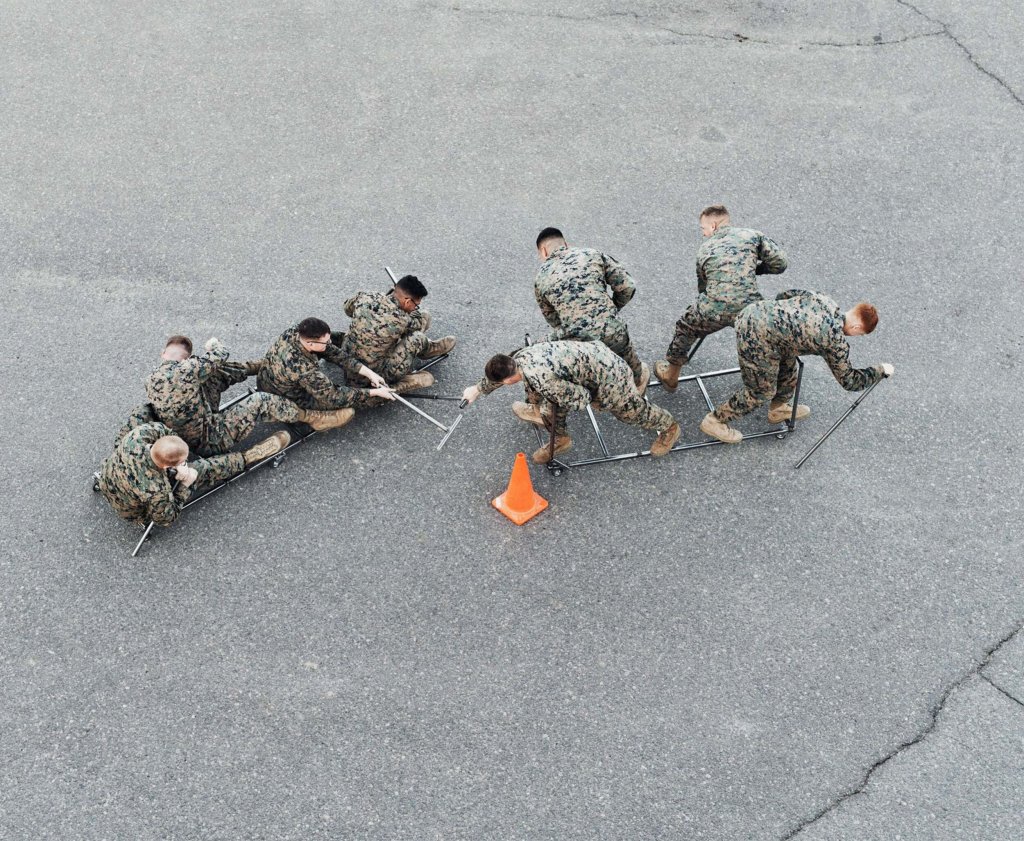
To solve a practical problem takes a special kind of thought process. Most importantly there must be a consistent intention aimed at a fruitful result. Technicians and those who learn practical ‘trades’ such as building walls with bricks or carpentry, become great problem solvers very quickly. If they make a mistake, it is plainly on view and has to be taken down and attempted again. Generally, the selection process for soldiers will involve problem solving. Recruits become part of a small team arranging logs and ropes and other props to overcome an obstacle. Real work in real time.

It is said rather cynically that ‘doctors bury their mistakes’; but it is true. It is unfortunately also true of many of today’s politicians and leaders who are entrusted with the welfare of the State and it’s citizens. If they make a wrong policy decision or invent a plan for some new project or public works that goes wrong, the failure is forgotten. Money is wasted on projects that any ordinary person would say is a waste of time and money (just read my earlier blogs on the UK High Speed train project predicting failure). Why, you might ask, does India have a Space Programme when there are thousands of villages in India without proper sanitation? I am only using India as an example. Avoiding and/or mismanagement of real and urgent problems happens in every country run by politicians with their own agendas, not the people’s

If a race of intelligent beings came down from the Planet Problemsolving, they would certainly be appalled at the ignorance of humans in a skill the PP inhabitants are taught from birth.

If humans cannot learn from present times, we can learn from history. In the Biblical era, when Herod heard there was a child to be born who would one day be King, his solution was simple and brutal. To kill all male babes under the age of two years. The solution to his problem was immoral, self centred, and ineffective. Have we improved?

Giovani: The Slaughter of the Innocents

Today, the State of Israel is being led by a person with Herod like, problem solving hypothesis. Because there are fighters who are against the State of Israel (as a consequence of decades of ill treatment towards Palestinians) Israel is using genocide to prevent further problems, just like Herod. And just as Herod assumed a massacre would get every child, so it is assumed that the Israeli government actions will eliminate every fighter who is against the Israeli State. But history tells us that using starvation, disease, killing and maiming, stopping fuel supplies in winter and stopping safe escape routes, will be condemned by world organisations like the United Nations. South Africa has emerged from apartheid in the last century and has been the loudest voice of condemnation. They have learnt from their history.

Hitler is perhaps one of the greatest despots in modern times, who used similar problem solving techniques indiscriminately. He constructed concentration camps with impregnable exterior defences, then filled them with people of direct and indirect Jewish blood. We know the rest. Indeed, the people who know this best are living in the State of Israel today.

Let us examine a less emotionally charged problem being played out over the English Channel at the moment. The problem always requires a definition and for voters in the 2016 referendum it was identified as ‘immigration’. The ‘Vote Leave’ champagne and UKIP party championed the idea that ‘immigrants are a problem to the country’, in the run up to the referendum. Whilst most economists would disagree with this concept ( the USA is a prime historical example of immigration creating prosperity ) the problem was described in emotional terms. We know that rational debate stops when emotions are stirred, if we have lived life at all! Emotional beliefs do not use constructive thinking patterns based on analysis of facts and figures. ‘Solutions’ were expressed as three word slogans such as ‘Take Back Control’, ‘Brexit means Brexit’ ‘Get Brexit Done’.

Broadcaster James O’Brien on LBC said: “I’m looking for a chronology of the meaningless slogans Brexiters used to give people an excuse not to actually look at any detail, evidence or do any thinking.”

As the supposed ‘problem’ of immigration, moved from fringe to mainstream politics, the ‘final solution’ became leaving the European Union. The principle of ‘understanding the problem’ by using statistics for instance, was ignored since only one third of UK immigrants actually came from the European Union. Many of those who did were short term immigrants, such as students and migrant workers. As the fish and chip shop owner said to me on the day of the Brexit vote in June 2016, ‘Who is going to pick my potato’s?’

But the emotions of hatred and fear were exploited using false facts by those in power (just as did the leaders of Nazi Germany) and the UK left the European Union in 2020. Since then, the ‘problem’ of immigrants has not gone away. For no obvious reason the ‘problem’ has be re-defined to be the three per cent of immigrants who enter the country without proper documentation.

Under international law these fall into three basic camps; asylum seekers escaping persecution, economic migrants and the criminal underworld. These categories however require time consuming investigation on a case by case basis.

You Can Use Old Slogans

Far simpler for the government to stir public emotions using a three word slogan which is ‘stop the boats’. Chillingly, the ‘solution’ is steered away from creating safe routes and tackling criminal gangs to being one of ‘deterrent’ or fear. By ‘fear of being sent to Rwanda’ the UK government intends to stop people from risking their lives crossing the English Channel.

The horror of this solution and all ‘final solutions’ is not characteristic of any country that wishes to hold it’s head high in the European Courts of Human Rights and the United Nations. Similarly, the government of Israel is prepared to ignore the Article 2 of the Genocide Convention. The false logic of ‘the end justifies the means’ convinces only the emotions.

The complexity of statistical analysis and testing and proof finding and ethics and morality and compassion and common sense and lessons learnt from history and comparing alternatives and cost benefit analysis, should be the bread and butter for problem solving by those who lead nations.

But complexity is ignored because it does not invite the answer, ‘yes’ or ‘no’. These two words are fundamental to what is the basis of the referendum method of problem solving.

  • Shall I kill all the male children under two years of age? Yes or no?
  • Shall I get rid of the Jews? Yes or no?
  • Shall I destroy Palestine and it’s people as a method to destroy their militant leaders? Yes or no?
  • Shall we leave the European Union? Yes or no?
  • Shall we ‘stop the boats’ by making it illegal to do so? Yes or no?

Each time the question assumes a problem with which the man on the proverbial omnibus, may not agree is a reasonable question to be asked. The question is too simple to answer for the complex mind, but easy for the simple mind.

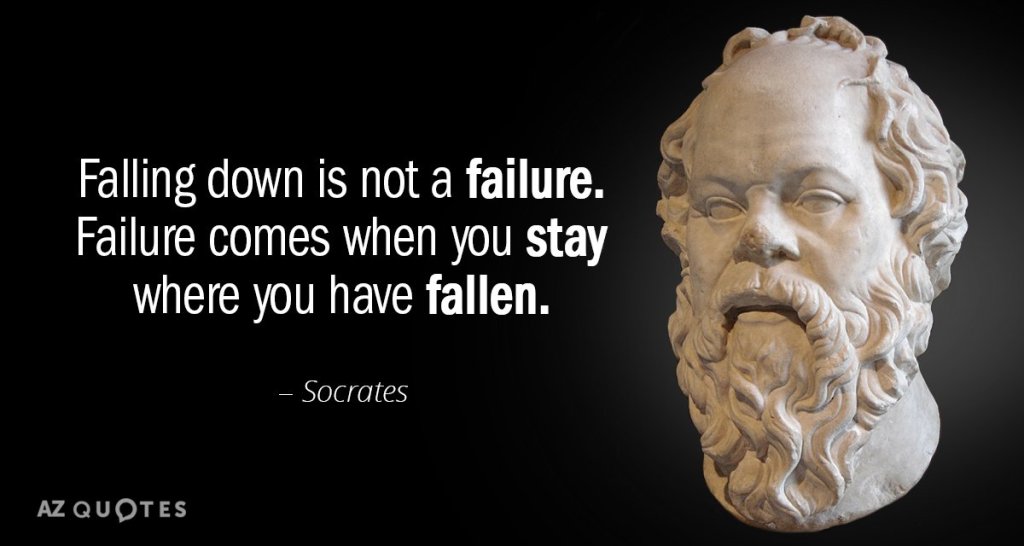
The so called ‘wisdom of the crowd’ is not something that history proves. Wisdom is unfortunately a rare commodity – whether two thousand years ago or the present day. We only have to listen to Socrates (470-399 BC) opinion about the ‘common man’…

Back to the Present

The present is the greatest gift

I visited my mechanic at his garage a few weeks ago and was surprised to find the place deserted. But an impressive Delorean sports car sat there with it’s rear engine exposed as if ready for ‘take off’. After a few moments of wonder, the garage owner appeared wiping his hands on a rag. ‘Oh!’ I said, ‘I thought you had gone back to the future!’

He didn’t laugh and had probably heard the joke all morning but it made me think on the film ‘Back to the Future’. What a nonsense premise for a story I always think. Odd that in a society that considers itself rational and scientific, writers are fascinated by illogical impossibilities and their absurd consequences. Such non-real accounts are of course, fiction, and humans have an ability that is often taken for granted; to live in factual and fictional worlds simultaneously.

Films like this such as Disney’s ‘Alice Through the Looking Glass’ introduce concepts of non-linear time that I do not believe children are likely to understand or benefit from. Contrary to Lewis Carroll’s original concept, a character known as ‘Time’ played by Johnny Depp, is central to the story as Alice time travels to change the past.

‘You cannot change the past!’ screams Alice at one point in the film.

The same insight applies to the future…a simple fact that children would do well to be taught at an early age. But of course, science fiction knows no end to the concept of jumping forwards and backwards along the illusion of linear time.

The Time Machine’, directed by George Pal, 1960. (Photo by Hulton Archive/Getty Images)

Whilst Western fiction writers are sending their characters off ‘through time’ in absurd contraptions, philosophers and some indigenous tribes like the Dogon, describe a ‘non-linear time’ model in which all pasts, presents and futures exist together.

Just as one needs a map to know a destination, a time traveller needs to know the where and when of a proposed journey. There are many oracle card designers and readers in Western societies today; overtaking the famous ‘Tarot’. An ‘oracle reader’ will use cards to predict ‘the future’ but preface the prediction with ‘this is only one of many futures.’

It would be good for us all, in my view, if we admit that the fourth dimension which we call ‘time’ is a mysterious, filtered perception and, in my view, better left so.

What then? Well, this leaves us with ‘the present’ and we should not feel the lesser for it. Perhaps we should pause and seriously contemplate how much we live in the present and how much in selected memories of past and an imaginary future.

I have noticed how older people, enjoying the last flourish of their lives, tend to talk too much about things that they have done in the past. Sometimes these stories contain humour or valuable life lessons but mostly they are experiences intended to impress rather than amuse or inform.

This phenomena is not only applicable to personal history, but also scholars of global history, politics, religions and any subject that has come and gone.

We tend to understand now, that history is ‘written by the victors’. Writers filter facts in order to record a biased account for intentional or unintentional reasons. Politicians of all colours, do the same. We tend to put previous leaders on pedestals and forget their misjudgements and misdeeds. For example Winston Randolph Churchill was a man whose military mistakes are overlooked for his finer qualities of oratory and leadership. Nelson R. Mandela was an ANC terrorist imprisoned for his acts and yet later was awarded the Nobel peace prize for laying down the foundations of equality of the races and democracy in South Africa. Mother Teresa valued ‘poverty’ so much she rarely distributed the money she was given to the poor. Are these people really good role models for future generations?

The further back into the past one investigates, the more imagination and conjecture colours and shades reality. Religions have a hard time presenting a solid case around revered or ‘holy’ prophets and saints for the same reasons. The main difference compared to politics, in my view, is that for religions, ‘faith’ can be used to excuse the unprovable.

Religious scriptures that do not change endure, because they can be trusted. The dynasties of ancient Egypt could be argued to have remained powerful through thousands of years for this very reason. An nnovatory pharaoh, such as Akhenaten, was overruled by the priests on his death and past traditions restored.

Today academics study the past, apparently for it’s own sake. A cabinet full of Stone Age flints, for instance, is meaningless to the ordinary person. In contrast, the causes and consequences of war might be considered worthy of study and learning lessons, but this rarely happens. For this we pay a price and wars continue to this day.

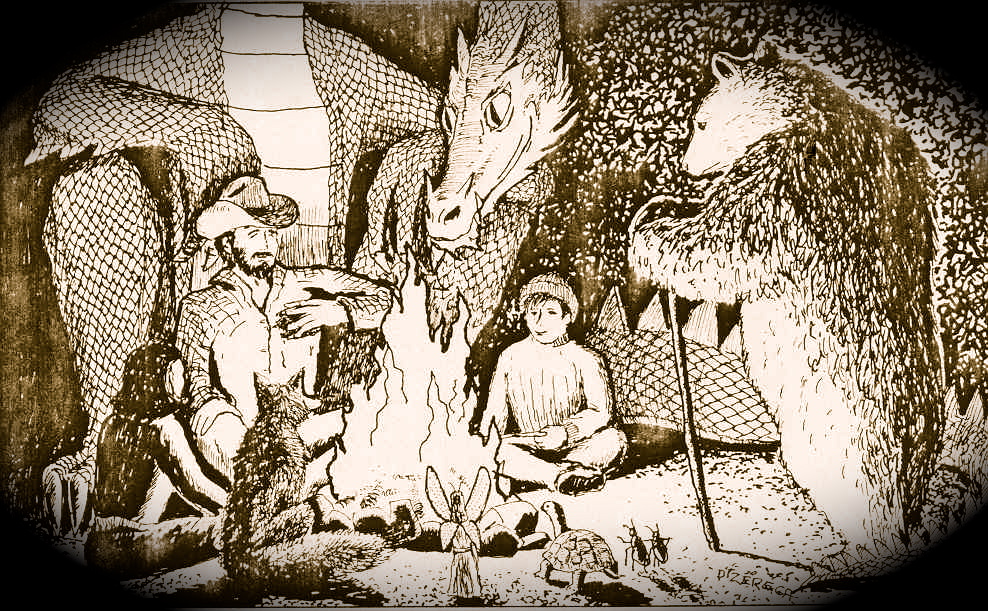
The tales of olden times, told around the camp fire by our ancestors, sustained knowledge and wisdom, whereas today there is little such continuity and consensus for our children.

Past and future are fraught with conjecture, imagination, bias, incomplete facts and false reasoning. I suggest that the value of both the past and future as treated in the West today, is at best limited and at worst, misleading.

Which leaves us with the present. The ancient Greeks had a word for the quality of the present moment which is ‘kairos’. It describes the true value of every moment. When they measured time with solar shadows or lunar observations for purely practical reasons, they called it ‘chronos’. The two were distinct and even turn up in the Holy Bible in Acts 13:18 and 27:9 .

In the East, ancient thinkers have encapsulated the same idea; such as in Zen Buddhism and Taoism. In Zen, the meditator is kept in the moment by being struck with a stick by the teacher, should a student’s mind be observed to be wandering.

But perhaps it is a surprise to find the same understanding also described in the Holy Bible. Ephesians 5, 15-17, James 4 and Psalm 118 all refer to and imply an awareness of the quality of the ‘God filled’ moment. What the ancient Greeks called ‘chronos’ is time as a measured ‘tick’ of time, however this might be done. This, apart from being helpful when arranging appointments, is a double edged concept that creates the stress of having to avoid ‘lateness’ and ‘sloth’ and ‘waste’.

‘What a complete waste of time!’, we say and yet how is this ever possible?

In contrast, the kairos moments embrace all our thoughts and actions and give grace for inspiration to enter a persons soul. Those who only measure time experience the frustration which we call ‘impatience’.

In Western Judaeo-Christian history, there has always been an understanding of not only the right moment to perform an action but a right season. For instance, there are times in the Jewish Astrological calendar that is it wise to start a new enterprise. This is the month of March or Aries in astrology. If one is wishing to start a new business, for instance, then the unique qualities of this part of the solar year, add benefit to the enterprise and make it more likely to succeed.

The contrast between chronos and kairos concepts of time bear a parallel resemblance to a ‘five senses’ life and an ‘inner senses’ life respectively. The majority of the population are primarily engaged in the former; particularly the agnostics who believe that when the watch winds down, it is dead. Non such ‘clockwork minds’ are able to give less importance to the five senses and develop awareness of ‘Mind’. Mind is what is happening within ones body / mind unity, as a microcosm of everything in the Universe.

This ‘universal’ way of life, is one of the many graces obtainable through being sensible of the subtle, ‘unmeasured’, qualities of our soul and being present in it.

The Era of Terror

In 2001 on September 11th there was an attack on the World Trade Centre in the city of New York and simultaneously other locations critical to national security. Many United States of America citizens felt threatened in their own country for the first time; horror was not happening somewhere else. President George W. Bush famously declared a ‘war on *error’ and many sympathetic and perhaps frightened nations, rallied to the clarion call.

The problem was, what is a *errorist? Is it an individual, a group, an army, a State or just a cause?

A definition of *errorism is;

‘The unlawful use of violence and intimidation, especially against civilians, in the pursuit of political aims.’

This definition creates an ambiguity as it so broad, it includes conventional warfare between countries. But perhaps all ‘war’ is a form of *errorism? At the other extreme, one person acting alone can be a *errorist. Attacks by one or many are high risk missions usually against a considerably superior force.

*errorism is mostly a means of engendering fear in a population for political aims and in my view is a tactic distinct from total war.

I list below five examples historical examples of *errorist conflicts. The question I am asking myself is ‘how could these have been better dealt with?’. The conclusion I reach is not what you might expect, given the cost that individuals and nations pay in efforts to ‘eliminate’ the *errorist/s.

  1. In Rwanda there was a mass murder carried out by one tribe against another. Even next door neighbours became enemies overnight and were dealt with brutally.
  2. The Irish Republican Army emerged from Southern Ireland against Northern Ireland using terror tactics. After three decades of getting nowhere with violence the IRA joined the government under the name of their political wing; Shin Feinn and a peace treaty ‘The Good Friday Agreement’ signed.
  3. A Coalition of Nations invaded Afghanistan on 7th October 2001. After a couple of decades they departed unceremoniously, leaving the Taliban extremists to form a government.
  4. The Green Peace ship ‘Rainbow Warrior’ was sunk by two agents of the French government in New Zealand’s Auckland Harbour as it threatened French projects in the region. The agents were sent to jail and Rainbow Warrior II was launched.
  5. The Archduke Ferdinand was assassinated by a Serbian in an act of terror that started the First World War, due to a complex system of Treaties within Europe.

In these examples it can be seen that the *errorist is unlikely to achieve their aim by the use of violence, whilst civilian populations suffer most. Governments also fail to ‘come out on top’ during protracted campaigns against politically motivated *errorists. If the head of the mole is hit, another one pops up.
The challenge, in my view, is one of problem solving: a subject assumed to exist where it often does not. Yes, if your country is attacked you use force to repel the attack, but when the enemy disappears as the smoke rises from the scene of carnage, who are your armies expected to fight? The best they can do is ‘patrol’ and in the process be picked off by an unseen enemy. So what would a ‘problem solver’ do?

If I can use the metaphor of the problem of driving a nail into a piece of wood, we may view it from a different perspective; a tried and tested problem solving technique.

(1) There are those who would argue that a hammer is too brutal and something soft, such as a banana should be used. The United Nations Peace Keeping Force during the Rwandan genocide in 1963/4 are an example of this. Because of strategic priorities and orders ‘not to fire unless in self defence’ they were powerless to stop the atrocities Hutu’s atrocities against the Tutsi.

(2) After decades of effort with little success, the person hitting the nail gets tired. The British Army during the decades of the Northern Ireland ‘troubles’ failed to achieve their aim of keeping the United Kingdom safe from *errorism. The two sides finally came together and shook hands as both finally realised the futility of violence.

(3) In Afghanistan the original nail turned into one of a multitude. As fast as nails can be driven in, others appear unexpectedly. Both the Russian invaders and the Coalition Armies failed to fight effectively against the guerrilla tactics of the Mujahidin and Taliban respectively. The Coalition was beaten militarily and politically, as was the USA in Vietnam.

(4) The nail fails to be driven in one stroke. The *errorists are detained, tried, put in prison but released before their sentences expired. The sinking of the Green Peace ship is an example of this. The building of a new ship to replace the old is an example of the futitily of violence.

(5) Sometimes the hammer produces an unintended spark which sets fire to the whole workshop. The assassination of the Arch Duke Ferdinand igniting the first World War is an example of this.

How our metaphorical nail got there in the first place and whether a skilled carpenter would have more success, or removing the wood from the nail, or not using a hammer, are just a few of the options unlikely to be considered.

What today is termed ‘soft politics’ must be a viable option to the ‘alpha male locking of horns’ approach of the past. Certainly there are lessons from the past which have repeatedly failed to be learnt.

In present times, matters which you might consider to be of the most extreme importance to individuals and nations are put in the hands of politicians and bureaucrats. If there are wise advisers in government or opposition or in the civilian population, they might be ignored or suppressed (prison) or ‘eliminated’ (deportation or execution). This process compounds the dissent in civilian populations.

In the 21st century one would hope that solving problems by direct confrontation is no longer an option. Wars are expensive and if for no other reason than this, governments need to face up to those who commit *errorist acts against them with the answer to a simple question; where did this come from? In my view, unpicking the answer is the beginning of a solution.

It’s Not a Phobia

Regular readers will know that I am interested in words and language and how sometimes a shortage of words limits the boundaries of thought.

My case is that there is no excuse for a shortage of words, in any language, as they are easy to make up.

The study of lexical semantics is concerned with this issue. It includes and in a manner requires the creation of new words in language through ‘common use’ rather than academic or inspired thought by an individual. Languages not only define themselves but give birth!

Perhaps the process of the movement of a word into common usage is a product of both conception by an individual and adoption by society because society has a use for it.

So here is my attempt as an individual, at introducing a new word into the English speaking world. My intent is that common understanding and adoption of it’s the word would correct a ‘vagueness’ and introduce a ‘precision’ in thought.

The word I propose to challenge, correct and replace is ‘Islamaphobia’.

This is why. A ‘phobia’ is generally understood as an extreme and irrational fear of something. In common use phobias relate to fear of spiders, rats and more abstract concepts like enclosed spaces.

I question here whether a phobia regarding a religion, and those who are members of that religion, really induce an ‘extreme and irrational fear’ in others. I mean, really?

Are there those who are extremely and irrationally fearful of Christianity? Are there those who are fearful a religion that has love as its founding ideal? People might have been fearful of it’s armies such as in the Crusades, but those armies were never the product of the ethics of the teachings of the Prophet Jesus of Nazareth.

So should modern societies be ‘extremely and irrationally fearful’ of the ethics of the teachings of the Prophet Muhammed?

I would argue no. Societies in the West are aware of being irrationally fearful when it manifests as a prejudice and this is more closely what is expressed in the word ‘Islamaphobia’. But is this prejudice rightly placed in the list of spiders, rats and enclosed spaces?

Perhaps a new word is needed to describe this prejudice against people of this faith.

There is one in common use for the prejudice against members of the Hebrew Faith and this is of course, anti-Semitism. It is not Semitic-phobia because there is no such word. It’s a bit weak.

So the word I suggest is used to describe prejudice against people of the Islamic faith is;

anti-Islamic‘. I have saved it to my ‘Word document’ dictionary, as it is not there.

Perhaps one day, it will be.

Rabbits in Headlights

Understanding decision making

We live at a time when volcanoes of information are filling the sky with an uncertain grey dust and obscuring our horizons.

The internet may have enabled ‘nation to speak unto nation’ but instead of bringing understanding and concordance, the effect appears to be the opposite. People with little knowledge consider themselves expert.

I am often confused when at the end of a presentation the speaker asks the virtual or real audience, what they think. ‘Put your thoughts in the comments below’. Really? Who is the expert here? The speaker or the listener?

So how do we make decisions? What is real and true? What is fake?

With this ‘information age’ came a whole generation of young people who were given high expectations in life. ‘You too could one day be Prime Minister’. Statistically true but probably as likely as falling off a cliff.

Being an ‘expert’ has become raised in esteem at the same time as reducing it’s social value. Numerous professions are being disgraced by the media, such as the police, social workers, school teachers, health workers on the evidence of shocking but isolated incidents. It’s a compelling use of emotional persuasion rather that logical reasoning. Those who struggled to reach beyond a life of manual work, are being rewarded with low wages and flagging public confidence.

How has this happened? How do we decide things, really? Are our opinions being made for us?

There is a book that appeared in a permissive 1971 called ‘The Dice Man’ by George Cockcroft which I thoroughly recommend to adventurous readers. The theme of the book is a psychiatrist who starts to make every personal decision with a die. It’s as simple as that. The ‘moral’ values of this character’s life are eliminated and his behaviour become socially ‘exploratory’.

What the theme of the book shows us is that we make decisions and yet those decisions might as well be random for all the understanding we have about how they came about. One might also question where one is going in life.

To get to the rub here; humans decide using their heads, their hearts, their intuition or just randomly; including omission. Most of the time it’s a combination of all of these in unequal proportion of strength of influence.

If that sounds complicated, it is. And when two humans decide something together it gets a whole load more complicated. When a man meets a woman in a bar and they are both looking for a life long partner and wondering if ‘this is it?’, there is a lot of thinking, feeling, intuition and ‘do I feel lucky?’.

When a married couple are shown a house by an estate agent (or realtor), usually the husband is measuring the garage while the wife is in tears over the beautiful kitchen and views of the garden. Or they may both see nothing about the house that they like. Perhaps the agents description pressed the wrong buttons and they thought they were going to look at something else.

What about political decisions? If you live in a democracy you get a vote, now and again. How do you decide? Those whose tendency is to use their mind to make decisions, may read a party manifesto or listen to the speeches of candidates to form a decision based on information.

The problem with this is that the information is almost always biased. Candidates may have only selected facts that support their policies. This may unknowingly contain information that was generated by a hostile state and fed into the minds of politicians and voters alike. Then the bias is from randomly elsewhere and yet intelligent people base their decisions on it.

People are constantly mislead even by their own governments in the same way. For instance, a government might present as fact something that is not true. This has become prevalent in much of modern politics whether in the USA or the UK. The disgraced ex-prime minister Boris Johnson was known as a compulsive fibber even in his school reports and is still present in his ‘I don’t care’ decision making.

To give another example of biased decision making, only those scientists were quoted during the Sars 2 – Covid 19 pandemic whose ideas supported the policies of governments. For instance, if they were specialists in virology and immunology who thought untested RNA vaccines were the best solution to the problem of hospitals becoming overwhelmed, then they were selected to advise ministers and front with the public in interviews.

The decision making process before during and after the pandemic highlights the many strands to justifying decisions that affected people’s lives and livelihoods. The poor decisions displayed little understanding of how decisions should be made. Perhaps the problem was never hospital capacity but keeping people fit to continue to go to work and for children to study; all by using socially reassuring and cost benefited methods.

Much of the justification of actions by governments during the pandemic was accepted by the general public because persuasion was targetted at the emotions rather than the mind and good old ‘common sense’. Instead the emotion targetted at populations was fear. If governments can persuade their populations that they have to do x,y and z otherwise they will die or cause the deaths of others, then they gain a dominating position.

Proffesor Mark Woolhouse wrote in The Guardian newspaper

At a No 10 briefing in March 2020, cabinet minister Michael Gove warned the virus did not discriminate. “Everyone is at risk,” he announced.

And nothing could be further from the truth, argues Professor Woolhouse, an expert on infectious diseases at Edinburgh University. “I am afraid Gove’s statement was simply not true,” he says. “In fact, this is a very discriminatory virus. Some people are much more at risk from it than others. People over 75 are an astonishing 10,000 times more at risk than those who are under 15.”

The argument ‘get vaccinated or you will be passing a fatal illness on to others’ has also since been proved to be factually incorrect! The drug companies had thought about this but only conducted research using eight (or was it ten) rabbits. As to harms associated with the vaccine, these were strongly denied and anyone suggesting they may cause myocardial disease was discounted as a ‘conspiracy theorist’. This expression has evolved into an emotional criticism rather than showing a basic understanding of the difference between a ‘theory’ and a fact.

Again there has since been found a high percentage of excess deaths in those vaccinated, either causal or temporally correlated; a situation that has not been publicised, explained or apologised for by either drug companies or governments.

The whole ‘pandemic’ situation can be seen with hindsight by the rational mind as a ‘storm in a tea cup’ stirred up initially by a despotic government to whom few other nations openly respect in most other matters, namely the China’s Communist Party.

Pandemic Politics picture credit: The Economist

Was ‘lock down’ ever a better alternative to ‘go to bed’? How did ‘lock down’ ever become acceptable to freedom loving democracies?

Emotionally, many were traumatised by events when they really didn’t need to be, especially by constant fear inducing reporting by the media. The only solution offered to the fear of death, was to be vaccinated.

There were some who didn’t understand the science and didn’t feel the fear but made a decision about whether to be vaccinated based on intuition. These are the people with who are hardest for governments to deal with. Novak Djokovich knew his own mind on the subject of vaccinations and spent time in detention in Australia for his principles.

In summary, most life decisions are far more complex than we have to tools to make. Victorian education was based on fear induced fact learning. Today unrealistically optimistic self belief is taught in schools. Perhaps in the future children and young people will be taught how to gain a rigorous understanding of their psychological, emotional, intuitive and ‘I just feel lucky’ characteristics. Ultimately, understanding oneself with any clarity takes a lifetime to achieve, if at all. Trial and error decision making is really not a good tool for life in my opinion but it happens to an alarmingly high degree not least in those who lead us.

Governments and citizens have become like rabbits caught in the headlights of change. They look left and right for a safe direction to run but like unfortunate lapins, our future depends on making swift, informed, ethical, unbiased, emotionally intelligent, compassionate and inspired decisions for ourselves, our loved ones and those who come after us.

You have one sixteenth of a second to decide. Your time starts now.

Repeat Repeat

A Bomber crew are flying across a desert. Suddenly, all four engines cut out. They have miscalculated their fuel. The pilot sees a small dot of green below and glides the plane down to crash close by. The navigator lays the pilot down in the shade of a palm tree for the pilot has broken his leg. They discuss what to do and the navigator says he will explore at dusk on a bearing of 90 degrees. He does so and comes back in the morning reporting not having found anything. The next night he does the same with the same result. The pilot asks him why he set off in the same direction as the night before. The navigator replies that he wanted to be sure where he was going, by following his footprints.

That’s how many people get around, even those who can loose of their habits but do not. We learn a route and just keep going the same way. Probably the majority of the human population know how to get to only a limited number places, lierally and metaphorically, limiting their life experience.

In defence of this ‘keeping to a well known track’, humans live complex lives and repetition is a coping mechanism. We know that animals act in exactly the same way, scurrying through undergrowth on well worn paths and so doing become meat for hunters.

As humans should we not be more adventurous than animals? Even in our ‘modern’ city lives our culture encourages ‘everyday’ repitition. Many people listen to their favourite music tracks using the ‘repeat’ button the listen over and over again. Some book their holidays the day they return to go back to the same hotel a year later.

Like everything, exploring the unusual starts in our imagination. As creators we can imagine a thing and make it happen. That is very powerful but when a person lacks the ability to ‘think big’ or ‘out of the box’, then how can they progress through life? When you listen to conversation it is common to hear figures of speech such as ‘so’ (to start a sentence with a conjunction!), ‘to be honest’ or ‘in terms of’ repeated endlessly. They lack the ability to string together a line of words imaginatively without using meaningless words and phrases endlessly. Perhaps they are thinking faster than they speak and have never applied themselves to slow down. Perhaps their habitual words have become unconscious and if you challenged them you would only convince them they say ‘you know’ constantly by recording and playing back their conversations.

There is a verbal game show on BBC Radio 4 in which contestants have to speak for a minute without repetition, deviation or hesitation. It is not as easy as it sounds.

Sadly, much conversation involves listening to others giving accounts of situations in which they found themselves in the past. A simple trigger word such as ‘electricity’ will start them off on a story of how their house had no electricity for three days and they ran out of candles and matches they read books by more candles they found under the kitchen sink. If they have a partner, that person will be rolling their eyes because they have heard this story ad infinitum.

Repetition is boring. I said, repetition is boring.

Subtlety though, even something new, can quickly become a mere copy / repeat. The world of fashion for instance, challenges designers to think of some new design that has never been done before even if it is something as mundane as a new fabric design or hue.

‘Everybody, this year, is wearing blue!’

The designs hit the factories which start to make thousands of identical garments. At the office party the bosses wife discovers she is wearing exactly the same dress as his secretary. The secretary should have gone for the pink dress but had been made to feel it was ‘unfashionable’ by those who are paid to ‘set the trends’.

Japanese Soccer Fans pitcture credit: BBC

Happy souls who support a football team will do so with a level of loyalty that has them acting in greater unison than a school of fish; wearing the same football shirt, sitting in the same seat, eating the same hamburgers, singing the same songs.

Originality knows how to run for the hills, if we let it.

Religions are perhaps the strictest social organiser. They demand complete obedience to certain set norms in dress, behaviour and ritual; down to the greatest detail. Repetition of phrases, verses and even complete Holy books illustrates how humans can reduce their super computer brains to being mere SD cards, when prompted.

So what can be done to release humanity from reptition? How do we make the navigator in our heads walk on a bearing of 91 degrees and then 92 degrees each night; until a village is found at 112 degrees?

Sometimes it takes no more than just a mere tweek, to add variety to life. Those who commute to work probably follow the same route each day for years. Yet, there will always be other routes available even if they may take a minute or so longer. There may be alternative means of travel such as walking or riding a bicycle, performing cart wheels or sliding on ice. ‘Walking buses’ for groups of children is an excellent example of how simple changes can invigorate human activity.

Artists have always been beacons of innovative method and expression. Every author sits down and writes a book that no one has read before. It may follow perennial themes of love and war, but the story and characters will be entirely original. The more boundaries of literary norms that are broken the greater the appreciation of the book. James Joyce’s Ulysses is an example of stunningly novel literary…novel.

In every human activity success comes when imagination and the ability to explore the imagination, fuse into the entirely original. This is true for science as well as art, politics, engineering, design, exploration and all things humans reach out to in order to excel.

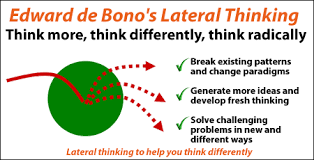
Learning how to think is a subject which is not taught in schools. This must surely be a folly partly produced by those who think repetitively. It is assumed that children already know how to think in the same way they acquire language; by repetition. This is true, of but of course the thinking skills involved in early learning are at risk of being mere copies of adults mechanical patterns of thinking. Psychologists like Edward de Bono created thinking tools that enabled the ability to think into infinity, or at least where no metaphorical human had thought before. Managers in commerce and industry sent their staff to learn his techniques and used them to gain commercial advantage.

If you asked the man or woman in the street to make up a new word in ten seconds, they would probably stumble. If you taught them the technique of substituting one vowel for another the task is simple. For example, ‘cat’ become cet, or cit or cot or cut. There we have two new words with no meaning yet ascribed.

Ask a friend to do something in the next minute that they have never done before and they might well just stare at the ceiling for a minute because that is what they always do when they cannot think. A person for whom imagination has no boundaries will roll up their shirt sleeve, dip their elbow in a tin of custard and write their name on the ceiling.

There we have two ends of the same problem. Thinking and acting via mere repetition and doing the same but in innovative ways. Somewhere in between these two extremes is a happy medium.

The human brain that can engage in acting whilst ‘not thinking’ such as a Zen Buddhist monk, can change their world. The pattern of logical thought becomes short circuited and the meditators brain changes frequency quite literally, to a completely new level.

Even though a Zen Buddhist monastery teaches using repetition, there is a level of awareness that eventually arises of it’s own accord; above the casual and ordinary whilst in the casual and ordinary.

In this way the world which humans perceive becomes unlimited and infinite in it’s possibilities. It is neither repetition nor innovation, but it is something. This insight is captured in the line which the singer Donovan wrote based on Buddhist philosophy;

‘First there is a mountain then there is no mountain then there is.’

How we live ultimately comes down to the energy patterns in our neural pathways; in the brain and spine and various nerve plexuses. How we think is directly related to how our synapses are used to work and from children and according even to gender, we run our own brains in increasingly mechanical ways.

At a more subtle level, our energy centres, or chakras, are also subject to becoming inbalanced due to overuse in one area or another. This is a whole new subject which I explore in another website chakracard.wordpress.com. But suffice to say that we live enclosed in what Don Juan in Carlos Castaneda’s book ‘The Fire From Within’ describes as a ‘luminous egg’. This is our energetic connection with the subtle worlds beyond physicality. This ‘egg’ can also be another boundary which Don Juan calls a ‘cocoon’. He explains , and I will give him the last word;

‘A mere glimpse of the eternity outside of the cocoon is enough to disrupt the coziness of our inventory.’ page 115

Picture credit: Tolteclightwarrior

Peace Begets Peace

Most people hate war, especially soldiers, so why does it happen?

The problem is that war is an option of last resort. Ideally, all other options have been explored before war happens, but from then on, politics is ‘extended by other means’, to paraphrase the Prussian General Carl Von Clausevitz. War will persist until it is possible to stop it; a process far harder to achieve than starting it!

Each conflict is a set of unique circumstances and different ways to reach a peace. At worst the war will become one of attrition and it becomes impossible for both sides to continue. Alternatively, political and public support for a war wanes or perhaps an overwhelming third force compels surrender.

You would like to think that ‘how to stop a war’ is taught in military academies, but such executive decisions are more likely made my politicians rather than military leaders and politicians usually have no experience of ‘conflict resolution’ at this scale. Even in wars which have been wars of attrition, the conclusion of war requires considerable diplomatic skill. For if one side is forced into conditions of surrender that are too onerous and dishonourable, the process of recovery becomes excessively hard and national pride will almost certainly wish to seek redress sometime in the future.

The world might have learnt this lesson at the conclusion of the first world war, which was one of attrition and the intervention of a third party; the USA. The armistice terms demanded by the Allies, were so severe that they left a ticking time bomb, ready to start of the second world war.

picture credit: Family Search

The present war in Ukraine has been described by some as the beginning of the third world war, but there is another view. It could be argued that what is happening in Ukraine since 2004, when Russia annexed parts of Ukraine and later the Crimean peninsula, is an unfinished rumble from the second world war.

In that war, an American General raced against the Russians to roll his tanks into Berlin ; General George Patten. The politicians tolerated his outspoken gaffs, because he was a superb military leader. Patten was of the opinion that the allies should continue to Moscow and finish the war for good.

The politicians ignored his advice and the United States spent the next few decades fighting the influence of communism in what became known as, Mc Carthy era. Countries such as Cuba, China, Russia and Vietnam caused considerable headaches for the American politicians and military; awakening a culture of suspicion of ‘reds under the bed’.

There is an argument that the present war in Ukraine is unfinished communist expansionism in Europe. President Putin justified invading sovereign Ukraine to the Russian people, by stating that his strategic aim is to defend Russia against an expanding NATO threat. The two allies of the second world war were now facing each other; just as General Patten envisaged was needed to end the war.

The technology of war inevitably played it’s part in this conclusion. The use of the Atomic bomb by the USA in the Far East, brought the conflict there to a sudden halt. Communist sympathisers within the Allies, gave the secrets of the atom bomb and the Soviet Union. They speedily test fired an exact copy of the American atomic bomb, shocking the world. This mutual threat has forced an unsteady world peace ever since, dubbed ‘the Cold War’. Despite the efforts of the International Atomic Weapons Agency, set up to prevent the proliferation of nuclear weapons. Nine or so countries now have them and others want it.

It is important to realise that after the fall and fragmentation of the Soviet Union, Ukraine was left with fifteen pressurised water reactors of Russian VVER design and importantly, Soviet era strategic nuclear weapons.

Three of these ex-Soviet countries were persuaded to give up their nuclear weapons in the Budapest Memorandum on Security Assurances. Belarus, Kazakhstan and Ukraine agreed to give up their nuclear weapons between 1993 and 1996. The nuclear powers overseeing this process were the Russian Federation, the United States and the United Kingdom. They agreed not to use military force or economic coercion against these three countries unless for self defence or in accordance with the Charter of the United Nations.

The diplomats and lawyers who wrote the Budapest Memorandum were perhaps, not clear about what constitutes ‘self defence’. Most strategists and tacticions, know that the principle of striking the enemy before they hit you, creates an element of surprise that can bring about an early victory. Putin’s original ‘Special Military Operation’ was exactly this but, unfortunately for him, it didn’t knock out his opponent with the first punch. The surprise was Putin’s.

Putin constantly cites NATO as a growing threat, especially after the fall of Viktor Fedorovych Yanukovych, Ukraine’s president from 2010 to 2014. Yanukovych had promised the Ukrainian people in his election manifesto, that Ukraine would apply to join the European Union or at least set up special trade agreements which would lead to this. But after a phone call from the Kremlin, he renaged on this promise and there were riots in the streets. These were violently suppressed by the government leading to over 100 deaths. Yanukovych fled to Russia and Volodymyr Zelenskyy was elected president on the promise of European integration. Europe responded with indirect support.

Ukraine is a convenient buffer state for NATO because it has arguably, prevented World War III. It has so far, been a narrow escape for all, provided Trump isn’t elected and gives in to the Russians. The USA has not been good the diplomacy of war and should have learnt some important lessons, such as from the war in Vietnam.

picture credit: Shoeleather History

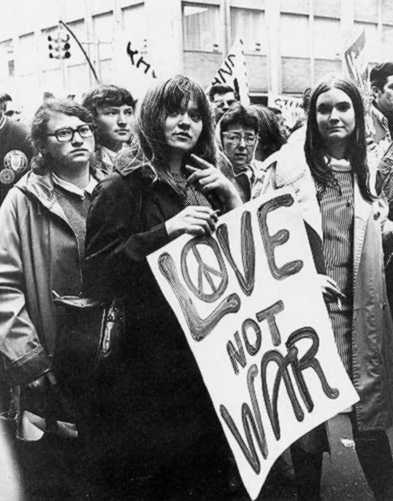
An indignant generation of young people in the United States rebelled against the war in Vietnam as it was played out graphically on their television screens. Newspaper reporters photographed the horror of war; photographs which stunned Americans and the world alike. Young men angrily burnt their call up papers in front of crowds of anti-war protesters as four successive Presidents presided over an unwinnable war. In a way, the protesters against this and later wars (such as the invasion of Iraq by the US and coalition forces in 2003) stuck their flag in the moral ‘high ground’. War was wrong.

Awakenings of conscience and consciousness happen at the individual level long before parliamentarians hear and reflect the ‘mood of the nation’. If war is going to be rejected as a method of ‘problem solving’, there has to be a global realisation of the immorality and futility of using violence against a fellow human being. It would be idealistic to suggest that this could happen in the near future but perhaps there is, a greater possibility for change than now, than there ever has been.

In my view, change will only happen with the introduction of a ‘third force’ which might be a charismatic world leader from this or another solar system, new technology or a third force with the means to eliminate humans, shared global problems of a catastrophic nature or just a spiritually and / or morally inspired realisation that violence is wrong.

picture credit: Physics World

The reference to ‘another solar system’ may have surprised readers! But the presence of advanced beings on earth is hardly a secret any more. The problem is that they are being characterised as violent and a threat to mankind. The narrative of ‘global security’ by successive U.S administrations, introduced ‘Star Wars’ under the Reagan and a whole new defence wing under Trump called the Space Development Agency. Hollywood has aided and abetted a global fear of invasion of ‘beings from outer space’ who wish humans harm.

The reality as described in Dr. Steven Greer’s film, ‘Close Encounters of a Fifth Kind’, is that highly evolved beings are watching and guiding us until we become peaceful towards each other and them.

Such a change of morals and consciousness is not a vain hope. There have been historical precedents. The crucifixion of one man in Roman Palestine, started a new religion based on love and compassion for all other people, including enemies.

Since then, sadly, religions have done as much to cause war as to prevent it. Countries at war, often claim that ‘God is on their side’ and yet logically, this cannot be true. Humans have free will and with that, responsibility.

The path to a planet where there is no war, is ultimately not in the hands of the politicians, lawyers, military leaders, religious leaders or industry; the arms industry has shown multiple times throughout history, that it is more interested in shares than ploughshares. The only possible novel outcome to being a victim of unrestrained violence, is for individuals to do nothing.

As the famous poster put it; ‘what if there was a war and nobody came?’

Mahatma Gandhi used non-violent protest to the British Raj, because that was how he was as an individual. His passive resistance, proved to be all that was needed to bring down the mighty British Raj in India. Peaceful overwhelming influence is an extraordinary power. When it fails, it makes powerful martyrs but when won, makes lasting peace. There will be a moment in the future for this to take place and until then we must wait.

Means to an End?

There are two kinds of people alive today; the manipulators and the manipulated.

It is important to realise how we are manipulated and recognise it when we see it. In this essay only one method will be considered because it is easy to see.

There is an old saying; ‘the end justifies the means’. This encapsulates a very real problem, but the fact that the expression is so well known and easy to understand has in a way, bled the life blood from it. But if it was not still full of meaning, there would not be so many examples of it.

For instance; a world leader wishes to invade a neighbouring state. There are various reasons which might be; historical, to obtain economic gain, to bring freedom to enslaved inhabitants, to eliminate a threat of war, to change a bad government for a good one etc.

All or just some of these reasons are used to persuade a population of a moral need. Then comes the twist. In order to achieve the aim, means are used which are far more destructive than the supposed problem being eliminated.

President Putin’s invasion of Ukraine is an obvious example but let us look nearer to home, to that bastion of fairness and reasonableness, the United Kingdom.

Politicians promise to solve problems. In this case they promised to ‘take back control of our borders’ in the 2016 referendum on Brexit. A minority right wing party, UKIP, perceived ‘immigration’ as being ‘out of control’ and having a detrimental effect on the standard of living. This despite the economic rule that immigration is beneficial to a country and the history of United States of America being a prime example.

But ordinary people do not have degrees in economics and the far right politicians are well known to pick a ‘scape goat’ cause for a problem; the Nazi policies towards minorities in 1930’s Germany being a prime example.

All nations have problems with land borders. They are hard to control. But an island nation should have an advantage and so it should be with the UK. Given this ‘false problem’ of immigration, how can the government ‘take back control of it’s borders’?

A degree of problem solving skill is needed, a faculty that is not unfortunately taught in schools and universities, including it appears, Eton; one of the most expensive private (fee paying) schools in the UK.

It was thought that if the UK could stop people wanting to come to the UK from their own failing countries, a solution would be to stop their country from failing. This megalomaniac assumption suggest that a minor world power is able to solve problems in other countries.

Unfortunately, two thirds of the countries from which people flee to the UK are not in the European Union; countries like Afghanistan.

So voting to ‘take back control of our borders’ would largely, not be solved by leaving the European Union. La di dah.

In the case of Afghanistan, large amounts of money and human life had already been lost in trying to prop up an Afghan government and Army. History shows that complex tribal nations are almost impossible for successful intervention by third party states, and so it was in Afghanistan. The Americans decided to pull out their support, the Afghan government and Army collapsed and the power vacuum was taken over by the Taliban.

So it is obvious that removing the need to flee from a country is not in the power of any one nation or even a United Nations.

The rules of asylum state that this must be done in the first safe country entered. This however is absurd as a single country cannot reasonably take all the refugees from a neighbouring country, once a certain number has been reached. Italy is a good example where refugees from Tunisia arrive in boats in such numbers that the government cannot cope.

The European Union must take some of the blame for not taking an overview of it’s member states and allocating refugees, asylum seekers and immigrants in proportion to their ability to do so. Germany has taken a disproportionately large number compared to other EU nations, while Italy is begging for help. The problem perhaps was instrumental in the election of a right wing government there.

But let us return to the UK. Having voted to lose all influence over European Union policy by leaving, it weakened it’s influence in the countries through which immigrants pass. France is a prime example and now has to be given money by the UK to carry out border controls on the north coast of France, most of which will be ineffective as the majority of traffickers operate from the UK.

The problem is never clearly defined, as ‘immigrants’ have varied motives. The economic migrants used to help with harvesting seasonal crops in the UK and those have largely ceased to do this; crops have rotted in the fields as a result. Young Albanians work in the UK illegally and return with amounts of money that it would take decades for them to earn in Albania.

Genuine asylum seekers are not given safe routes by the UK government, excepting Ukrainians and Afghans for whom there is a system on line to get a visa.

Instead of extending this humane approach to all asylum seekers, who make up 80% of ‘illegal immigrants’, the UK government have put forward another idea.

This ‘means to an end’ is intended to be so harsh that it will dissuade those seeking asylum, many of whom are forced to arrive in unsuitable small boats on UK beaches. The government’s idea is to treat them all as having entered the country ‘illegally’ and to send them to a third country; Rwanda.

In doing so the government of the UK are choosing to ignore the human rights of the asylum seekers and ignore the ruling of the European Court of Human Rights, of which the UK is still a member (even though many who voted for Brexit did not realise this political independence of the ECHR).

Ironic that the UK had done much to promote Human Rights within the European Parliament when it had influence to do so.

Instead their ‘solution’ to immigration by asylum seekers is to class them as criminals for entering the UK illegally, and sending them to Rwanda.

Here, clearly, the end is being used to justify the means for if anyone should question why this policy is being followed the reply by government politicians such as the Chancellor Jeremy Hunt is words to the effect, ‘would you rather they drown?’

By concentrating the emotional decision on the horror of women and children drowning in a cold sea, the appeal to the faculties of their opponents is not rational but emotional.

The rational ‘problem solving’ has been skipped over and a ‘solution’ being tried that mostly works politically. Is it not rather being seen to act on an election promise in readiness general election next year?

What will happen to immigrants once they arrive in Rwanda is hardly advertised. No doubt the Rwandans have been given money as other advantages to their nation are doubtful. At worst the money supply will stop in a few years after a change of government and the Rwandans will get their machetes out again.

Thus it can be seen that horror and inhumanity is being ‘justified’ as being the only solution to ‘saving people from drowning in boats in the English Channel’.

The tail is most certainly wagging the dog and this is how our own thoughts can be manipulated to think what is happening is ‘okay’. Bad things are ‘justified’ as ‘an evil to stop a worse evil’. In reality, it’s an evil instead of a humane solution.

Should we not be instructing the problem solvers in ‘problem solving’? The books of Edward de Bono have been used by business leaders to teach this skill and the reader is recommended to study them if a life in politics is being considered.

Matter Over Mind

When is a weather balloon not a weather balloon?

We live in a physical reality. From birth we engage with this moving and static universe and learn how it works; how to manipulate it and survive.

Then someone comes along who does ‘magic’. Perhaps it was at a children’s party when you first encountered a conjurer who made objects appear and disappear. Rows of coloured flags explode from her hat and little red balls pop out of her mouth.

Suddenly, rules that govern physicality are turned upside down, so like innocent children, we just laugh.

Later on in life, we understand that magicians are illusionists. They have studied the techniques of deception and taught themselves how to use them. Here are some;

Speed; prestidigitation, dexterity e.g. playing card tricks.

Misdirection; directing the audience so that they assume the contrary e.g. which ball the cup is in. Focusing the audience on one thing whilst doing another unnoticed, such as stage ‘banter’ and ‘slight of hand’.

Concealment; classic ‘smoke and mirrors’ such as using a curtain to hide a deceit.

Props; devices which appear to be not what they are; they have hidden doors, mirrors and compartments that reveal previously hidden objects.

Psychology; hypnotism, mentalism e.g. reading unconscious signalling in facial expressions to determine personal facts.

This list is not exhaustive but the main point is, magicians do not use obvious cheating. They know that they can be accused of using ‘stooges’ to perform pre-rehearsed actions. To counter this challenge, magicians use methods such as throwing a Frisbee randomly into the audience to choose who to invite to take part in the trick. Illusionists may be tricksters, but they will need to leave the audience without any explanation of what they have just observed, or lose credulity and reputation.

picture credit: EarthSky.org

Very recently an ‘air balloon’ was shot down over North America by the USA. The official story was that this balloon carried instruments used by China to spy on America. Questions were naturally asked as to how this and many other such balloons were not monitored or even known to exist, by those in charge of defending the nation. After some ‘re-calibration’ of America’s air space, surveillance and monitoring equipment, three new objects were found. Most significantly these were never ‘rationalised’ as balloons. One was described as ‘hexagonal’ and an ‘unidentified object with no obvious means of propulsion’ and the others of different shapes, equally unidentifiable. After several days, during which wreckage was recovered, it was announced that these three objects were in fact ‘weather balloons’. Do you get the feeling that matter is being described to make you form an opinion that the government want you to have?

The initials U.F.O were avoided quite deliberately for understandable reasons. Further obfuscation (misdirection) has been created because UFO’s are now called Unidentified Aerial Phenomena or UAP’s and there is an equivalent Unidentified Submersible Phenomena or USP’s. For those in the know, and as described by Dr. Steven Greer on You Tube for decades, there are clandestined (‘black ops’) projects outside of the military and government control which have built anti-gravity craft using alien reverse engineering obtained in the 1950’s. The other three UAP’s in question, were almost certainly examples of anti-gravity, human engineering. The cover-up to their undeniable discovery (prompted but not connected to the ‘weather balloon’ incident) is what the counter intelligence community term ‘stage craft’. This is a simile from our familiar family entertainment shows where illusionists make things appear and disappear at will.

This series of events is worthy of particular attention as they provide a clear example of how public perception can be manipulated to whatever the non-democratic departments of governments desire.

The illusionist techniques employed in such ‘minor’ incidents can of course be scaled up to gain public approval of serious government policy. Within the military known as ‘psychological operations’, there are ‘false flag operations’ where an innocent third party, such as a ‘hostile state’ is blamed using fabricated evidence.

picture credit: Wikipedia

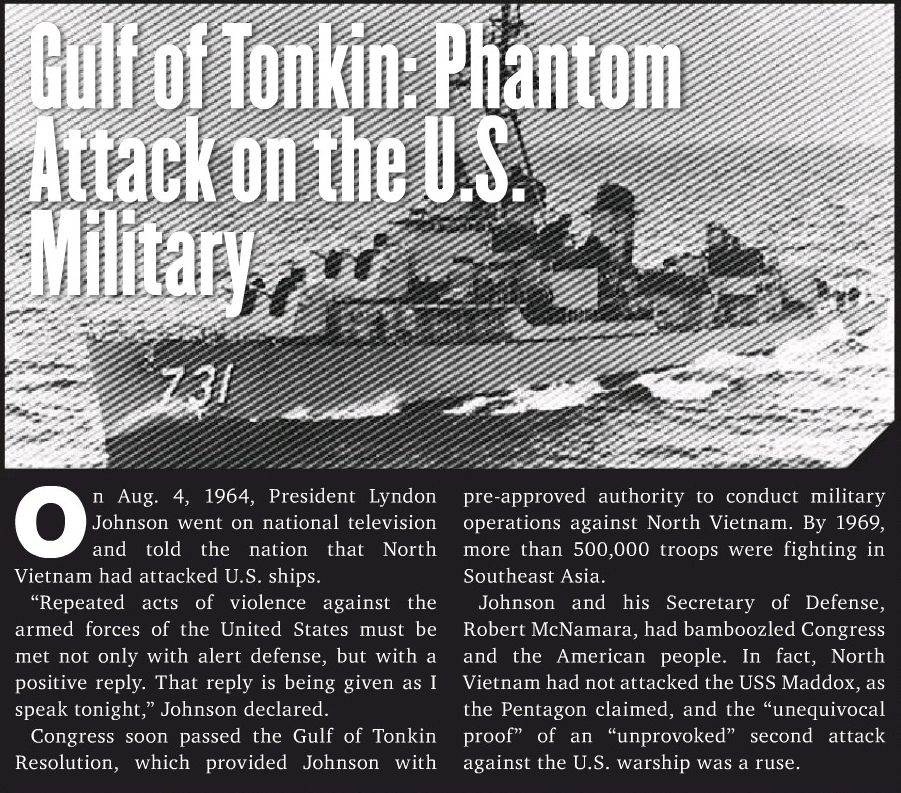
For instance, the ‘Gulf of Tomkin’ incident was probably the tipping point that committed the USA to war in Vietnam in 1964. North Vietnamese motor torpedo boats are meant to have engaged American ships in the Gulf of Tomkin whereas there are other claims that these were not NVA’s craft but American. A more mainstream explanation to the illusion is that there was a ‘communication error’ by the Americans which stands out as being vague at best and unforgiveable at worst. In all cases, unforgiveable.

picture credit: Pinterest

That is not the only war needlessly started. In 2003 the USA and an allied co-coalition, invaded Iraq on the grounds that there were ‘weapons of mass destruction’ in Iraq. This despite the fact that UN observers had been searching for such weapons for months and found nothing. The war was justified as being intended to;

“disarm Iraq of weapons of mass destruction, to end Saddam Hussein’s support for terrorism, and to free the Iraqi people”. (source Wikipedia.com)

History or ‘hind sight’ now enables most people to see than none of these three objectives were justified or effective. There were no WMD’s. Hussein did not support Al Quaida and the Iraqi people did not necessarily find foreign invasion a better option to living under a cruel but stable dictator. Iraq was destroyed, leaving little working infrastructure and services, and the regional and tribal ‘commanders’ were left to fight each other in the power vacuum…so called ‘freedom’.

Similar examples of ‘illusion’ by politicians, industrialists, pharmaceuticals and clandestined world actors, are to be found almost everyday in current news reports.

My overall point is that a scientist is not a person who understands things, but one who questions things. In the material ‘reality’ that most people believe is ‘all and everything’, everyone needs to be scientifically sceptical about how world events are reported. The techniques of the illusionist are frequently applied in a manner that appears to be without motive. Discovering the motive is the final and most hard to find piece of the puzzle.

This subject is extremely complex and the ‘stage craft’ of the actors confirms we are watching an act, but this is not a kid’s party. Most people chuckle and sit back in their seats, rather than refuse to leave until what has really been going on, is explained. There is after all, always an explanation, it’s just that, with the serious problems of today, we get the feeling that we are never intended to find out what it is.

picture credit: AZ Quotes

All of this may be rather bleak. However, mankind was never sent here to change the world, just to learn to be a better human being. Perhaps we have to look at this problem from a completely different perspective and that is to consider why there even is matter at all. Perhaps the knowledge that matter is interchangeable with energy casts some understanding. If mind / Universal Mind was seeking to know itself it could not do this in a vacuum. It has to create a very dense version of energy, which is what we call matter. In this material universe we are able to perceive how energy works because the two are the interchangable; it’s just that matter goes slowly enough for us to interact with it intelligently.

Those lessons, which the material Universe with all it’s entanglements and complexity, are directly transferable to the energetic or spiritual universes and when applied, give the greatest understanding of this highest spiritual truths.

You want to know what is spiritual?

Don’t approach spirituality.

To know what is spiritual,

Figure out what is physical.

Master Shi Heng Li Shaolin Monk