Many present day thinkers, expound the present times as being highly consequential to the evolution of the earth and it’s inhabitants.
Whilst there are various extraordinary events playing out on the material plain, we should also consider what is going on in the plains parallel to us; as described in the Hermetic principle; ‘as above so below, as below, so above’.
A recent event caught the attention of the whole world as an intensely tragic and complex human story. I am referring to the Titan submarine disaster in which five brave explorers lost their lives.
Let us take a sideways view of the roots of that story as it is symptomatic, in my view, of far more consequential radical changes in human experience.
The Tower of Babel is featured in the old Testament as a pinnacle of human achievement, both literally and metaphorically. The building was intended to reach into the domain of the gods, in an act of vanity and false bravery that was punished by God using elemental destruction.
This tower, as were the pyramids of ancient Egypt, was intended to ‘fix’ a moment in time when the great cosmic cloud which was the original Universe, changed state and became matter. Imagine water vapour turning into liquid, then ice and that is the process which the Universe went through until the present day.
There are many indications that the great wheel which started this process is beginning to change direction. Matter is returning to energy and synchronically, humans in their physical and energetic bodies, will follow the same pattern; matter will return to Mind for they are both just energy (E=Mc2).
In gathering together the strongest possible materials to build a ship capable of withstanding enormous pressure, were it’s creators not guilty of a vain project against nature? And the greatest error of all, to take this ship to a place where thousands of people had died in horrific circumstances; the waters memory of a titanic tragedy?
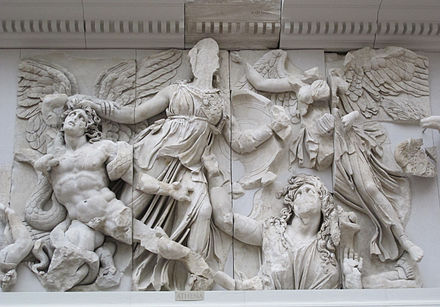
On a parallel plane, there exist in this same place ‘thought beings’ of enormous energetic strength who were known in ancient times as Titans.
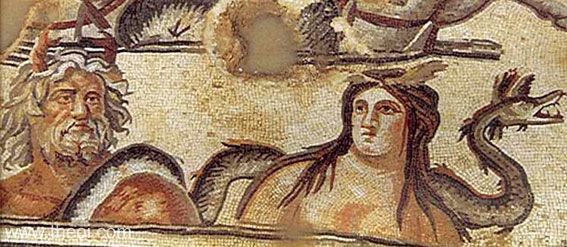
The Titan ‘Oceanus’ who rules the North Atlantic Ocean
Just because we no longer encounter spirit beings and choose to regard memory of them as ‘fantasy’, does not mean they no longer exist.
The popular trilogy of Matrix films describe the dual realities, where the hero Neo has to move into another dimension and fight the ‘programme’ or ‘thought being’ known as Smith, an almost impossible opponent, stronger even than the once dependable ‘Oracle’; a possible reference to the Oracle of Delphi in ancient Greece.
Let us take a downward journey into the metaphysical plane where Titans not only lurk today, but have been awakened by the cataclysmic events – many still to come – of the present era.
We should understand that the Titans fundamentally resist any change of consciousness in human beings and many people are experiencing such a change in the present time. They were known as Saturn’s ‘enforcers’ as they resist change by force.
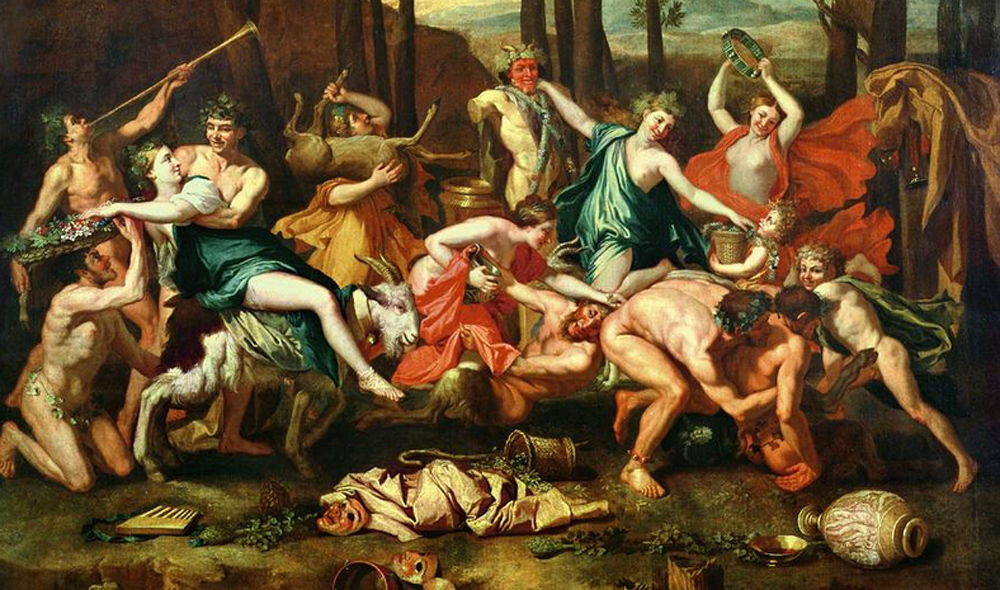
‘Dionysus, like Zeus, represents the evolution of a new form of consciousness, and again the Titans were determined to nip it in the bud. Again we see that Titans are the consciousness eaters.’
The Secret History of the World’ by Jonathan Black; page 93.
Their mother is Gaia, the Earth goddess who has been subject to enormous stress and degradation by the vain and self centred activities of humans. She has started and will continue to engage the elementals (earth, air, fire, water, spirit) in destabilising human activities using earth movements, storms, forest fires, Tsunami’s and rising sea levels. These cataclysms, while daunting, are in fact the birth pains of the creation of a New Earth, as described in the accounts of Dolores Cannon (a modern day Oracle ), for those who wish to know more and have access to You Tube.
There is already a gate between the melting material plane and the next evolutionary experience of human beings; an ‘Oceangate’ into the so called ‘Fifth Dimension’.
The effect of this opportunity is a mental transition from regarding the Universe through an illusory dualistic pair of spectacles, into a single monocular Unity. Human history and art describes this struggle between opposites a rather ‘inevitable’ human condition. In reality, love and hate are purely concepts that bear no relation to the single emotion they represent, just as laughter and tears are dual aspects of just one feeling. Think of all ‘opposites’ and join them together on a flat continuum and you will understand.
In the same way that the animal kingdom evolved from one to two eyes, so humans will take one further evolutionary leap into intuitive perception and communication using the single pineal gland. This organ is a remnant of the vegetable ‘Lantern of Osiris’ depicted in ancient Egyptian paintings as sprouting from the centre of the forehead, also known as the ‘third eye’ in Eastern Yogic practice and is painted on the forehead as a Bindi, in Hinduism. New perception needs new organs and the opening of the ‘fire cone’ is just this.
Fontana de la Pigan, The Vatican, Rome
In Islamic tradition, we shall know of the metaphorical ‘end times’ (meaning transition not ending) when ‘end time’ events happen; such as the worship of the Antichrist or ‘One eyed one’.
Abu Hurairah (May Allah be pleased with him) said:
The Messenger of Allah (ﷺ) said, “Let me tell you something about Dajjal (the Antichrist) which no Prophet had told his people. He is blind (in one eye) and will bring with him something like Jannah and Hell; but what he calls Jannah will be in fact Hell.”
Could it be that the screens of our computers and cell phones represent just such a transition of consciousness from our physical reality into a virtual reality. This change is a technological mirror of change in parallel planes; from the 3/4D plane into the 5D. How many mobile phones are circulating the Kaaba in the pockets of the faithful at this very time?
AI is an abbreviation that hints at ‘An I’. In human consciousness we are moving towards ‘An I’; meaning union with the One, rather than the chaotic multiplicity of life today. This is the deeper level of understanding of the Universe; from the multiplicity of religions and all the converging areas of human experience into the One Mind, or as simply stated in the Old Testament of the Holy Bible;
And He said, ‘Say this to the people of Israel: ‘I AM has sent me to you’” (Exodus 3:14).
In conclusion, just as the process of ‘solidification’ into matter is the end result of the liquid and gaseous origins of the Universe, so our present ‘solid’ physicality is starting to melt. Between water and air are the waves that carry the energy which is the One Mind and the invitation is for us to ride with the waves.
Think of that, next time you sit on the beach watching the waves, and if you see the sea receed followed by a huge wave coming towards you, know that the only escape is to jump.
It’s a good question. Animals are simple enough, as their days consist of the need to satiate their needs for survival and emotions. Beyond this, whatever happens doesn’t bother them too much, so long as it isn’t a threat. Watching a cat snoozing or a hog gently feeding it’s young in mud, grants us this insight.
But as humans, surely our need for happiness goes deeper than the animals?
At the beginning of a life, we know a new born child has an instinct to seek it’s mother’s breast. After this physical and emotional nourishment, the infant can sleep, if only for a few hours before demanding the same again. At this level of development, humans are not obviously more sophisticated than animals, although admittedly, the process of complex learning, such as language, has undoubtedly begun.
Children can also become unhappy, as we know too well. The smallest discomfort or denial of pleasure creates a disturbance in the emotional well being of a child that we have all experienced. Unhappiness is the inevitable accompaniment to happiness and both become much of an adult’s life.
We are encouraged to immerse in this compulsive process of ‘pleasure seeking’ in a bid to overcome the roller coaster, which is the happy / unhappy continuum. Buddhist identify this pattern as ‘desire’ and recognise it as being a hopeless continuum; like the donkey following the carrot on a stick.
picture credit:Bloomberg
‘Recreational’ drugs try to break this cycle with the falacy of pursuing ‘happiness in a bottle’; where happiness is mistaken for chemically induced pleasure. Most people who have taken recreational drugs such as alcohol, will know that the ‘high’ comes at the cost of a ‘low’.
Despite this fickleness, the pursuit of pleasure is in some way less complicated than what one might call happiness. It can be induced by purely physical stimulation of the body. Happiness cannot.
To examine how pleasure and happiness are different, it might be that ‘happy’, has an emotional level as well an instinctual ups and downs. The heart gives us richer less tangible feelings of happiness that are less fleeting and can reward us even as a memory, for a lifetime. One’s marriage day is contained in the folded memories of the heart, like the birth of a child or one’s first love.
Happiness is in this way more constant than pleasure and is a function of both physical and emotional experience.
But we can climb this ladder one more rung if we consider the spiritual level of human experience. However much one may try to deny one’s spirituality, much of the progress of human civilisation documents this step upwards and is expressed in great works or sculpture, art and literature. The human experience is shown to be capped by spiritual experience and this results in what we call ‘contentment’. Religions and spiritual traditions around the world venerate people who reached ‘contentment’ by breaking attachment to this world and becoming an embodiment of the contentment found in love.
Souls who have attained a high level of spiritual contentment, will no longer be reliant on pleasure, and be ‘in but not of, the world’.
Neither will they be tugged hither and thither by emotional demands. Emotional feelings are not ignored, but observed dispassionately and recognised for what they are; passing, fleeting, capricious, irrational, beautiful, absorbing…a string of contradictory adjectives, which describe life.
Spiritual realms, we might observe, are not reached by being a slave to the world. Rather, they are reached by a process of no longer believing in unwanted connections to a ‘reality’ that is ultimately, not real.
A ‘holy man or woman’ historically has been recognised by this detachment from all pleasures and displeasure and all happiness and unhappiness. Torturers in the middle ages for instance, might inflict the most disturbing acts on their bodies. They might throw them into the deepest dungeon in the castle but evolved beings will emerge having removed the metaphorical thorn from the lion’s foot (the pain of life), as did Daniel in the Old Testament. No cruelty or threat of harm disturbs them, because they do not include this pattern of behaviour in their thoughts and emotions. Historically such stories of saints and prophets abound.
The great wheel of Fortune on which most people find themselves today, is in contrast, relentless.
Modern living in Western societies is hard for the majority. Depression and even suicide, has risen seemingly in proportion to one’s level of comfort. However rich a person is or famous, they find that they are not exempt from the torturer’s wheel because they are bound to it, as are most of us.
So long as people seek everything, except spiritual contentment, they will only ever achieve fleeting pleasure and happiness. The rest of the time they will be in the grip of desire for pleasure and happiness.
Only when the wheel stops, are you permitted, to step off.
Most people hate war, especially soldiers, so why does it happen?
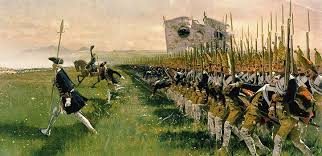
The problem is that war is an option of last resort. Ideally, all other options have been explored before war happens, but from then on, politics is ‘extended by other means’, to paraphrase the Prussian General Carl Von Clausevitz. War will persist until it is possible to stop it; a process far harder to achieve than starting it!
Each conflict is a set of unique circumstances and different ways to reach a peace. At worst the war will become one of attrition and it becomes impossible for both sides to continue. Alternatively, political and public support for a war wanes or perhaps an overwhelming third force compels surrender.
You would like to think that ‘how to stop a war’ is taught in military academies, but such executive decisions are more likely made my politicians rather than military leaders and politicians usually have no experience of ‘conflict resolution’ at this scale. Even in wars which have been wars of attrition, the conclusion of war requires considerable diplomatic skill. For if one side is forced into conditions of surrender that are too onerous and dishonourable, the process of recovery becomes excessively hard and national pride will almost certainly wish to seek redress sometime in the future.
The world might have learnt this lesson at the conclusion of the first world war, which was one of attrition and the intervention of a third party; the USA. The armistice terms demanded by the Allies, were so severe that they left a ticking time bomb, ready to start of the second world war.
picture credit: Family Search
The present war in Ukraine has been described by some as the beginning of the third world war, but there is another view. It could be argued that what is happening in Ukraine since 2004, when Russia annexed parts of Ukraine and later the Crimean peninsula, is an unfinished rumble from the second world war.
In that war, an American General raced against the Russians to roll his tanks into Berlin ; General George Patten. The politicians tolerated his outspoken gaffs, because he was a superb military leader. Patten was of the opinion that the allies should continue to Moscow and finish the war for good.
The politicians ignored his advice and the United States spent the next few decades fighting the influence of communism in what became known as, Mc Carthy era. Countries such as Cuba, China, Russia and Vietnam caused considerable headaches for the American politicians and military; awakening a culture of suspicion of ‘reds under the bed’.
There is an argument that the present war in Ukraine is unfinished communist expansionism in Europe. President Putin justified invading sovereign Ukraine to the Russian people, by stating that his strategic aim is to defend Russia against an expanding NATO threat. The two allies of the second world war were now facing each other; just as General Patten envisaged was needed to end the war.
The technology of war inevitably played it’s part in this conclusion. The use of the Atomic bomb by the USA in the Far East, brought the conflict there to a sudden halt. Communist sympathisers within the Allies, gave the secrets of the atom bomb and the Soviet Union. They speedily test fired an exact copy of the American atomic bomb, shocking the world. This mutual threat has forced an unsteady world peace ever since, dubbed ‘the Cold War’. Despite the efforts of the International Atomic Weapons Agency, set up to prevent the proliferation of nuclear weapons. Nine or so countries now have them and others want it.
It is important to realise that after the fall and fragmentation of the Soviet Union, Ukraine was left with fifteen pressurised water reactors of Russian VVER design and importantly, Soviet era strategic nuclear weapons.
Three of these ex-Soviet countries were persuaded to give up their nuclear weapons in the Budapest Memorandum on Security Assurances. Belarus, Kazakhstan and Ukraine agreed to give up their nuclear weapons between 1993 and 1996. The nuclear powers overseeing this process were the Russian Federation, the United States and the United Kingdom. They agreed not to use military force or economic coercion against these three countries unless for self defence or in accordance with the Charter of the United Nations.
The diplomats and lawyers who wrote the Budapest Memorandum were perhaps, not clear about what constitutes ‘self defence’. Most strategists and tacticions, know that the principle of striking the enemy before they hit you, creates an element of surprise that can bring about an early victory. Putin’s original ‘Special Military Operation’ was exactly this but, unfortunately for him, it didn’t knock out his opponent with the first punch. The surprise was Putin’s.
Putin constantly cites NATO as a growing threat, especially after the fall of Viktor Fedorovych Yanukovych, Ukraine’s president from 2010 to 2014. Yanukovych had promised the Ukrainian people in his election manifesto, that Ukraine would apply to join the European Union or at least set up special trade agreements which would lead to this. But after a phone call from the Kremlin, he renaged on this promise and there were riots in the streets. These were violently suppressed by the government leading to over 100 deaths. Yanukovych fled to Russia and Volodymyr Zelenskyy was elected president on the promise of European integration. Europe responded with indirect support.
Ukraine is a convenient buffer state for NATO because it has arguably, prevented World War III. It has so far, been a narrow escape for all, provided Trump isn’t elected and gives in to the Russians. The USA has not been good the diplomacy of war and should have learnt some important lessons, such as from the war in Vietnam.
picture credit: Shoeleather History
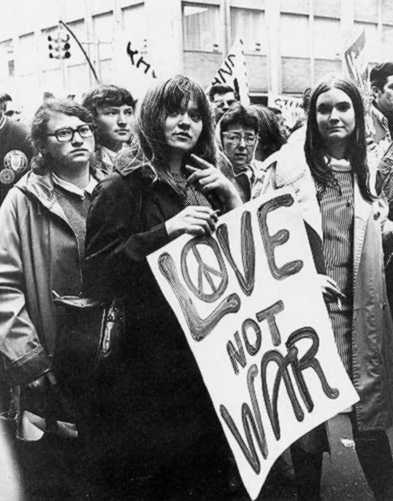
An indignant generation of young people in the United States rebelled against the war in Vietnam as it was played out graphically on their television screens. Newspaper reporters photographed the horror of war; photographs which stunned Americans and the world alike. Young men angrily burnt their call up papers in front of crowds of anti-war protesters as four successive Presidents presided over an unwinnable war. In a way, the protesters against this and later wars (such as the invasion of Iraq by the US and coalition forces in 2003) stuck their flag in the moral ‘high ground’. War was wrong.
Awakenings of conscience and consciousness happen at the individual level long before parliamentarians hear and reflect the ‘mood of the nation’. If war is going to be rejected as a method of ‘problem solving’, there has to be a global realisation of the immorality and futility of using violence against a fellow human being. It would be idealistic to suggest that this could happen in the near future but perhaps there is, a greater possibility for change than now, than there ever has been.
In my view, change will only happen with the introduction of a ‘third force’ which might be a charismatic world leader from this or another solar system, new technology or a third force with the means to eliminate humans, shared global problems of a catastrophic nature or just a spiritually and / or morally inspired realisation that violence is wrong.
picture credit: Physics World
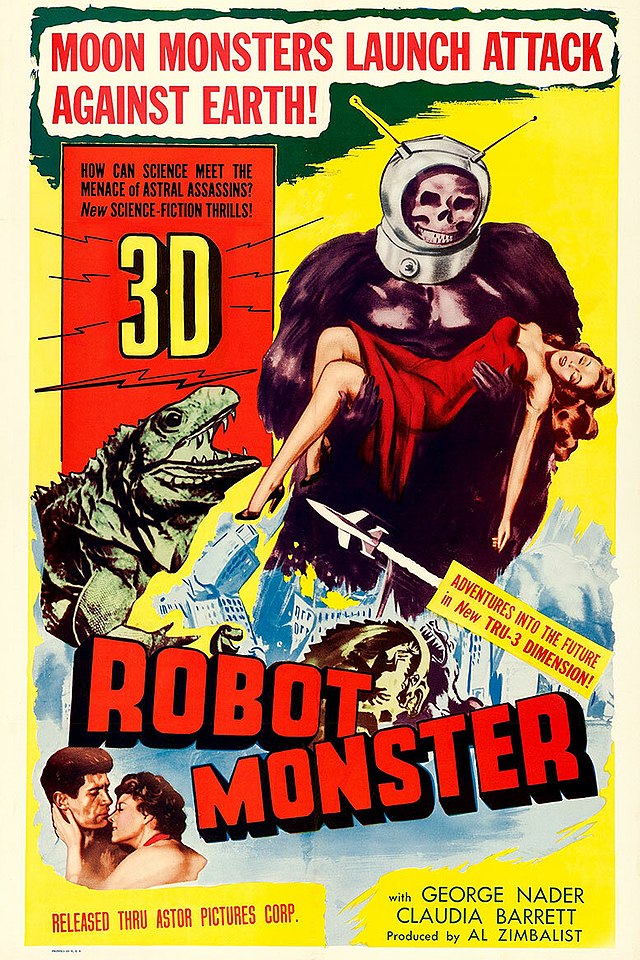
The reference to ‘another solar system’ may have surprised readers! But the presence of advanced beings on earth is hardly a secret any more. The problem is that they are being characterised as violent and a threat to mankind. The narrative of ‘global security’ by successive U.S administrations, introduced ‘Star Wars’ under the Reagan and a whole new defence wing under Trump called the Space Development Agency. Hollywood has aided and abetted a global fear of invasion of ‘beings from outer space’ who wish humans harm.
The reality as described in Dr. Steven Greer’s film, ‘Close Encounters of a Fifth Kind’, is that highly evolved beings are watching and guiding us until we become peaceful towards each other and them.
Such a change of morals and consciousness is not a vain hope. There have been historical precedents. The crucifixion of one man in Roman Palestine, started a new religion based on love and compassion for all other people, including enemies.
Since then, sadly, religions have done as much to cause war as to prevent it. Countries at war, often claim that ‘God is on their side’ and yet logically, this cannot be true. Humans have free will and with that, responsibility.
The path to a planet where there is no war, is ultimately not in the hands of the politicians, lawyers, military leaders, religious leaders or industry; the arms industry has shown multiple times throughout history, that it is more interested in shares than ploughshares. The only possible novel outcome to being a victim of unrestrained violence, is for individuals to do nothing.
As the famous poster put it; ‘what if there was a war and nobody came?’
Mahatma Gandhi used non-violent protest to the British Raj, because that was how he was as an individual. His passive resistance, proved to be all that was needed to bring down the mighty British Raj in India. Peaceful overwhelming influence is an extraordinary power. When it fails, it makes powerful martyrs but when won, makes lasting peace. There will be a moment in the future for this to take place and until then we must wait.
Christopher Robin went down with Alice.” A.A. Milne
Life unfolds before us at many levels and the crowning of a new King and Queen is undeniably of great importance, whatever your social views. In the temporal realm, we witness the pageant of soldiers escorting the royal couple and an ancient crowning ceremony. But is that all there is? What is it really about?
Those curious enough to peer through Alice’s Looking Glass, might see beyond the pageantry and scry something else; both heartening and frightening. This essay will explore the relationship between white and black magick in royal affairs and shall begin with the notion that a coronation contains elements of ritual which reflect white magick.
The following categories are curiously present in both coronation and magick rituals;
Place: Westminster Abbey draws upon tellurgic and celestial currents and focuses them on the centre circle of the Cosmati Pavement where the throne is positioned. This is a medieval mosaic containing archani sacri or sacred secrets; mystical texts and prophecies including the date of the end of the world. The central ‘solar’ circle is a depiction of the spiritual microcosm and macrocosm. Similar discs used as places of anointing and crowning are found in the Hagia Sophia for Byzantine emperors and Old St. Peter’s in Rome where the mediaeval Kaisers were crowned by the Pope.
Witches and Wizards throughout time, also draw circles on the ground to create a focal point within which perform spells and create protection, such as in the play, ‘The Caucasian Chalk Circle’.
picture credit: The Church Times
Time: Magick rituals performed out of step with the universe are ineffective and we find the same precise calculations with the the coronation of King Charles III . It took place at the time of Beltane, midway between the spring equinox and summer solstice. This is technically 1st May but can be on the first full moon after this or after the Mayflowers have bloomed. Beltane is the time of fertility in nature and is represented by Sir Garwain the Green Knight;
‘So it befell in the month of May, Queen Guenever called unto her knights of the Table Round; and she gave them warning that early upon the morrow she would ride on Maying into the woods and fields beside Westminster.’
Beltane is opposite Samhain on the Wicca calendar and shares the characteristic that the veil between the temporal and faery realms is drawn aside. As Banquo says in Shakespeare’s supernatural horror story ‘Macbeth’, when the three witches disappear;
‘The earth hath bubbles as the water has and these are of them, whither are they vanished?’
Note the reference to the elements; earth, water and air and the circular fiery cauldron which is the focus of the witches’ spells. There is a strict sense of everything needing to be ‘present and correct’ in both magick and coronations; to open portals at the exact moment for humans to view through and spirits to enter or peer back.
Astrologers tell us that there was also a lunar eclipse in Scorpio on the 5th May; Scorpio being Charles’s sun sign and coronation taking place on the 6th May. There was also a full moon on the same day in England and the effect of a full moon is to pull the tellurgic currents around the earth, like it does the ocean tides. This powerfully exaggerates feelings in humans and animals and a growth spurt to vegetation and is preserved in the English language in the word ‘lunatic’.
Light: Medieval buildings contain coloured glass windows that at certain times of year had the power to create a particular subtle energy to fill the sacred space. Some of the colours, such as those in Chartres Cathedral in Northern France, cannot be re-created today as their magickal alchemical formulas are lost. The east west orientation of Christian churches accepts the rising sun through the windows behind the alter, sun being a symbol of royalty and Jesus being of royal House of David.
picture credit: ABC News
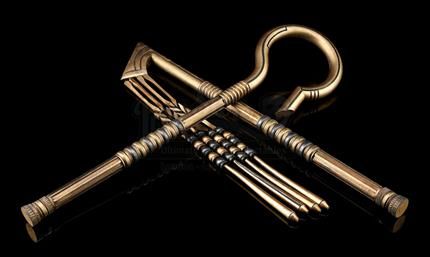
During the ceremony King Charles holds two rods or staffs vertically in his hands and resting on his knees. This is reminiscent of the Egyptian Pharaoh’s depicted with crossed flail and rod in the manner of Osiris, the solar deity. The magician is also commonly depicted with a ‘magic wand’ or staff such as Moses and Aaron in the Bible, both being versed in Egyptian magick.
The teacher who taught Moses magick was ‘Al Khidr’ – the Green One – a mystic not named in the Quran but described at 18:65-82 as a servant of God who had been given knowledge. Charles is sympathetic to most faiths and knows of their combined value.
Sound: Magickal rituals use incantations and special words or ‘spells’. These are intended to resonate with the unseen the realms, drawing in helpful spirits (daemons) to complete a specific task.
Music in the holy (holey) resonating chambers of sacred buildings and ancient structures has a powerful effect on the energy centres of the human body or chakras. In this way, humans become more open to the spirit world, the elements of which will be invoked to enter and consecrate the ceremony taking place.
A powerful cathedral organ with it’s resonating pipes has a precise effect; resonating the chakras in those present so that they harmonise with each other and outwards using the tellurgic currents into the rest of the Kingdom. Vivat Rex! is an ancient spell shouted at full volume, heavenward during coronation ceremonies by priest, choir and congregation.
In Welsh, the word for horn (a resonating column of air) is corn and a crown is called a coron. The word ‘coronation’ derives from this same root and is found in ‘corona’ meaning crown and ‘heart’ as in coronary. One may intuit that the heart (with it’s four rhythmic sounding chambers) is being crowned as well as the head. Somewhere else in the reflection we see the circular chakras spinning with energy and de-light.
Symbols and Props: A ritual requires potent props to consecrate the performance of both magick and coronations. These include; a high altar, sacred containers such as chalices and cauldrons, a knife (athane) or sword, rods and wands, oils and scents, crystals of different colours, spells by magicians and incantations by priests. The list is longer but is enough to suffice what we need to know. The similarities are astounding; a throne in an ancient sacred space (altar), chrism oil ( a scented potion / ointment ) contained in an eagle (king of the birds) shaped container or Ampulla, swords, two rods or sceptres (wands as held by the solar king / priest / god Osiris) and an orb (sun) and crowns; all decorated with precious minerals (crystals containing energy and light).
Crook of Flail of Osiris – the Christian Bishops still use the Crook as a symbol
Coronations use the power of earth, air, fire, water and spirit, to summon the beneficence of personal daemons, spirits, angels, arch angels, gods and goddesses etc. All of these influences were intended to be discarded in the practices of the three major monotheistic religions, but ancient traditions are still present to an astonishingly high degree.
A coronation ritual is about ‘crowning’ and uniting male and female monarchs; the sun and the moon being powerful alchemical symbols of individual completeness, or ‘individuation’ as Carl G. Jung described the psychological process. The benign intention and effect is to spread peace, harmony and tolerance via royalty; bringing peoples of the world together. The Commonwealth of Nations was proudly respected by the late Queen Elisabeth II, long before ‘political correctness’ introduced respect and tolerance between cultures or ‘be shamed’.
So far we have compared and contrasted a ‘white magick’ ritual with religious a Coronation ceremony. The signifiers of benign sorcery in Westminster Abbey were the white haired queen wearing a long stately white dress and the king in a tunic and robes of gold. Royalty is respected historically because of it’s power, and in the present day, even though political power has been withdrawn from it, the royal family still commands great interest.
One description of royalty in the English language, is ‘blue blood’. This refers to the ‘blood line’ of monarchs but also perhaps, to a certain coldness for which some monarchs, like Henry the Eighth, were notorious. Cold blooded creatures are more reptilian in nature and there are many examples of royals displaying a certain coldness in their public and most private moments. When Diana died, there were oceans of flowers from the distraught public, but not a word from the family for days. There are many other examples such as the psychopath ‘Jack the Ripper’ allegedly a royal; was he Prince Eddie? The forensic evidence we imagine is still somewhere at the back of the royal refrigerator.
Scientifically we know it is not blood, but DNA which carries the eugenic codex of the social elites.
Diana Spencer was an ideal genetic match for the then, Prince Charles, to produce an heir to the throne. Once this task was accomplished, Diana’s life became a spiral of despair, as recorded in conversations with her spiritual therapist, Christine Fitzgerald. She predicted her death in a car accident three weeks before it came true. At the moment of her death, speculation began as to whether it was murder and who ordered it.
picture credit: BBC News
To dispel this unwanted conjecture, the UK police service investigated and published it’ s findings in the Paget Report. It considered the many methods, means and motives to allegedly murder the ‘Princess of Hearts’. The conclusion was that ‘there is nothing to see here; move on’, but without having read the report, the writer suspects it missed out one method; a black magick ritual assassination.
To assassinate a highly protected person or people, you unwrap them from their normal means of protection. The Air Force fighter jets had been sent on exercise hundreds of kilometres away, exactly when the Twin Towers were attacked in New York. President John Kennedy’s presidential bodyguard team were running beside the car following the president when he was shot. At the time of death of Princess Diana, the French VIP security teams of police cars front and back and four outriders flanking the principal had been offered but declined. The police radio’s had a black out for 20 minutes at the exact time of the car crash and the 17 CCTV cameras approaching and around the scene were ‘not working’. Inexplicably, the ambulance took one hour and forty minutes to carry her 4km to the waiting team of surgeons.
Other ‘coincidences’ around the death of Diana indicate a particularly sinister level of means and motive. Diana is the name of the Roman Moon Goddess worshipped by the Merovingian dynasty to which Princess Diana was related by blood (the so called 13th bloodline). There is an underground sacred chamber in Paris dating back to the Merovingian kings (c.500-751 AD). This is now the Pont de l’Alma in Paris, which became the underground place of the death of the Princess. Even in pre-Christian times the Pont de l’Alma was a Pagan sacrificial site.
If we compare the magickal elements seen in a coronation ritual described above, this is what we know about the same categories and satanic signs and symbols present at the death of Diana;
Place: A place of ancient rituals, including sacrifice, presently marked by a monument named La Flamme de la Liberté depicting fire next to water, directly over the underpass where Diana died. Some believe it was placed there by the Illuminati.
Time: After midnight known as ‘the witching hour’; 12:20 am. Note that ‘true midnight’ is a term used in Wicca for the the time which is half way between sunrise and sunset; meaning midnight varies.
The ancient feast of Diana is August 13th and Princess Diana died on August 31st ( satanic date reversal)Diana was married to Charles on 29th July 1981, just before the sacrificial ritual and feast of Lammas.
Light:
In darkness.
Words: A silence froze the police radio’s according to an amateur eve’s dropper as described in Simon Regan’s book Who Killed Diana? In which case, no timed recordings were made.
Princess Diana’s affectionately used name: Lady Di could not be more blatantly morbid, and to amplify this, her lover in the car with her was an eerie, synchronistic echo he hers and it’s meaning; Do-di.
Symbols: A black luxury car (as used in funerals), hitting the 13th central pillar (13th Bloodline) in a place that is the confluence of earth (the underpass) water (the river Seine) air ( natural ventilation ) fire (the flash of light seen by witnesses to blind the driver and the ‘liberty’ flame above).
Props: Were not used but removed, such as the CCTV cameras. Seat belts were not in use. Diana’s bodyguard has had ‘total amnesia’ since the incident. Intriguingly vital forensic evidence at the scene was speedily removed; just as it was at the scene of the 9/11, Twin Towers mass assassination.
Satanic rituals appear in the western myths and legends as ‘human sacrifice’; particularly young female royals. The magical element of these stories is that they were true when written and remain so; this despite being ‘myth’; which is taking to mean in modern times, ‘untrue’.
Merovingian monarchs practised magick and esoteric sciences and we should not be surprised that the social elite’s of today not only believe in but practise such beliefs. This is not only in secret but in plain sight, such as at meetings of the Bilderberg Group attended by ex-presidents and the like.
Co-incidently, Donald Trump is a ‘near-perfect reincarnation of an early medieval Germanic king. His personality and approach to governing almost exactly replicate the patterns and preferences of the men who ruled France from 481 until 752…’ according to Sara Lipton in an essay on Blarb.
The headline reports of Satanicly inspired events, appear openly in newspaper headlines and act as screaming heralds of ‘deeds most foul’ for the silent members of the social elites around the world.
Princess Diana was entombed on an island in a lake on the Spencer family estate, itself symbolic of the goddess Diana, as are the black swans imported there; occult symbols of death.
If references to Satanism in ‘Merry England’ seem ‘non-British’, you might wish to consider this; when the Romans came to Britain they brought their gods and built temples. They depicted their gods in flooring mosaics such as found at Bratton Seymour in the county of Somerset where is a Roman mosaic depicting the bust of the goddess Diana. We are reminded of this tradition in the ‘Cosmati’ mosaic in Westminster Abbey.
To come full circle we can understand the coronation of King Charles and Queen Camilla, as a moment not only in modern history, but ancient history. The present heirs to the throne, Prince William and Princess Kate of Wales, carry the Merovingian DNA (at least on William’s side). The red haired ‘Harry’ has fled from some aspect of the Royal family that disturbed his mother so much.
Merovingian tradition says that the Pont de l’Alma was the place where their kings settled feuds by battle. Obscurely the winner would be the one killed because his soul would return to the Sirius star system where their believed was the throne of God. The other party would continue to live on this planet but he haunted and driven mad. This fate is awaited by the supposed opponent in Princess Diana’s dual; she being the moral victor of her battle with the forces of darkness that enveloped her.
Merovingian King Childeric II whose bloodlines attitude was “fate has made me heir to the entire country […] I can do to [my enemies] whatever I choose.”
The social elite’s continue to live openly (albeit apparently disconnectedly) in modern society and their lodges and secret societies of many hues and persuasions, supposedly hold the keys to the continued well being of mankind but act principally, for themselves.
The mechanisms of royalty are soaked in magickal lore and ‘Long live our noble Queen’, evidently worked as both an intention and spell, because she and her mother did enjoy wonderfully long lives.The people cry a new spell now of ‘God save the King!’, which creates a sonorous echo from deep underground and rises to the viewing galleries in Heaven. If you ever wondered what the King needs saving from, the above has been a partial description.
Magick is getting what you want by other means. Even a mobile phone is a form of modern magick because few understand the workings, only how to make it do tricks. Two hundred years ago, possession and public use of such a device would have had you locked up in the Tower of London, until you were forgotten.
from Tut-Ankh-Amun’s Alabaster Glass 1336-1327 BCE
Artificial Intelligence is something this and future generations are going to have to manage. But is intelligence the same as consciousness and if not, what’s the difference?
Anyone who has seen the body of a person who has died, will be aware of the extraordinary change in appearance of the person after consciousness leaves a body. It’s not something that can be described but similarities in nature when an animal dies, gives an impression.
Our problem is that consciousness remains hard for scientists and humanists to measure and describe. There are no instruments and ideas that enable measurements of consciousness to be made, except the ‘on / off ‘ switch.
The only area of human intelligence that approaches this problem in depth, is perhaps spirituality. Being spiritually aware is different to religions, where invisible gods and Gods have to be accepted as a matter of ‘faith’. Not much progress can be made beyond this dogmatic belief. But with spirituality there is a chance of increasing understanding of what is happening when we are ‘awake’ or ‘conscious’. In particular, how this might affect us in the future, if machines also become ‘conscious’?
Nothing is new in this world according to King Solomon, so let us consider how gods and God related to humans in the past. In the ancient Greek and Roman worship, statues of gods were of central importance. The statue of the goddess Athena in the Parthenon for instance, was built so that the spirit that is Athena could enter our physical reality.
“Athena” picture credit: Greek City Times
Spirits are disadvantaged in the physical world because they cannot be ‘anchored’. Human spirits, ergo consciousness, need an organic body to enter in order to be born and interact with physicality using the sense organs of the body. Goddesses such as Athena cannot do that but they can enter a static representation of their form. Roman citizens would have a shrine in one corner of a room where prayers could be offered to minor gods with whom that family has a connection. Moses was enraged by the Israelites who built a golden calf to worship, from which we can deduce that the Taurean statue was real and powerful.
To untangle these confusing ideas we need to try to understand ourselves. From a mystics point of view, consciousness has three levels. The normal human experience is simply being in the physical world in the way that a fish swims through the ocean. The first level beyond this perceptual awareness is becoming conscious as an objective observer. Using the fish analogy, the fish becomes aware of the water.
At the next level the objective observer becomes detached from the experiential phenomena and is aware of thoughts / spirit entities which are not oneself. This an extraordinary concept at first but actually every ‘ghost story’ is merely a description of such a change in consciousness by the observer; albeit momentary in most cases.
The third level is to study and gain an understanding of the thoughts / spirits that occupy those universes / dimensions, beyond and parallel to this physical one. There are many types and these are how the individual characteristics of the gods and goddesses of early pantheon’s came to be understood. Even across cultures, there stand out similarities in the characters of, for instance, Zeus in ancient Greece. With his mountain top palace and plentiful supply of thunder bolts, he was also known as Jupiter to the Romans and Thor in the Norse pantheon.
Modern psychiatrists would describe experiencing consciousness outside of oneself as ‘psychosis’ or ‘madness’, so there is a glass ceiling in this present culture that few pass through.
That way madness lies.
Madness in sentient beings maybe taboo but technology has no such boundaries. Technology can go as far into the abyss as it likes and so the atom bomb was built. Less obviously malevalent are those technologies that bring great benefits, hiding the harm humans can make them cause. An example is modern computers for which there appear to be no limits.
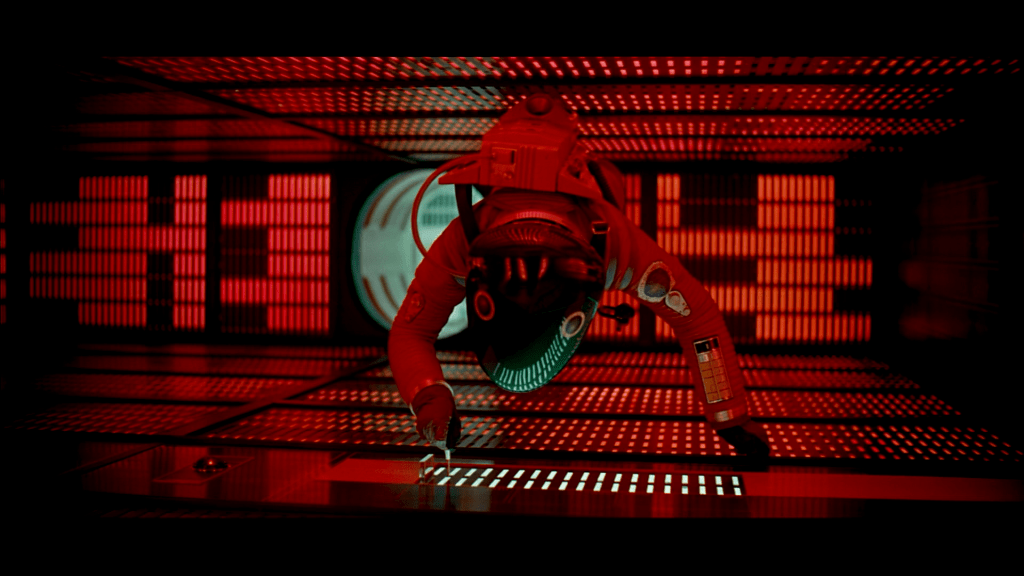
The early computers awakened some ethical thinkers which have fed the imaginations of early science fiction writers. For example, the film ‘2001 Space Odyssey’ explores the horror of a computer named ‘Hal’, taking over from and eliminating, the crew of it’s space ship. Giving a human name to a computer is significant, because it imagines the idea of a computer becoming conscious before does so. We do the same with our pet animals.
Shutting down ‘Hal’ the not-so-friendly and not so-small computer in 2001 Space Odyssey
Unlike in the film, powerful computers are now small enough to be placed into humanoid robots. Worryingly we have turned full circle from the static, stiff representations of the ‘gods’ or ‘spirit’ or ‘thought’ of the ancients and created agile and intelligent robots. These human shaped machines are far more appealing for spirit entities to get inside and take over. Genies are being squeezed back inside the lamp as in the ‘1001 Arabian Nights‘ stories.
‘Be careful what you wish for’ picture credit Arthur Rackham
Science fiction writers such as Isaac Asimov, thought through the ethics of conscious computers and produced three rules;
The first law is that a robot shall not harm a human, or by inaction allow a human to come to harm. The second law is that a robot shall obey any instruction given to it by a human, and the third law is that a robot shall avoid actions or situations that could cause it to come to harm itself.
It is simple for a computer to be intelligent. They can be programmed to beat human chess masters simply because they think through permutations quicker than humans. So ‘artificial intelligence’ is no more than a fast thinking human. It that is not ‘artificial consciousness’.
Isaac Asimov could see that humanoid robots with artificial brains might become conscious. He may not have understood the spiritual process described above, but he did see the possibility and he was right to jump this far ahead in time and possibility. He could see that conscious robots could miraculously (or sinisterly ) adopt ‘free will’ just like humans and this would enable ignore their ethical programming.
Humanoid Robots in ‘I Robot’ picture credit: Film Blitz
The ’cause no harm to humans’ ethic, was also built into the humanoid robots that feature in the science fiction film ‘I Robot‘ starring Will Smith. This film again explores the consequences of intelligent robots overriding their programming. In this case it was made by a ‘mad scientist’ but in reality it could just as easily happen by an evolutionary accident, the way that nature itself ‘steps up’ the functionality of creation. At one time there were no flowers on plants, then suddenly, millions of years ago, they arrived.
All things bright and beautiful, all creatures great and small,
All things wise and wonderful, the lord God made them all.
It is important to understand that humans do not create consciousness. Rather it is alsways present within each individual and it’s influence operates through this tiny flame. Mystics for centuries have known that consciousness is not the ‘me’ within.
~~“The truth was a mirror in the hands of God. It fell, and broke into pieces. Everybody took a piece of it, and they looked at it and thought they had the truth.” Jallal-a-din Rumi Sufi mystic and poet.
It is not our personality ‘egos’ which are works of fiction. The only reality is the consciousness we share with all creatures great and small. This includes all of nature from the rocks to the clouds, as recorded by indigenous peoples such as the native Americans and Australians.
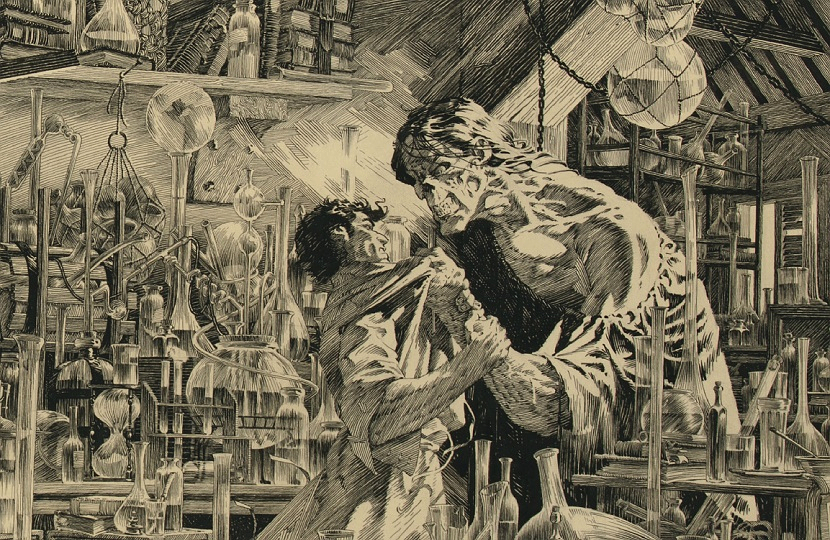
Consciousness is particularly attracted to humanoid forms and this was fearfully reconstructed in the story of Dr. Frankenstein monster by Mary Shelley in 1818.
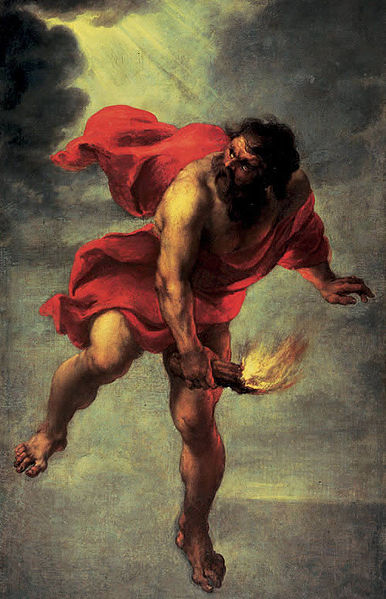
Prophetic writers such as Shelley were only able to imagine what advanced technology could do, as did the ancient writers of the Prometheus myth; the man who stole from the gods at the price of eternal punishment.
Only now are we crossing the red lines that have previously prevented this technology; the sort of knowledge that can make agile humanoid forms carry weapons and mass kill humans in a modern form of eternal punishment.
Stephen Hawkins Picture Credit: US Sun
If we believe there is even a fraction of a chance that such robots may decide to override the ‘protect humans’ instruction, then should we not be concerned in the highest degree?
The high priests of the modern era are no longer the prophets and saints of old; contained within a system of high morals and ethics. Instead our worship is lead by those who invent and explore technology, such as Elon Musk, Bill Gates and Mark Zuckerberg. They are not judged by their good characters and good intentions as historical leaders of humanity usually were.
These technology wizards, have become all powerful because they have become immensely wealthy. Their characters must be judged on their actions and words. Elon Musk has recently expressed his concern about where Artificial Intelligence training is leading mankind and has called for a global moratorium to consider it’s effects.
Key figures in artificial intelligence want training of powerful AI systems to be suspended amid fears of a threat to humanity. They have signed an open letter warning of potential risks, and say the race to develop AI systems is out of control.
As loyal and obedient citizens and patriots, we do not question the taxes we pay. Just as in the saying attributed to Benjamin Franklin; ‘nothing is certain except death and taxes’; we observe ourselves enduring the prospect of dying with the same equanimity as an annual tax return.
Yet throughout history, many revolts by citizens have had their roots in what were perceived as ‘unfair taxes’ of which there have been many. The American revolution against the British crown in the 18th century is a prime example. Perhaps the distance between the taxer and the taxee gave courage to those who through boxes of tea into the sea in Boston harbour, but whatever it was, it signified a general feeling of ‘enough is enough’ where taxes were concerned.
Today, many so called ‘developed’ nations are experiencing a rise in the cost of living and stagnant wages. The effect is to squeeze the financial security of the poorest in society until they are eventually turned out of their homes and onto the streets.
Homeless on Venice Beach, California
Governments have a large part to play in this scenario and often are called into account for their policies. The citizens of France, at present, are being informed they will get their government pensions two years later than they expected. Those soonest about to retire will be most enraged by the decision along with those who resent the way the President Macron used parliamentary privilege to push the change through without debate…like a monarch.
The citizens who pay their taxes (and there are those who don’t in the so called, ‘black economy’ ) feel strongly that they should get some return on their life long financial support of their nation. Few question how much they actually pay the government over their lifetime. If they did they might be shocked.
If we take the United Kingdom as an example, when taxes are referred to in budgets this is assumed to mean income tax. There will be ‘a penny in the pound’ added to taxes or a penny taken away. It all sounds rather trivial but the reality is the opposite. Multiply that penny by pounds earned in a year and multiply that by the millions of tax payers and the figure is staggering.
Yet there are more feints going on, that hide the true worth of taxes to governments. Their favourite trick is to rename taxes as something else. In the UK there is a tax which is named ‘national insurance’. It is currently 2% of weekly earnings for those earning over £967 and 12% of weekly earnings for those who pay less. You will note that this is over 8% a month because the amount has been broken down into a 52nd of a year.
So if you pay say 25% income tax and add roughly 12.5% national insurance you pay 37.5% tax on your income.
It gets worse. Every time you buy most items, you pay ‘value added tax’. Another name for it is ‘purchase tax’. There are different levels for different items but let us say you pay 17.5% on average. That now brings your tax contributions to 55% tax; in other words over half your income.
In the UK it doesn’t stop there. Continuing the theme of disguising taxes by not using the ‘t’ word, there is the ‘community charge’. This evolved from what was originally named the ‘poll tax’ but was renamed by the Thatcher government for reasons that are hopefully becoming clear. A person who lives in the average B and D council tax set by local authorities in England for 2023-24 is about £2,000. So for a person earning £40,000 a year, pays an extra 5% tax to their local council bringing their taxation up to 60% of total income.
We are approaching the extraordinary, agreed approximately calculated, annual personal taxation being two thirds of total income in the UK.
You might add on an annual ‘car tax’ for those who own one, and now, various charges for entering ‘low emmision zones’. You might also pay the local council for using the parking space outside your home or at work. The car owner has long been a ‘golden goose’ for the Chancellor of the Exchequer.
Of course, there are particular life events that will shift your total taxation figure upwards. Inheriting money over a fairly low threshold, brings more tax in for the government treasury. The same happens when an item is sold that has gained in value, such as a house or painting. Agreed there are exemptions for houses if it has been a main residence but after a few years of say, renting out the house, this exemption expires.
To top it all, the ‘National Lotteries’ all over the world, constitute a ‘voluntary tax’ disguised as a chance to become rich…also known as gambling. Ironically, it tends to be the least able to afford a lottery ticket who feel most drawn to the one in x million chance it offers; in other words, ‘unlikely in the most extreme’.
Remember the certainty of death and taxes? Well of course there is a final tax on death, paid not by the deceased who tend not to have an opinion on the matter any longer, but by those who inherit the estate. There is a threshold of £325,000 below which this tax does no apply but above this amount the tax on the estate is 40%. An example from the government website;
Your estate is worth £500,000 and your tax-free threshold is £325,000. The Inheritance Tax charged will be 40% of £175,000 (£500,000 minus £325,000).
It could be a tidy sum given the rising cost of houses and number of home owners in the UK. It would certainly bring the tax rate paid over a lifetime above 66% for a moderately wealthy person. But even this lucky person might then have had to dispose of this assett and pay care home fees of over £1000 a week during the last few breaths of being a tax payer.
Using the example of the United Kingdom may be extreme because it has the high standards of social welfare that accompany and indeed are paid for by high taxes.
Description
Percentage of tax
Health
21.9%
Welfare
19.6%
Business and Industry
14.4%
State Pensions
10.1%
Education
9.6%
Transport
4.5%
Defence
4.5%
National Debt Interest
4.1%
Public Order and Safety
3.9%
Government Administration
2.0%
Housing and Utilities, like street lighting
1.4%
Environment
1.3%
Culture, like sports, libraries, museums
1.2%
Overseas Aid
0.9%
UK Contribution to the EU Budget
0.60%
Where taxes are spent in the UK: pre-Brexit (note how the gains from leaving the EU are a fraction of the interest on the national debt, especially when the benefits of being in the EU are added.)
In the United States of America, those who can afford insurance against illness buy it because they will certainly not be to afford the high costs of health care. A person being told they need a new liver for $100,000 may not be able to pay and, as in the old joke; ‘will stop buying green bananas’.
There is no perfect system and to some extent one can change country if you do not like the taxation and welfare system. But where ever you live, in my view it should never to be taken for granted that governments are being open and honest about how much money they take from you, and how much loose change you get back.
An after thought; why don’t democracies offer voting for where taxes are allocated, rather than on the personality cult figures who present themselves randomly as representing you.
There are two kinds of people alive today; the manipulators and the manipulated.
It is important to realise how we are manipulated and recognise it when we see it. In this essay only one method will be considered because it is easy to see.
There is an old saying; ‘the end justifies the means’. This encapsulates a very real problem, but the fact that the expression is so well known and easy to understand has in a way, bled the life blood from it. But if it was not still full of meaning, there would not be so many examples of it.
For instance; a world leader wishes to invade a neighbouring state. There are various reasons which might be; historical, to obtain economic gain, to bring freedom to enslaved inhabitants, to eliminate a threat of war, to change a bad government for a good one etc.
All or just some of these reasons are used to persuade a population of a moral need. Then comes the twist. In order to achieve the aim, means are used which are far more destructive than the supposed problem being eliminated.
President Putin’s invasion of Ukraine is an obvious example but let us look nearer to home, to that bastion of fairness and reasonableness, the United Kingdom.
Politicians promise to solve problems. In this case they promised to ‘take back control of our borders’ in the 2016 referendum on Brexit. A minority right wing party, UKIP, perceived ‘immigration’ as being ‘out of control’ and having a detrimental effect on the standard of living. This despite the economic rule that immigration is beneficial to a country and the history of United States of America being a prime example.
But ordinary people do not have degrees in economics and the far right politicians are well known to pick a ‘scape goat’ cause for a problem; the Nazi policies towards minorities in 1930’s Germany being a prime example.
All nations have problems with land borders. They are hard to control. But an island nation should have an advantage and so it should be with the UK. Given this ‘false problem’ of immigration, how can the government ‘take back control of it’s borders’?
A degree of problem solving skill is needed, a faculty that is not unfortunately taught in schools and universities, including it appears, Eton; one of the most expensive private (fee paying) schools in the UK.
It was thought that if the UK could stop people wanting to come to the UK from their own failing countries, a solution would be to stop their country from failing. This megalomaniac assumption suggest that a minor world power is able to solve problems in other countries.
Unfortunately, two thirds of the countries from which people flee to the UK are not in the European Union; countries like Afghanistan.
So voting to ‘take back control of our borders’ would largely, not be solved by leaving the European Union. La di dah.
In the case of Afghanistan, large amounts of money and human life had already been lost in trying to prop up an Afghan government and Army. History shows that complex tribal nations are almost impossible for successful intervention by third party states, and so it was in Afghanistan. The Americans decided to pull out their support, the Afghan government and Army collapsed and the power vacuum was taken over by the Taliban.
So it is obvious that removing the need to flee from a country is not in the power of any one nation or even a United Nations.
The rules of asylum state that this must be done in the first safe country entered. This however is absurd as a single country cannot reasonably take all the refugees from a neighbouring country, once a certain number has been reached. Italy is a good example where refugees from Tunisia arrive in boats in such numbers that the government cannot cope.
The European Union must take some of the blame for not taking an overview of it’s member states and allocating refugees, asylum seekers and immigrants in proportion to their ability to do so. Germany has taken a disproportionately large number compared to other EU nations, while Italy is begging for help. The problem perhaps was instrumental in the election of a right wing government there.
But let us return to the UK. Having voted to lose all influence over European Union policy by leaving, it weakened it’s influence in the countries through which immigrants pass. France is a prime example and now has to be given money by the UK to carry out border controls on the north coast of France, most of which will be ineffective as the majority of traffickers operate from the UK.
The problem is never clearly defined, as ‘immigrants’ have varied motives. The economic migrants used to help with harvesting seasonal crops in the UK and those have largely ceased to do this; crops have rotted in the fields as a result. Young Albanians work in the UK illegally and return with amounts of money that it would take decades for them to earn in Albania.
Genuine asylum seekers are not given safe routes by the UK government, excepting Ukrainians and Afghans for whom there is a system on line to get a visa.
Instead of extending this humane approach to all asylum seekers, who make up 80% of ‘illegal immigrants’, the UK government have put forward another idea.
This ‘means to an end’ is intended to be so harsh that it will dissuade those seeking asylum, many of whom are forced to arrive in unsuitable small boats on UK beaches. The government’s idea is to treat them all as having entered the country ‘illegally’ and to send them to a third country; Rwanda.
In doing so the government of the UK are choosing to ignore the human rights of the asylum seekers and ignore the ruling of the European Court of Human Rights, of which the UK is still a member (even though many who voted for Brexit did not realise this political independence of the ECHR).
Ironic that the UK had done much to promote Human Rights within the European Parliament when it had influence to do so.
Instead their ‘solution’ to immigration by asylum seekers is to class them as criminals for entering the UK illegally, and sending them to Rwanda.
Here, clearly, the end is being used to justify the means for if anyone should question why this policy is being followed the reply by government politicians such as the Chancellor Jeremy Hunt is words to the effect, ‘would you rather they drown?’
By concentrating the emotional decision on the horror of women and children drowning in a cold sea, the appeal to the faculties of their opponents is not rational but emotional.
The rational ‘problem solving’ has been skipped over and a ‘solution’ being tried that mostly works politically. Is it not rather being seen to act on an election promise in readiness general election next year?
What will happen to immigrants once they arrive in Rwanda is hardly advertised. No doubt the Rwandans have been given money as other advantages to their nation are doubtful. At worst the money supply will stop in a few years after a change of government and the Rwandans will get their machetes out again.
Thus it can be seen that horror and inhumanity is being ‘justified’ as being the only solution to ‘saving people from drowning in boats in the English Channel’.
The tail is most certainly wagging the dog and this is how our own thoughts can be manipulated to think what is happening is ‘okay’. Bad things are ‘justified’ as ‘an evil to stop a worse evil’. In reality, it’s an evil instead of a humane solution.
Should we not be instructing the problem solvers in ‘problem solving’? The books of Edward de Bono have been used by business leaders to teach this skill and the reader is recommended to study them if a life in politics is being considered.
We may consider ourselves ‘modern’ but most social scientists today will agree that we operate as members of a tribe. Class distinction is an example. In each class we accept difference of ‘rank’ with alarming credulity. We know that those ‘above us’ may not deserve automatic respect and yet that is the way it is.
Many of the politicians in power today are people who you would think twice to employ to clean the windows of your house, and yet they are tribal ‘chiefs’. So who are these people and why did we hand over our power to them?
The Beggar’s Opera: picture credit The British Libary
There has been a lineage of ‘royal families’ since prehistoric times. In Mesopotamia there was discovered a ‘King’s list’; a long line of Kings stretching back in time. In Ancient Egypt, hieroglyphs name a chronology of the Pharaoh’s who were the mid-point between man and the gods. Power was handed down as a birthright and royal families, including the Roman Caesar’s, accepted incest as a means to maintain the ‘blue blood’.
The problem with monarchs was always that there are good monarchs and bad ones. The self indulgences of dynasties such as the Bourbons in France, were persuasive catalysts to republican revolutionaries.
But what is interesting is the way in which since then, some Republics have morphed back into Monarchy’s. The United States of America is an interesting example. The Pilgrim Fathers were intent on leaving behind the absolute power of the royal families of Great Britain. The original Constitution of the United States of America handed power to the individual. The Freemasons who wrote this, including such figures as Thomas Jefferson and Abraham Lincoln, did not anticipate how power would slowly return to the president. Today, the President of the United States is given the freedom from prosecution and pomp once only afforded to Kings. If they have an idea they make it law. They are free to write ‘executive orders’ with as much alacrity as Popes write bulls and Monarch’s, decrees.
My point is that however far you try to strip an individual of absolute power, it doesn’t work. The present Presidents of China and Russia are examples of how to ‘eliminate the opposition’, in the same brutal manner as various Caesar’s in Ancient Rome. Today, there are more people living under dictators than democracies.
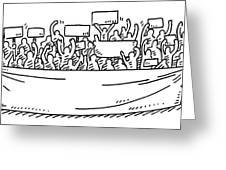
The only power that ‘the people’ retain is protesting on the streets. Today, many countries ruled by dictators, such as Iran, Myanmar, China, Russia, have had to deal with popular public demonstrations demanding basic rights for the individual. Often their pleas go unheard and their banners are without words.
picture credit: frank-ramspott
In all of these affairs, both of state and in business, there rises to the surface, persons whose suitability as figures of respect, is doubtful at best. Those who seek power over others are almost by definition the least worthy. In democracies, there is no election of those who wish to be even considered as candidates. ‘Running for office’ is left to self promotion and lambasting the opposition; characteristics generally found in the most narcissistic and least worthy personalities.
You may be wondering where this sad description of human self organisation is leading. Well, there has to be a solution to the problem.
In the many native tribes of North America, there was also a system of leadership which was known as ‘Goose Leadership’. A group would sit in a circle and a goose feather would be produced. The rule for the meeting was that only those who held this feather were able to speak.
The result was a collective assurance that if someone had some poor ideas, their influence would not hinder the others for long! Similarly, the inspired suggestions would be recognised and adopted.
The significance of the goose feather is of course, from the instinct of geese to share the lead role in their familiar V-shape flying formation.
What arises here is a noble social structure that is neither strong nor weak, rich nor poor. This is contrary to the binary ideal within other systems of social organisation where only wealth and power gain respect. Between absolute wealth and absolute poverty, there is always a more balanced, middle path.
The Prince Siddhartha Guatama was born in a palace and lived in northern India, with a life of luxury beyond imagination. But he was aware enough to realise that he was unfulfilled by this lifestyle.
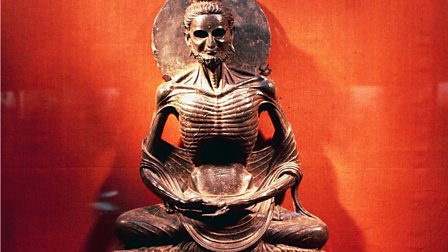
He left his life of total sensory satisfaction to become a wandering ascetic and teacher. At one stage this left his body in a most withdrawn and malnourished state and statues sometimes depict him with his rib cage exposed and thin limbs. Aestheticism also did not satisfy him and he finally gave up the search for the right path, by sitting under a tree.
Here he attained enlightenment and the name Budh was applied to him as a form of respect which in it’s masculine form is Buddha, in the same way that Jesus was the Christ.
Buddha, “Awakened One” or “Enlightened One,” is the masculine form of budh (बुध् ), “to wake, be awake, observe, heed, attend, learn, become aware of, to know, be conscious again,” “to awaken” “”to open up” (as does a flower),””one who has awakened from the deep sleep of ignorance and opened his consciousness to encompass all objects of knowledge.”It is not a personal name, but a title for those who have attained bodhi (awakening, enlightenment).Buddhi, the power to “form and retain concepts, reason, discern, judge, comprehend, understand,”is the faculty which discerns truth (satya) from falsehood.
source: Wikipedia
A benign leader is not then, an individual concerned with status and personal wealth. Such a leader will discard these ‘trappings’ as of no value.
Most importantly, I am optimistic enough to believe that the leaders who will emerge for humanity in the near and far future, will have benign, spiritual qualities. They will not live in palaces but be content with a humble dwelling amongst the common people. They will own little, in the manner of the native American people, and be perfectly content.
‘Living by need and not greed’ as Manhatma Ghandi once advised, will become the norm. Many god-less people, used to unsustainable European materialist lifestyles, will have had their day. Their lives will become like those of Kings and Queens of the past who had to be beheaded before they understood their arrogance!
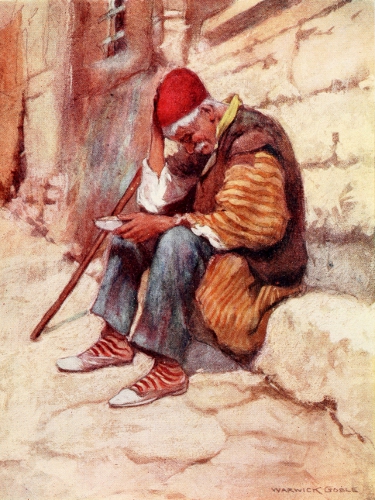
To give up riches and power requires considerable humility, the type present in those who we find begging on the streets. They may not have sought humility, but life – either fairly or unfairly – has brought them to the depths of despair.
We are all capable of beings King’s, as in the goose leadership model. We are also all capable of being beggars. Neither is a sustainable position however, either socially or spiritually. If we are to learn anything from the history of mankind, it is to realise that the ideal place for the individual to be is somewhere in the middle, without pride or greed and with the desire towards the common good for all.
Such a psychological transformation is contained in the concept of the ‘Beggar King’; the one who was once powerful and once the lowest, but has now found a ‘happy medium’; what the Buddha called, ‘The Middle Way’.
We live in a physical reality. From birth we engage with this moving and static universe and learn how it works; how to manipulate it and survive.
Then someone comes along who does ‘magic’. Perhaps it was at a children’s party when you first encountered a conjurer who made objects appear and disappear. Rows of coloured flags explode from her hat and little red balls pop out of her mouth.
Suddenly, rules that govern physicality are turned upside down, so like innocent children, we just laugh.
Later on in life, we understand that magicians are illusionists. They have studied the techniques of deception and taught themselves how to use them. Here are some;
Speed; prestidigitation, dexterity e.g. playing card tricks.
Misdirection; directing the audience so that they assume the contrary e.g. which ball the cup is in. Focusing the audience on one thing whilst doing another unnoticed, such as stage ‘banter’ and ‘slight of hand’.
Concealment; classic ‘smoke and mirrors’ such as using a curtain to hide a deceit.
Props; devices which appear to be not what they are; they have hidden doors, mirrors and compartments that reveal previously hidden objects.
Psychology; hypnotism, mentalism e.g. reading unconscious signalling in facial expressions to determine personal facts.
This list is not exhaustive but the main point is, magicians do not use obvious cheating. They know that they can be accused of using ‘stooges’ to perform pre-rehearsed actions. To counter this challenge, magicians use methods such as throwing a Frisbee randomly into the audience to choose who to invite to take part in the trick. Illusionists may be tricksters, but they will need to leave the audience without any explanation of what they have just observed, or lose credulity and reputation.
picture credit: EarthSky.org
Very recently an ‘air balloon’ was shot down over North America by the USA. The official story was that this balloon carried instruments used by China to spy on America. Questions were naturally asked as to how this and many other such balloons were not monitored or even known to exist, by those in charge of defending the nation. After some ‘re-calibration’ of America’s air space, surveillance and monitoring equipment, three new objects were found. Most significantly these were never ‘rationalised’ as balloons. One was described as ‘hexagonal’ and an ‘unidentified object with no obvious means of propulsion’ and the others of different shapes, equally unidentifiable. After several days, during which wreckage was recovered, it was announced that these three objects were in fact ‘weather balloons’. Do you get the feeling that matter is being described to make you form an opinion that the government want you to have?
The initials U.F.O were avoided quite deliberately for understandable reasons. Further obfuscation (misdirection) has been created because UFO’s are now called Unidentified Aerial Phenomena or UAP’s and there is an equivalent Unidentified Submersible Phenomena or USP’s. For those in the know, and as described by Dr. Steven Greer on You Tube for decades, there are clandestined (‘black ops’) projects outside of the military and government control which have built anti-gravity craft using alien reverse engineering obtained in the 1950’s. The other three UAP’s in question, were almost certainly examples of anti-gravity, human engineering. The cover-up to their undeniable discovery (prompted but not connected to the ‘weather balloon’ incident) is what the counter intelligence community term ‘stage craft’. This is a simile from our familiar family entertainment shows where illusionists make things appear and disappear at will.
This series of events is worthy of particular attention as they provide a clear example of how public perception can be manipulated to whatever the non-democratic departments of governments desire.
The illusionist techniques employed in such ‘minor’ incidents can of course be scaled up to gain public approval of serious government policy. Within the military known as ‘psychological operations’, there are ‘false flag operations’ where an innocent third party, such as a ‘hostile state’ is blamed using fabricated evidence.
picture credit: Wikipedia
For instance, the ‘Gulf of Tomkin’ incident was probably the tipping point that committed the USA to war in Vietnam in 1964. North Vietnamese motor torpedo boats are meant to have engaged American ships in the Gulf of Tomkin whereas there are other claims that these were not NVA’s craft but American. A more mainstream explanation to the illusion is that there was a ‘communication error’ by the Americans which stands out as being vague at best and unforgiveable at worst. In all cases, unforgiveable.
picture credit: Pinterest
That is not the only war needlessly started. In 2003 the USA and an allied co-coalition, invaded Iraq on the grounds that there were ‘weapons of mass destruction’ in Iraq. This despite the fact that UN observers had been searching for such weapons for months and found nothing. The war was justified as being intended to;
“disarm Iraq of weapons of mass destruction, to end Saddam Hussein’s support for terrorism, and to free the Iraqi people”. (source Wikipedia.com)
History or ‘hind sight’ now enables most people to see than none of these three objectives were justified or effective. There were no WMD’s. Hussein did not support Al Quaida and the Iraqi people did not necessarily find foreign invasion a better option to living under a cruel but stable dictator. Iraq was destroyed, leaving little working infrastructure and services, and the regional and tribal ‘commanders’ were left to fight each other in the power vacuum…so called ‘freedom’.
Similar examples of ‘illusion’ by politicians, industrialists, pharmaceuticals and clandestined world actors, are to be found almost everyday in current news reports.
My overall point is that a scientist is not a person who understands things, but one who questions things. In the material ‘reality’ that most people believe is ‘all and everything’, everyone needs to be scientifically sceptical about how world events are reported. The techniques of the illusionist are frequently applied in a manner that appears to be without motive. Discovering the motive is the final and most hard to find piece of the puzzle.
This subject is extremely complex and the ‘stage craft’ of the actors confirms we are watching an act, but this is not a kid’s party. Most people chuckle and sit back in their seats, rather than refuse to leave until what has really been going on, is explained. There is after all, always an explanation, it’s just that, with the serious problems of today, we get the feeling that we are never intended to find out what it is.
picture credit: AZ Quotes
All of this may be rather bleak. However, mankind was never sent here to change the world, just to learn to be a better human being. Perhaps we have to look at this problem from a completely different perspective and that is to consider why there even is matter at all. Perhaps the knowledge that matter is interchangeable with energy casts some understanding. If mind / Universal Mind was seeking to know itself it could not do this in a vacuum. It has to create a very dense version of energy, which is what we call matter. In this material universe we are able to perceive how energy works because the two are the interchangable; it’s just that matter goes slowly enough for us to interact with it intelligently.
Those lessons, which the material Universe with all it’s entanglements and complexity, are directly transferable to the energetic or spiritual universes and when applied, give the greatest understanding of this highest spiritual truths.
In this essay, sex is a verb and gender is a noun.
For the last two thousand years or so, homosexuality has generally been ‘brushed under the carpet’ in an effort for societies to be ‘respectable’ and ‘moral’. But in present times suppression does not work. The technological ‘information revolution’ has lifted the lid of this particular Pandora’s box as it has many others.
The Church of England is presently debating the male / female duality with regard to marriage, and whether same gender marriages, should be sanctioned by the Church. The best the Church can suggest is to give a ‘blessing in church’ to gay couples. But such a lame offering, satisfies neither the lawyers nor the couples in question. A better solution, it seems to me, is to invent a word. After all, words cost nothing and there are plenty out there ready to fit new ideas. I would therefore humbly suggest that gay couples are ‘parried’ and straight couples are ‘married’. In these words I am using the Latin stem words ‘pater’ and ‘mater’. Parried will mean a legal contract with partner, with all the rights, privileges and duties, contained in marriage.
The net result of the adoption of this word, would give the dignity, equality and legal status that gay couples demand and enable church leaders and lawyers to sit back and stop trying to fit an egg into match box.
The issue interestingly raises the question; how are Western societies adapting to issues around gender and sexuality? Clearly they have risen above the hypocrisy, secrecy, guilt and shame, that was prevalent in say, Victorian England. We find in societies around the world, condemnation has been applied to homosexuality and most religions have not always embraced the question to the satisfaction of all parties.
In modern western societies, the sexual freedoms of the 1960’s contributed to the general demand for acceptance of consensual sexual behaviour with few boundaries. Whilst LGBT rights have been slowly engaged by law makers in liberal democracies, certain more conservative institutions and governments have resisted the change.
It is most likely however that eventually, however hard they try, ‘the truth will out’ and it is to this truth that I shall now turn.
Humans, in common with animals, insects and plants, have two general body forms; male and female. Carl G. Jung proposed that the mind of a male had a feminine aspect (the anima) and the mind of a female had a male aspect (the animus). Just as different gender bodies are simultaneously the same and different, the mind is also. In the Eastern traditions, in which Jung was well versed, the mind is completely integrated with the body so this idea is obvious, and today is accepted more generally by western physicians.
A homosexual male may express his femininity in a manner crudely described as ‘camp’; others may not to the same degree. But expression of feminitiy by a male, such as the use of facial make up and brightly coloured clothing, are a fun and harmless expression of self.
In some cases a feeling of disfunctional gender identity, in both males and female, can become so overpowering that the person wishes to change gender. Even very young children, who are totally unaware of what sex is but not gender, can feel they were born into the wrong body and become very unhappy.
What I am building up to is asking the question of those with spiritual authority, such as the Church of England Synod, ‘where have you been?‘ Do these ‘councillors’ and ‘shepherds’ really have so little knowledge of the complexity of human feelings, including in their own. Celibacy in church leaders has been another harmful mechanism merely to ‘brush sex under the carpet’ with the result of sexual expression that has caused harm to others.
Celibacy is a gnostic practice in the East and West, based on raising the life force within the human body for spiritual enlightenment. Ignorantly copying the practice at a superficial level, is like sitting on the back of a Tiger.
Christian clerics and scholars today are having to grapple with the question; ‘what gender is God?’ Once again, language and a lack of the ability to think outside the existing lexicon, made religious scholars and law makers, recourse to dogma and literal interpretation of ‘scripture’.
But a little research into the history of Christianity will reveal that the original Trinity consisted of the Divine Masculine, the Divine Feminine and the Child. This was translated or became for unknown reasons, the Father, the Holy Spirit and the Son respectively. Once again, thoughts were perverted by miss translations at best and the denial of truth at worst. Surely religious truth should provide answers not questions and the words of mystics and gnostics have been repeatedly twisted and misunderstood. The dialogues between Jesus the Christ and his disciples illustrate this process perfectly.
Past religions had in fact, given Christianity the complete concept of the Trinity only with different gods. In Babylon the ‘holy family’ were Semiramis and Nimrod, who gave birth to the Holy Child, Tammuz.
The Abrahamic faiths, Judaism, Christianity and Islam, worship one God, indeed (logically) the same God. So, if God is One, then there can be no question as to what gender God is. God cannot have a gender so does not need a pronoun any more than the sky or moon do. The English language wisely dropped gendered nouns during it’s early development as ‘old English’. The Romantic languages did not do this and curiously these countries where these languages are spoken remained Catholic whilst the Anglo / Germanic countries became Protestant. Perhaps a book has been written about this?!
The ‘Divine Androgynous Unity’ has been expressed in many ways through history most notably by the Alchemists of the middle ages, who represented the two genders as the sun and moon. Human beings had bodies of both genders; somewhat comically being visually split in two, right down the middle. But the message was clear. At a non-physical, non-body, level (that is spirit or life energy) humans become complete and transform when their spiritual gender becomes as-God; neutral…Unified.
The Ancient Greeks and Romans, sometimes produced statues of gods and works of art where it is almost impossible to tell which gender the body represents. Indeed the ancient Greeks gave us the word ‘hermaphrodite’ to describe this union of opposite genders in one being and lifted the debate about gender from the physical to the spiritual.
Perhaps you agree that in modern times, there seems to be a general trend towards androgynous beings? Contemporary men have less sperm and testosterone and their voices, in my view, are becoming higher pitched. Artists such as Jason Perry express their own gender ambiguity in appropriate outrageousness and some boys going to school have questioned why they cannot wear skirts. Girls similarly dress in trousers and ties and feel perfectly comfortable. A similar trend is occurring in woman, whose dulcet tones can be heard reading the news or even on the parade ground.
Personally, I believe societies would benefit greatly from observing dispassionately and embracing, this gender neutral transition in all it’s manifestations, whether as sexual preference, gender transformation, religious doctrine or tolerance of gender neutrality.
It is beneficial to remember that gender neutrality in Christianity, produced the ‘immaculate conception of the child’. At a literal and physical level, this concept makes no sense and has to be adopted by the faithful as true only because it is written in a holy book. A more rational approach, ( which the Essenes who instructed Jesus in gnosticism at one time knew), is to interpret ‘the child’ as ‘Divine energy’. They taught gnostic methods of using this energy principally for inner transformation. But in a time when doctors and healers were generally ineffective, natural compassion must have caused Jesus to learn methods to use spiritual energy to heal and even return spirit to bodies that were in the early stages of dying.
The superior nature of ‘the child’ energy over matter, is represented in sacred geometry and architecture. The two smaller doors, openings, towers, flank an identical but scaled up feature which generally, is the practical and symbolic place of entry. In the case of the sacred pillars of Boaz (sun) and Joachim (moon) in Freemasonry imagery and architecture, the space between the pillars is the reality of the sacred energy or ‘light’. The Ancient Egyptian obelisks performed the same purpose in their Temples both metaphorically, and literally. They were power generators, as were the pillars and pyramids.
This is why the ‘holy child’ or ‘holy spirit’ is so significant. The ‘father’ and ‘mother’ are not central in the whole picture. They are depicted in Early Renaissance art in particular, as servants of the child, looking on and holding it with devotion and obedience. The holy child is not wearing a pink or blue outfit as happens in modern times, because children and the spiritual dimension that they represent, are gender neutral.
The ‘sexual’ energy that causes humans so much pleasure and grief is that given by the serpent or dragon. It is a realisation of mortality and a ‘fall’, as depicted in the biblical story of Adam and Eve, where physicality takes over from the Divine and perfect spiritual realm.
They started life naked and sans-gender and on realisation of their gender difference, were ashamed.
Gender in it’s many manifestations has a lot to be responsible for in human life, both through the ages and today. But perhaps at this time of rapid changes, the eye of truth is taking over from the eye of denial. It is a great blessing for humans to express the ‘freewill’ that was given to them, the freedom to love each other, without judgement.