Word War

picture credit: Domestic Violence Co-ordinating Council / Delaware / USA

Is it wrong for a victim to commit a crime against their abuser?

Consider a wife who has suffered various kinds of abuse over many years from her husband. One day she picks up a kitchen knife and stabs him to death. You have seen this story in movies and books many times and one is always split between compassion for the victim and condemnation of their crime of murder.

Now chose a word to describe the action of wife;

Attack? Defence? Pre-emptive? Revenge? Anger? Terrorism?

Most courts would find the wife guilty of murder. Her defence of ‘self-defence’ or ‘after years of abuse’, would be considered as mitigating circumstances and might reduce the sentence significantly.

When children fight they will commonly defend themselves with an accusation; ‘so and so started it.’

They might have been a peaceable victim who was attacked by a bully. In most ethical standards and laws, a violent act permits self defence by the victim. If the bully claimed to have attacked in order to prevent being attacked this is unlikely be regarded as permissible unless the victim had made to strike and the bully blocked the attack before striking back. Children can confuse adults with this simple excuse or ‘defence’ for violence and so do modern leaders!

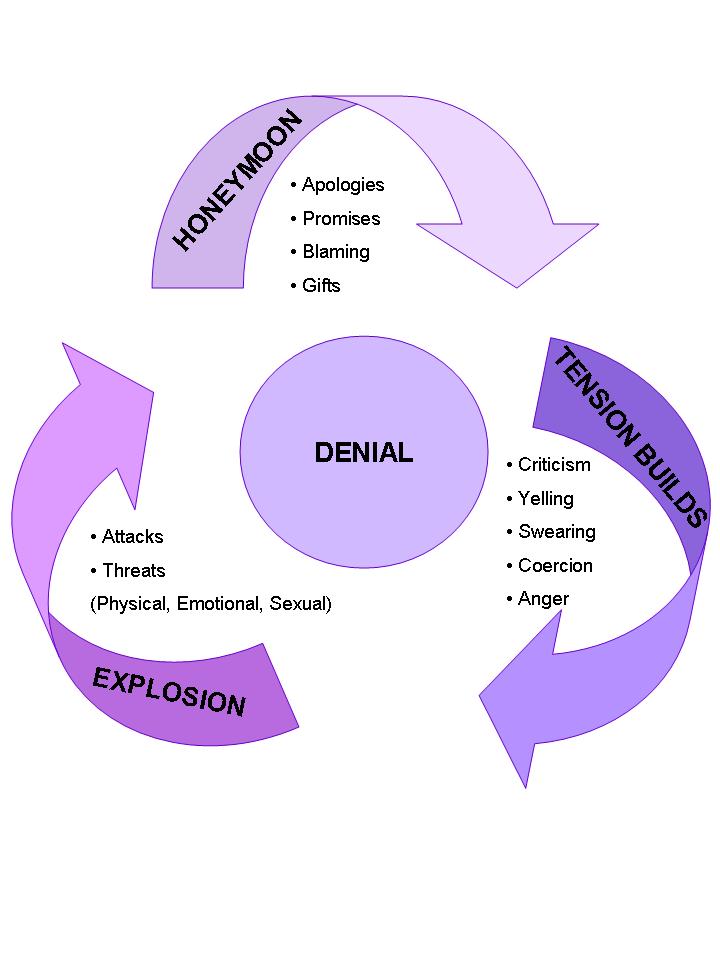
The abused wife who retaliates in anger is like a country that has suffered abuse from a neighbouring state for many years. If brought to breaking point, the victim state will decide it has had enough of violent attacks and incursions onto their land. They will strike back. The question is, did the victim start the violence by objecting to abuse? Who ‘started it’ becomes almost impossible to define as the origin of the violence and the definition of the first act of violence is difficult to pin point. It probably wasn’t a single agressive act but multiple acts of passive aggression by either party.
picture credit: Communitycommons.org

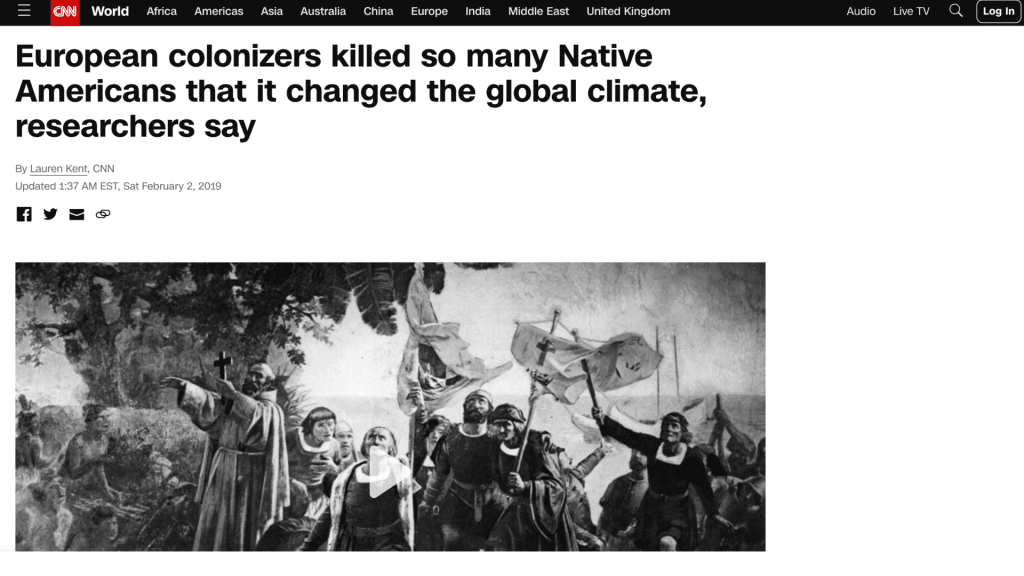
In the eighteenth century, the United States of America slowly dispossessed and committed murder and land theft against the indigenous population as had done other European colonisers before them.

The State of Israel was created by occupying Colonial powers in 1945 from which point onwards to the present day, Israel land stole land from and murdered anyone who was in the way.

Are not both of these examples of the ‘wife-beating husband’ and a continuous ‘they started it’ mentality? How much provocation should original and entitled inhabitants suffer before fighting invaders?

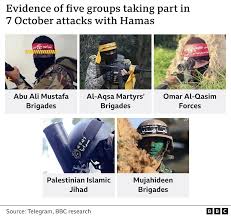
Today the Zionist government in Israel is trying to persuade the world that those who fight back against the genocide of Palestinians, are ‘terrorists’.

Over the decades the words ‘Jewish’ and ‘anti-Semite’ have become used as if by an innocent abused wife. It is certainly a fact that Jewish people have had a hard time through out modern and ancient history. They have been the victims of violent and non-violent abuse in many countries culminating in their attempted genocide by the National Socialist government of Germany in the early 20th century.
picture credit: BBC

When the Zionist government uses the defence today of ‘he started it’, the first question is when it started (certainly not on October 7th 2021) and how to reach a peaceful conclusion for this unhappy hostorical marriage of Jews and Palestinians.

The child in the playground who shouts ‘he started it’ does not realise that there are almost always passive options to violence, even if it is public humiliation or martydom. The Christians will tell you stories about this of their ‘turn the other cheek’ Messiah being murdered by the Jews of that time.

The Zionist government of Israel and the United States of America defend their invasions of Arab states over the last few decades by claiming that they are the innocent victims of ‘terrorism’. But who are the true terrorists?
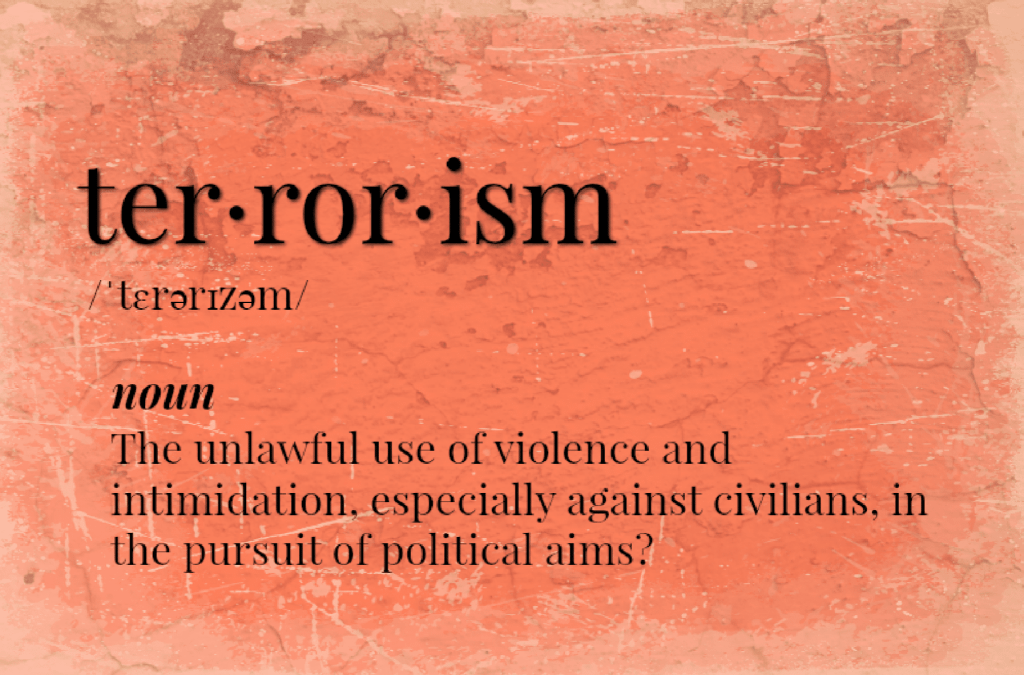
picture credit: Ryttch Magazine

A short detour to examine the word ‘terrorism’ is required. All violence creates fear in the victim but is this terrorism? The term is defined as;

‘…the calculated use of violence, or threat of violence, against civilians or non-combatants to induce fear and coerce governments or societies to achieve political, religious, or ideological goals.’

This is a definition according to AI; so open that it also clearly defines ‘war’ in it’s modern form, with civilians victims rather than military targets. Therefore I believe that ‘terrorism’ is more than this definition. It omits to define who is using this violence against civilians? Is it a nation’s armed forces or a small group of political extremists such as the IRA or ETA in the twentieth century?

Today nation states are deploying their armed forces for extreme ideological goals outside of the international laws of War. By any definition, abandoning law is unlawful and therefore this is terrorism.

As we are examining words used in war, let us consider the difference between ‘killing’ and ‘murder’. You will often hear news reports that civilians have been ‘killed’ by missiles but is this more accurately ‘murder’?

The AI definition of murder is;

‘The unlawful premeditated killing of one human being by another.’

We are told that modern drones and missiles can hit targets with laser accuracy. And yet, photographs of Gaza today are almost identical to photographs of cities ‘carpet bombed’ in WW II.

So if a missile lands on a school or hospital killing civilians, is this a ‘mass murder’ or a ‘mass killing’ – verbally sanitised as ‘collateral damage’? There is clearly a legal question of whether the missile was intended to be launched and targetted so as to cause loss of innocent life.

A soldier killing an enemy soldier is lawful because each expect to fight each other to death but civilians have no such expectation.

Today countries such as the USA and Israel will argue that they do not respect International Law and Courts of Justice as a sort of ‘get out’ clause. Time will be the judge of this but history suggests they will need good lawyers.
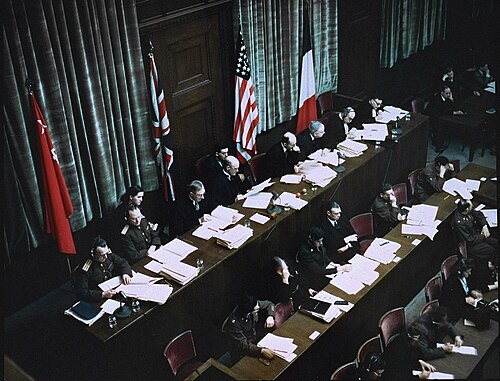
Nuremberg Trials after World War Two

Murdering innocent people should not be a subject for debate in countries that consider themselves ‘civilised’ but today leaders use words in such a way that they feel they can justify the most heinous crimes against humanity, by merely changing definitions. Trump has not declared war against Iran and his missiles and invading troops are a ‘military operation’. As there is ‘no war’ he argues that he does not need Congress to approve going to war on behalf of the people of the United States.

In my view, we all have a responsibility to understand not only what we are told but how we are being told it. Using language to alter truth exists in every language but our primary responsibility must surely be to not to manipulate language for

unholy ends.

You can quote me on this…when we do not stand up; we lie.

The Democracy Spectrum

If Democracy were a mental disorder each, and every country could be diagnosed as to where on the democracy spectrum their governmental policies lie. There are some countries who pay lip service to democratic rules and some who follow procedures to the letter. In between are the majority of countries and it’s a mix.

Democracy rules largely in the West, plus countries historically colonised by the West, and informs western self image that it’s political ways are superior to the rest of the world.

It is not easy to view objectively how this form of government operates in Europe and the United States of America. For instance in modern day Switzerland, the most important political decisions are decided directly by citizens through referendums. These may take place several times a year, swiftly and efficiently without fuss or interference. Citizens feel empowered because they are being included in important ‘course corrections’ of government. There is no pressure on a government to follow a manifesto on which they were elected; an expectation that fails to understand that sometimes the super tanker needs to change speed and direction when an iceberg moves into it’s path.

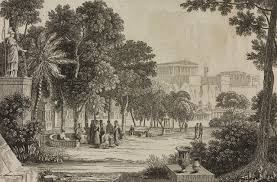
The ancient Greeks were of course the originators of ‘government by the people for the people’. The Platonic City was restricted in size by the number of citizens in a circular crowd who could hear an orator in their midst; a number calculated exactly to 5040.

Plato’s City picture credit: The Saturday Paper

This is called Direct Democracy, enabling individuals direct connection with those with the power to decide policy and law. In many ways it makes the most sense as each citizen has at least 1/5040 th influence on the destiny of their city state. In this way their loyalty to their nation would be expected to be very strong. They after all, are partly responsible for the consequences of the flaws and laws that effect their lives.

What inevitably usurped this system was the increase in the size of city States.

With increasing populations in large urbanisations, the Romans in particular gave citizens the right to vote for someone to represent their views, a Senator.

This is better in theory than in practice, for having given away their power to a third party, every citizen becomes disconnected to government. Senators may decide or be corrupted or bribed so as not to represent the views of those who elected them.

What contributed to the eventual downfall of the Western and Eastern Roman Empires were the Caesar’s who assumed control of all the power of the state, dictators. As well as fiddling the taxes and trade, Nero fiddled as Rome went up in flames.

At this point power has been completely removed from the influence of the general population and assumed by an individual acting in self interest, not the interest of the country and it’s citizens.

Again we have seen the rise of such dictators in governments in Western Europe and the United States of America in modern times.

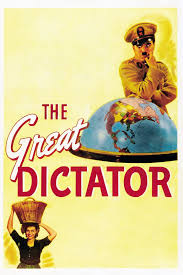
Charlie Chaplin’s Comedy of Terrors

So at the ‘dictator’ end of the democratic spectrum, there is no government of the people by the people. Politics has been reduced to one personality and a carefully vetted ‘hangers on’ who are absolutely loyal to the dictator.

These may be civilians who have gained power through wealth and influence in areas other than politics. Clearly this does not suit them in any way to a career in politics but that does not stop them for the reasons that entrepreneurs are natural risk takers and self believers. Failure in policy is unlikely to affect their lifestyle and they do not feel responsible for the well being of others, so they advise and influence in politics through a process of making mistakes.

The United States of America and the United Nations have a policy known as Democracy and Governance. The intention is to bring democracy to the countries of the world under autocratic rule. For the USA the Middle Eastern countries have been high on the list for DG transformation because of the natural resources and geographical location of countries such as Algeria, Libya, Egypt, Iraq, Iran, Syria, Lebanon, Oman, Saudi Arabia and others.

One of the first wars with Arab countries between the USA proxy in the region, Israel, was the Arab Israeli wars in 1948 and 1967.

The problem with promoting democracy in it’s many forms in the Middle Eastern Arab countries is cultural difference. Whilst the West may not like or approve of autocratic military leaders such as one time Libyan leader Muammar Ghaddafi or past Iraqi leader Saddam Hussein, life without unpleasant self styled ‘revolutionary’ leaders like them has proved far worse for the citizens of those countries.

It is likely that the present ‘regime change’ in Iran will have similar unintended consequences for the ordinary citizens of Iran.

The consequences of ‘regime change’ in the United States of America at this time are impossible to predict. The once dependable institutions were intended benignly, to protect the constitutional rights of the individual citizen. These rights have slowly usurped democratic institutions set up to prevent autocratic rule, such as Supreme Court.

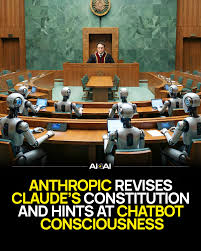
I write this with a partly wry smile knowing what comes next as far as democracy and freedom is concerned, in any country anywhere in the world. The future is already in the news in a story about a company called Anthropic.

Anthropic is described as a ‘safety and research company that’s working to build reliable, interpretable and steerable AI systems.’

It is currently in dispute with the government of the United States of America which wants full access to it’s systems for use in warfare without control by humans. Anthropic is refusing on grounds of this being unlawful and morally indefensible.

For as any child will tell you, a robot that has supreme power over humans is a bad idea. The 2004 film ‘I Robot’ was science fiction twenty years ago and reality today, if you call a drone a robot. Unless there is a ‘kill switch’ which is easily accessible to humans built into every autonomous device and humanoid, we are designing our own guillotines and artificial Robespierre’s.

At our present point in history we have choice to carry on fighting each other for whatever imagined reason…or stop.

To do this successfully will require an intention to give back power to the individual citizen, as in the original concept of democracy in Ancient Greece.

In serious legal trials this principle is still of vital importance and present as the jury of twelve citizens. The jury ensures that a diversity of view points consider the facts of a case without prejudice to the defendant and then a unanimous vote is required for conviction. Debate is encouraged and can take weeks but has been proven to be the most fair system yet devised in legal cases.

When government by the people is dismissed and an autocrat with strong personal views and belief takes over power, right minded citizens are reduced to nodding dogs.

Woof!

Peace Plan for Russia and Ukraine?

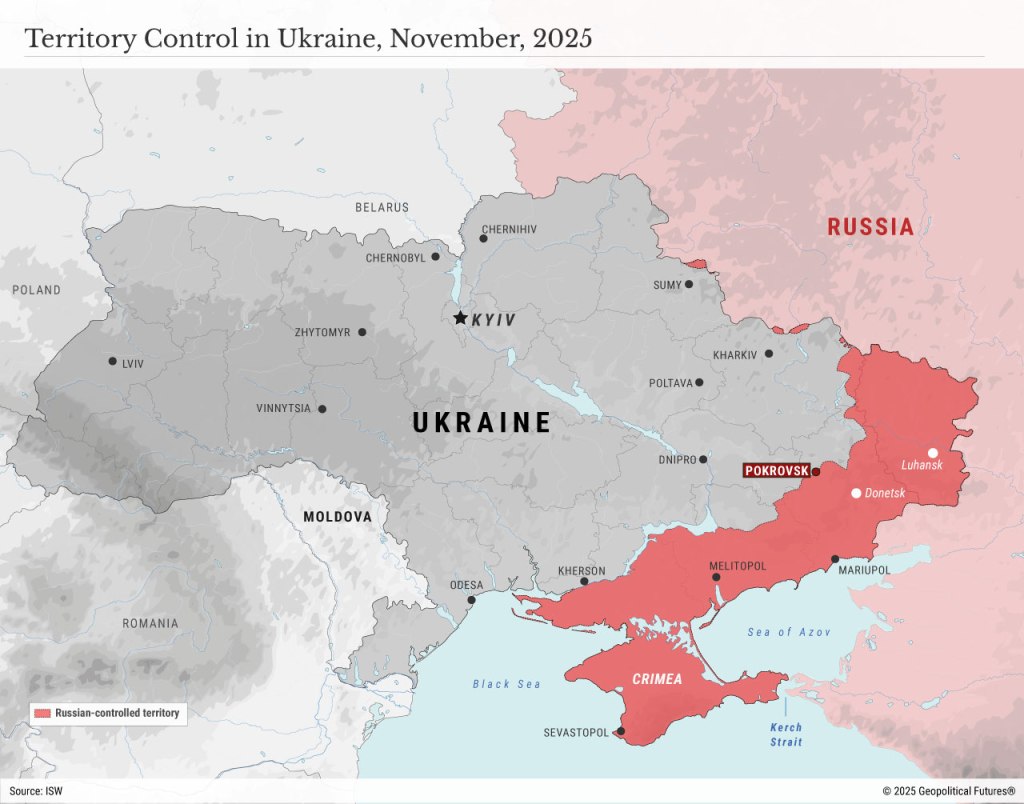
The following is a description of a process that I believe could bypass the current dead lock in peace negotiations. Today Ukraine is understandably against giving up territory for which it’s soldiers have died and, from their perspective, so is Russia.

picture credit: Geo Political Futures

On 11 May 2014 referendums took place under the Russian controlled Donetsk and Luhansk People’s Republics . They asked in essence, whether the population preferred to be Russian or Ukrainian. This initially appears fair towards the citizens as many of whom speak Russian. However, the results were clearly unrepresentative as by then large numbers of loyal Ukrainian’s had fled! The world was given a clear demonstration of how dictators use democracy when and how it suits them.

So, my suggestion is to take another look at this idea of asking the people of these regions the same question, but only after allowing displaced Ukrainian citizens to return safely to their homes and after peace has been declared and sustained. Such a process would have to be supervised by a neutral international organisation such as the United Nations.

This resettlement process should be given an extended period for the social, economic and political ‘dust to settle’; say five years. These parts of Ukraine would remain a demilitarised zone between Russia and Ukraine pending an agreed peace plan for the future. It is wise to acknowledge that Ukraine acts as a buffer zone between Russia and NATO. This has so far kept the two sides apart and long may it be so.

But presently neither Ukraine nor Russia can agree on the border and negotiations involving the United States are deadlocked. In such a case, consulting the people of those disputed regions must be the fairest way to decide.

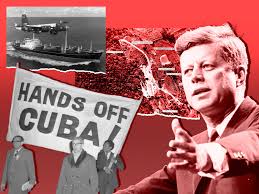
I would hope that Russia and Ukraine could invite soldiers in a peacekeeping role from non-European and non-NATO countries. The fear of NATO boots so close to Russia is in fairness to Russia, understandable. The Cuban missile crisis in 1962 that threatened full scale global war, was produced by just such a move and to repeat it at least in principle, would be to court extending the war for no clear advantage.

Cuban Missile Crisis 1962 picture credit The Independent

When reaching any peace agreement, diplomats work so that all sides are able to ‘save face’ and some sort of compromise is usually involved.

It should be pointed out to Russia that ‘Special Military Operations’ are not able to gain territory because of their self defined limits of operations. In contrast it is ‘total war’ that annexes neighbouring sovereign states as demonstrated by the German Nazis in the second world war. Ironically, we are told that the original aims of Putin were to eliminate Nazi’s from Ukraine and this story has apparently been the reason why Russian citizens are supporting the invasion of Ukraine. The right wing Azov Regiment in Mariupol were rightly or wrongly set up as the objective for Putin’s SMO. But it is clear that the initial invasion of Ukraine by forces on it’s northern border ‘on exercise’, intended to go straight for Kiev, with the intention of taking over the government.

Fundamentally, the two leaders are entrenched, literally and metaphorically over the old or a new Ukraine border. Therefore, I suggest that both sides should forget resolving their border claims at the present time. Instead, the regions under dispute and their populations, should be placed under the protection of a neutral organisation. There will be a promise and expectation to the citizens who live in those areas that in five years time they will be able to vote in a referendum to decide which country has sovereignty in their region. Immigration of citizens from both countries will have to be based on legal ownership of land and property otherwise illegal settlements will spring up as in Palestine!

Since Russia has already shown it’s willingness to abide by referendums over sovereigty, I would hope that Ukraine agrees to the plan. The delay of five years will allow genuine refugees to return to their homes, local and global economies and social services to ‘normalise’ and some stability to return to the regions. It might take ten or twenty years but this can be decided in the intitial negotiations over the agreement. Ultimately people will be able to vote for the system of government they prefer.

A note of caution when advocating referendums. They can be used to advantage as Putin has already shown. He has a precedent as also Adolf Hitler favoured using rigged, manipulated referendums (plebiscites) to provide a facade of democratic legitimacy to his dictatorship.

On the other hand, U.K. Prime Minister Margaret Thatcher disliked referendums calling them “a device of dictators and demagogues”. But she did submit to a referendum to decide whether the United Kingdom should join the European Economic Community in 1975.

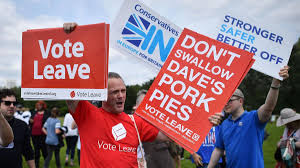
picture credit El Periodico UK Brexit

With this in mind, one should therefore treat referedums as carefully as unexploded ordance; the outcome can hurt! After a referendum result there might be left a substantial minority of disgruntled citizens for whom the outcome did not go their way. We saw this in the 2026 UK referendum over the question of whether to stay in the European Union. The result was narrowly in favour of leaving, a view that has reversed itself since. To avoid division and future instability, I suggest that a super majority is required of two thirds of the population before any result becomes law. The 50/50 referendum rule over Brexit was not open to public consultation. Brexit has illustrated however, that a large minority of disgruntled voters become considerably more political astute and active than a contended small majority and the same could occurr in the disputed Ukrainian territories.

To overcome perpetual border disputes, after a referendum has taken place, those uncomfortable with the outcome could be given the opportunity to move, together with generous compensation from Russia; what one might call ‘special military compensation’. Ukrainians could move to new Ukraine and Russian speaking Ukrainians who support the Putin regime could move to Russia.

War of Words

Words, good slaves but bad masters.

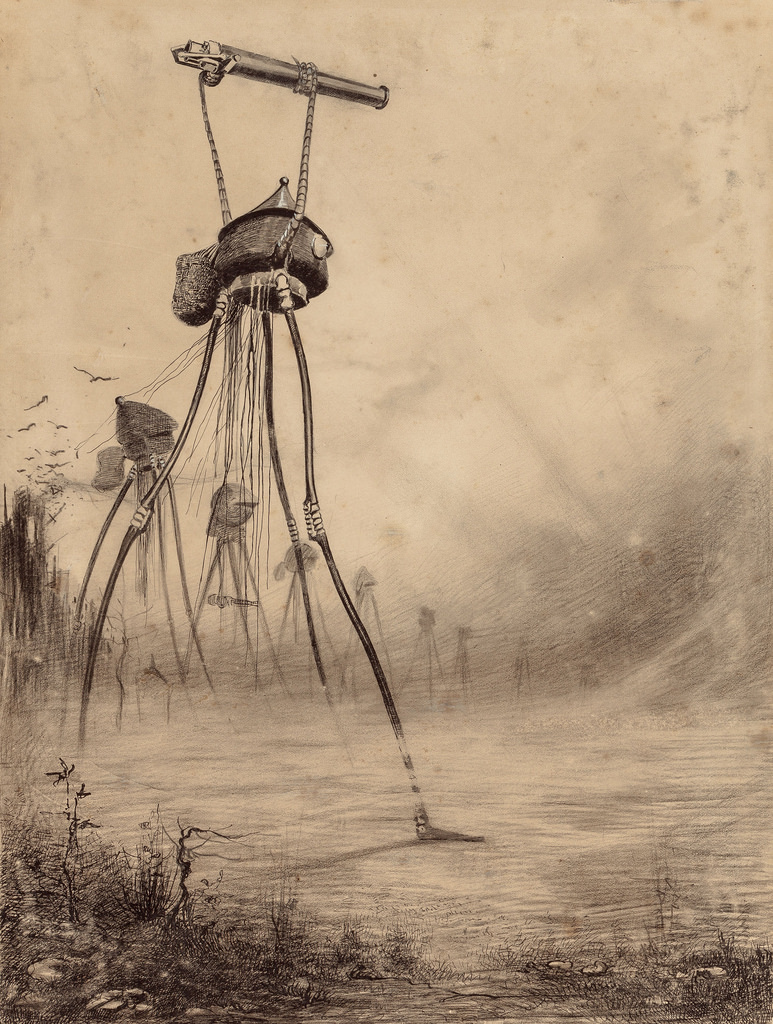
H.G. Wells wrote The War of the Worlds, a story about creatures from another part of the Universe invading the planet Earth and how the humans fought back. Words too can conquer worlds, especially the world in your mind. For this reason, I believe it is vital that we choose words that fit exactly the meaning we intend.

When speaking, we like to believe that we use words to converse clearly with others.

If there are no words in our own language we can create new words in fun and familiar ways. This linguistic phenomena is apparent in the speech of young people. New generations invent their own vocabulary with which to talk behind the backs of adults!

The power of language is it’s ability to open new perspectives on life. A restricted vocabulary will limit thoughts to the point that they no longer serve anyone’s best interest.

Words create our thoughts which can in inturn be inhibited by those words. Imagine a map of a city as a model of your neural pathways. Those journeys we repeat, such as to work, become familiar, almost over used. A map is also constrained by it’s boundaries. It does no show the whole world. The unreachable thoughts are as if in another dimension. Logic cannot venture beyond logic.

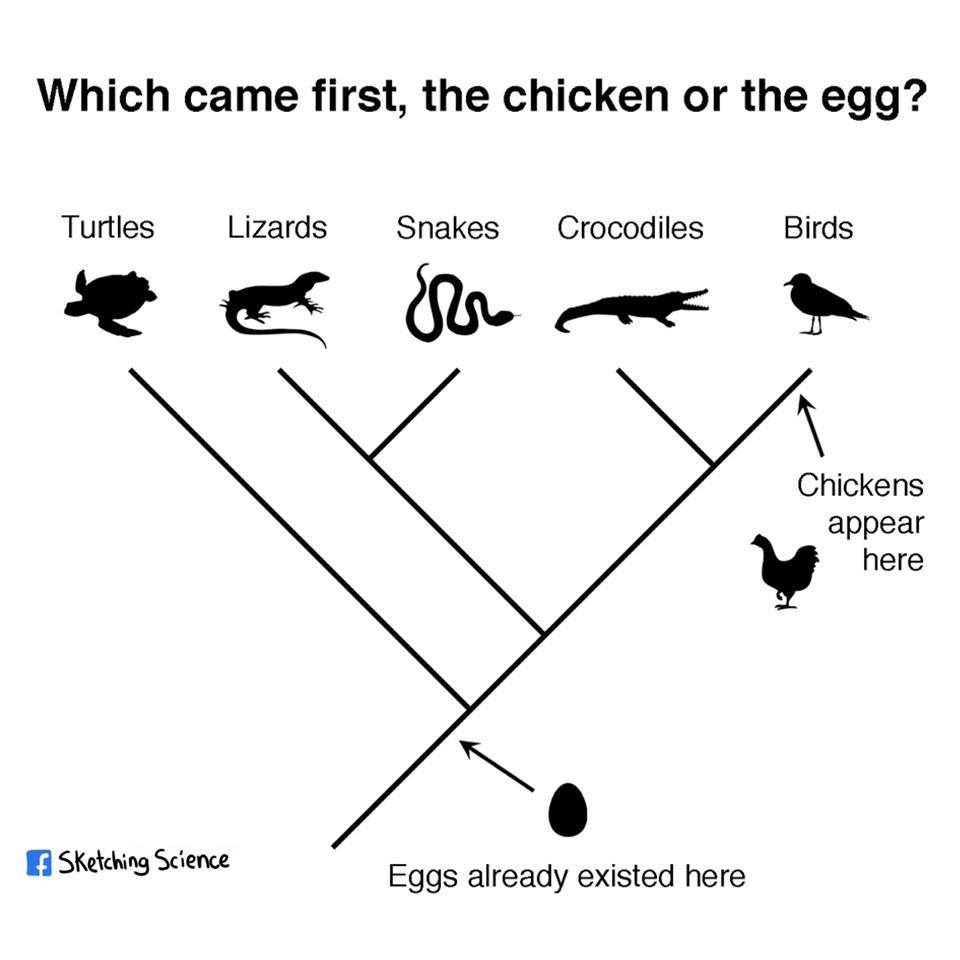
I listened to a debate on the radio recently in which scientists were challenging each other over the popular conundrum, ‘which came first, the chicken or the egg?’ They conjectured about birds as dinosaurs and an absurd point in time when the first egg was laid. Only one scientist suggested that change is a gradual process when viewed over long periods of time. No parrot changes colour over night. Evolutionary changes take thousands of years before being noticeable. There is no single moment when chickens and eggs come ‘into being’.

picture credit: The Australian Academy of Science

The same is true in astronomy. Do you believe the universe happened in a nano second as the so called ‘big bang’. Scientists are currently theorising that universes expand and contract over vast periods of time. The explosive power of the ‘big bang’ phrase, froze original thinking about how the universe began for decades. The universe was never a chicken, nor an egg…it is obviously both.

Semiotics is the science of language and meaning. In my view, we all benefit from understanding how we structure our thoughts using language and meaning. Here is an exercise;

Imagine a ‘cake’.

There are many categories we can use to describe cakes. There are cakes we sub-categorise by their ingredients such as a sponge cake, fruit cake, carrot cake and oat cake. Then there terms for cake which describe when we eat it, such as birthday cake, Christmas cake or wedding cake. Alternatively the means of production is a description such as home-made or shop-bought. Another way of thinking about cake is the origin of the recipe such as Black Forest, Dundee or French Fancies.

None of these sub-categories describe cake but the word cake includes all of the sub-categories. When we choose which cake is included in which sub-category we use thought to DISCRIMINATE between different cakes. This tool is an important power of mental faculty but unfortunately it’s meaning has changed in common usage. It has become to mean PREDJUDICE and in my view, there is a loss of meaning and ergo understanding, when these two are confused.

Discrimination is an objective skill whereas prejudice is subjective. When we think subjectively we mix emotions with logic. Feelings introduce prejudice for or against something in a way that cannot be explained logically. Insignificant examples are then used ‘prove’ to oneself and others that a prejudice is based on fact in a process known as ‘bias confirmation’.

Bear with me if you think I am stating the obvious but in my view much cultural, ethnic, racial, gender based, geographic, religious and political misunderstanding has it’s roots in how language governs thinking and in particular, prejudice.

A mind which for whatever reason developes a predjudice against a general category of something is in trouble. To use our previous example, it would be wrong to say ‘I don’t like cake’ when what is meant is that you do not like cake with a lot of cream.

When it comes to making prejudices against categories of fellow human beings we hit trouble. Any prejudice is more a product of intolerance, misunderstanding, eliteism, narrow mindedness and other unelightened views in the mind of the observer. However, we hear predjudice views in the news regularly so it is important to unpick how and why they are held.

Consider the term ‘anti-Semitism’. The German journalist Wilhelm Adolph Marr lived at the end of the nineteenth century. He popularised the term ‘anti-Semitic’ to describe anti-Jewish sentiment within political ideology and the general public.

This prejudice towards Jews we know has been present for thousands of years. What was new then was the term, ‘anti-Semitic’. It could be argued that this contributed to the start of the second world war and it remains in common usage today, so did it ever serve the world well?

Let us examine the term. We might question the meaning of the term Semite. Who can define what this means other than an anthropologist? Cynics might suggest the use of the term was a pseudo scientific device to impress and support a prejudice which in turn came from right wing views on eugenics.

Certainly just as ‘cake’ has many sub-categories, so does the word Semite. Historically a Semite might be from a specific geographical location such as Canaan, Judah, Judea, Israel or Palestine.

The term ‘Jew’ is entomologically derived from the tribe of Judea. Then of course there are sub-categories for a Jewish person by religion such as orthodox, conservative or reform. Then there are those who are Jewish but do not practice a religion such as non-practising Jews and those who do not believe in God such as Zionists; who might be Jewish or Christian.

Sometimes language is used to catergorise a ‘people’ and using this categorisation, Semites would be a group who speak Hebrew and / or Aramaic.

The Nazi’s in the 1930’s arbitrarily define a Jew by racial characteristics, not religion, derived from an elitist philosophy of the Aryan race being superior to others on which an extreme predjudice was based.

We might expect a national category of Jew, but the Supreme Court of Israel has determined there is no Israel nationality.

There are other sub-categories of Jewish identity such as by culture, ethnicity and politics, but I hope that I have made the point that the terms ‘Semite’ and ‘Jew’ mean many things to many people depending on what category you choose to define them.

Who is a Jew? picture: Instagram

There is a criticism of the term Semite as meaning Jewish by non-jewish people, that it ‘disingenuously’ excludes those who also identify themselves as Semite, such as Arabs. Does the term anti-semite poplarly applied to Jewish people, imply a denial that Arabs are also of Semitic origin?

In my view, the nineteenth century pseudo scientific phrase ‘anti-Semitic’ continues to obfuscate clear thought and sustains predjudice rather than exposing it. It has been used by politicians in particular with the intention including victims of the holocaust and stealing their suffering to gain the moral high ground. Such verbal smoke and mirrors has spawned wars and continues to do so to this day, unquestioned.

In my view, it time to clear our thoughts of words that do not describe precisely what they mean. This is not just a matter of taking sides but simply being clinically clear about where are ideas come from? Are they the product of predjudices? What are the intended and unintended consequences?

To be impartial in a debate that is more a minefield than a cornfield, let us reverse the coin and examine the current term for ‘hatred of Muslims’; Islamaphobia. Again, should we not question the use of this term? Should the psychological term ‘phobia’ really be used to describe a fear of spiders, snakes and Muslims? Clearly confusion, not clarity will result from humans being casually categorised using a word from the science of psychology incorrectly, rather than a clear expression most people understand.

Fortunately, words can serve us to correct such unclear thinking. We can invent new words or phrases in any language and in doing so, say exactly what we mean, fairly and without bias.

It should not be, but if a bigot wishes to describe a group of humans using a term of predjudice, then I suggest that those describing distaste of a sub-category of a human being, should use the prefix ‘anti’. This creates the terms anti-jewish or anti-muslim concisely and without ambiguity. Alternatively, the terms ‘jew hate’ and ‘muslim hate’ in countries where ‘hatred’ is an important aspect of a legal definition and unambiguous to all. The prejudice is clear to all and not spun with fake science. It also makes clear that these are irrational generalisations.

There is a war of the worlds, but it is contained in our heads, not the heads of other people who we may not understand.

In my opinion, the dangerous, self-unaware prejudices that thrive in the emotional biases of current politics, poison the thoughts of otherwise rational and compassionate human beings, and in doing so whole communities. Such hatred of difference is so divisive that it incites violence between one group and another. The simplest example is when governments of countries declare war on each other.

Words are powerful as they form a part of the process whereby we create and sustain our beliefs. How much of the horror that we see in the news today, started as copied or learnt bias, built on an emotional response to an unfiltered stimulus, that slipped under the barrier of compassion towards others.

It is clear to many but sadly not all, that those who express ‘anti’ views in the name of a religion, are not following the most basic rules of the religion they profess to follow.

Fortunately, those who are strongly, even violently prejudiced, are in a tiny minority. The general population do respect and are prepared to learn from, those who are different to themselves. The world’s religions all follow the principle of do-as-you-would-be-done-by.

Magick, Majesty and Matrix

‘The world is an illusion, a dream. It only appears to be real

to the person who is unaware that it is a dream.’ Alan Watts

There is a famous story about a trickster named Rumpelstiltskin. The daughter of a Miller must spin straw into gold. Her father has promised the King she has this skill, but she does not. A strange impish man appears and spins straw into gold on behalf of the Miller’s daughter for three nights. In return, she has to promise him her firstborn child. When she marries the king, she forgets her promise. So, the strange man appears again and demands her child, but she refuses. He says she has three days to guess, otherwise he will take the child. A servant happens to find the little man who is singing a rhyme, which includes his name. The Queen reveals she now knows his name, and Rumpelstiltskin sinks into the ground.

https://www.grimmstories.com/en/grimm_fairy-tales/rumpelstiltskin

The story has appeared in different guises but has the same structure worldwide. Academics have categorised the form as ‘The Name of the Supernatural Helper’ in the genre of ‘fairy tales’.

Like most such tales, it hides meanings beyond the level of a nursery audience. The Miller is clearly also a trickster archetype, as he tells a complete lie to the King, putting his daughter in peril of being called a fraudster. She, in turn, must make a Faustian bargain with the Devil to hide the truth from the King.

It is worth noting that politics today contains similar patterns of lies and pacts with hopelessly untrustworthy tricksters, for personal power and gain. Both President Putin in Russia and the Zionist Israeli government have invaded and made war with their neighbours, disproportionate to the threat posed to their own countries. They expect the world to be fooled by their deceit. A trickster ‘Trump’ ineffectively poses as a ‘peace maker’ to gain a gold medal.

Historically, Jeffrey Epstein is alleged to have made pacts on behalf of shadowy organisations with a view to shaming and blackmailing public figures. He could not spin golden threads from straw, but he convinced many that he could.

Such alluring but shady dealing describes the energy of the trickster archetype well.

To the princess, the character of Rumpelstiltskin is both a blessing and a curse. Psychologically, the creature represents the trickster archetype within her own shadow animus. ‘Stiltskin visits her at night and produces the desired golden threads each morning for three days, to get her out of trouble. It is worth noting that three is a magical number, as in the expression ‘third time lucky’. Names, numbers and spells sustain the suspense of this story.

The transmutation of base matter into gold is a representation of an alchemical and psychological mutation of lead into the noble metal gold, and a feminine persona and a male animus into a noble human, respectively. Perhaps the Miller’s daughter learnt risky deceit for personal gain from her father – her animus model?

We must question why the gold is spun into gold ‘threads’ instead of, say, gold coins? The spinning wheel is again a very ancient symbol. Mahatma Gandhi used it to represent ‘honest work’ to make a political point, but the wheel also represents ‘wholeness’ and the turning of the Universe we call ‘time’.  

picture credit:
Ancient Egypt Online

A sphere is the shape on the crown of the great creator and sun god Ra.

A thread is another old symbol going back to Ariadne and the Minotaur in ancient Greece. It represents the ability of the rational mind to follow a line of reasoning, the product of which today is the basis of science. A thread also suggests woven cloth or carpets, as in the magic carpets of the One Thousand and One Nights tales. Today, the World Wide Web is capable of transporting anybody anywhere in the world instantly.

The whole of the ‘reality’ in which we live has been described as an illusory matrix. In The Matrix cinematic trilogy, the character Neo can move from one reality into another. The Matrix is depicted on a computer screen as lines of descending pictograms. This is certainly an oversimplification and a product of the limits of computers when the film was made.

picture credit: Hindu American Foundation

Two eminent scientists, University of London physicist David Bohm, a protégé of Einstein and one of the world’s most respected quantum physicists, and Stanford neurophysiologist Karl Pribram have put forward a theory that the whole Universe is a hologram. In his book ‘The Holographic Universe’ Michael Talbot describes a ‘revolutionary theory of reality’. We may be familiar with lasers producing talking images of people located elsewhere in real time. There is now a holographic performance by the Swedish pop group ABBA in a London theatre, which many find remarkably real.

Abba Voyage in London: picture credit The Standard Newspaper

A holographic Universe involves ‘warping and wafting’ lines of information-rich energy to create what humans experience as matter. The ancients demonstrated the pivotal moment of their supreme control of matter by building the pyramids on the Giza plateau. Their dynastic evolution moved from an energetic world focused on minor gods and the afterlife, into solid matter.

In a way, this is what Rumpelstiltskin is doing. He uses golden straw to create the eternal element, Au or Gold. Intriguingly, the symbol Au derives from the Latin aurum, for Aurora, the goddess of dawn. Each day, poetically, the beginning of a new world; a new beginning for mankind, and the Miller’s daughter. So perfect are her tricks that she transforms herself from a humble citizen into a Queen. This is the alchemical marriage, as depicted in many of the Alchemist’s works and represents spiritual perfection.

In the story, Rumpelstiltskin says that he wants nothing except a living child. He has mastered the material world and now craves what he can not create, a living child, or you might say, consciousness. This also happens to be the limit of modern science, but perhaps Artificial Intelligence will take up the role of the ancient demigods?

Agent Smith picture credit Weaving Movies Wallpaper

The Agent Smith character/s in the film The Matrix are demonic autonomous programmes which have penetrated the firewalls of The Oracle and threaten humankind.

Key to unravelling the complex layers of our story is the riddle of the trickster’s name. Today, passwords allow us to enter a programme and keep others out.

Words represent ideas, and ideas are the initial stage of the Creation process. ‘In the beginning was the word and the word was with God and the word was God.’ (John1.1)

In magical spells, words and their ‘spelling’ are important. The most well-known might be ‘Abracadabra’, which it has been suggested to mean ‘may it be so’. It is a spell of manifestation and, more darkly, deconstruction. Abracadabra can be spoken, losing one letter at a time to ‘deconstruct’ something.

Rumpelstiltskin, somewhat vainly, believes the princess will never discover his name. Commonly, tricksters can become victims of their vanity and underestimate those whom they are trying to deceive. The politics of the USA today is poisonous with self-important deceivers.

So fundamental to his very existence is the name Rumpelstiltskin that when revealed, he physically deconstructs as a programme uninstalls.

He never achieves his goal of possessing and perhaps creating life. He is beaten at his own game of deceit by one who is more deceitful. The Miller’s daughter has done this by confronting the mischievous spirit within herself. When humans confront their shadow side in this manner, they become whole or ‘holy’. The trickster disappears.

A child will readily listen to this tale, not knowing and not needing to know its levels of meaning. It is a healing story; one that may be carried through life as a mental ‘anti-virus’ programme, always scanning for what will spin the creation process through the realm of dreams.

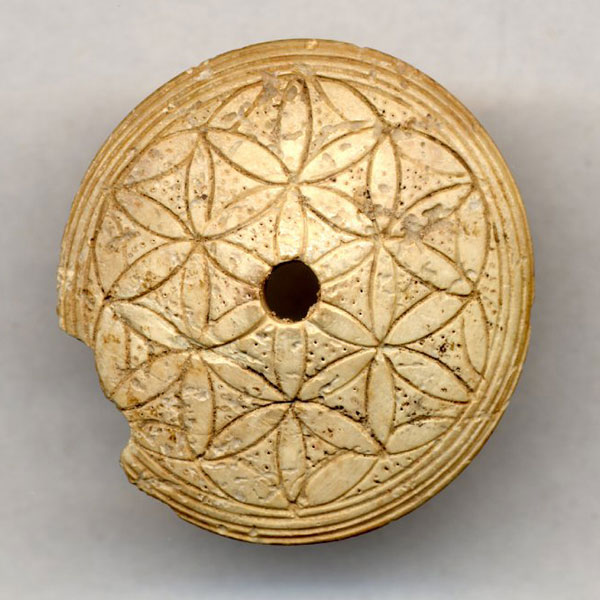
the Flower of Life picture credit Alziend

Peace Begets Peace

Most people hate war, especially soldiers, so why does it happen?

The problem is that war is an option of last resort. Ideally, all other options have been explored before war happens, but from then on, ‘the continuation of politics by other means‘, to paraphrase Carl von Klauswitz.

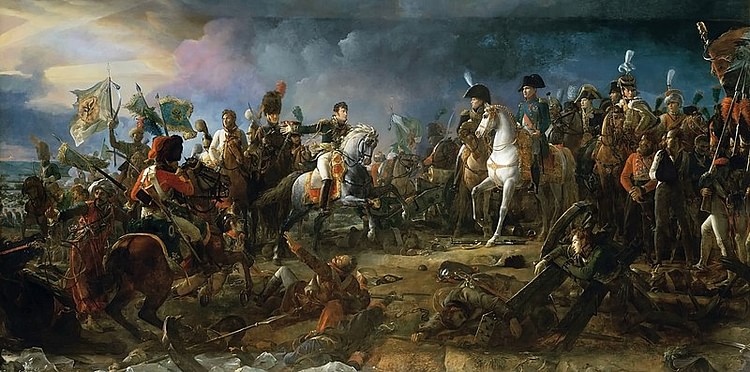
picture credit: World History Encyclopaedia

War will persist until it is possible to stop it; a process far harder to achieve than starting a war. Each conflict is a set of unique circumstances and different ways to reach a peace. At worst the war will become one of attrition and it becomes impossible for both sides to continue. Alternatively, political and public support for a war wanes or perhaps an overwhelming third force appears that compels surrender.

You would like to think that ‘how to stop a war’ is taught in military academies, but such executive decisions are more likely made my politicians rather than military leaders and politicians usually have no experience of ‘conflict resolution’ at this scale. Even in wars which have been wars of attrition, the conclusion of war requires considerable diplomatic skill. For if one side is forced into conditions of surrender that are too onerous and dishonourable, the process of recovery becomes excessively hard and national pride will almost certainly wish to seek redress sometime in the future.

The world might have learnt this lesson at the conclusion of the first world war, which was a spiral of attrition requiring the intervention of a third party; the USA to make it stop. The armistice terms demanded by the Allies, were so severe that they left a ticking time bomb, which exploded as the second world war.

The present war in Ukraine has been described by some as the beginning of the third world war, but there is another view. It could be argued that what is happening in Ukraine since 2004, when Russia annexed parts of Ukraine and later the Crimean peninsula, is an after shock of the second world war .

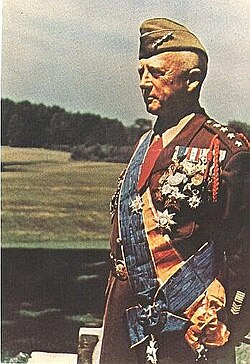
In that war, an American General raced against the Russians to roll his tanks into Berlin ; General George Patten.

The politicians tolerated his outspoken gaffs, because he was a superb military leader. Patten was of the opinion that the allies should continue to Moscow and finish the war for good.

The politicians ignored his advice and the United States spent the next few decades ‘fighting communism’ in what became known as, Mc Carthy era. Countries such as Cuba, Korea, China, Russia and Vietnam caused considerable headaches for the American politicians and military; feeding a neurotic culture of suspicion of called;  ‘reds under the beds’.

There is an argument that the present war in Ukraine is the continuation of the communist expansionism in Europe that immediately followed the conclusion of the second world war. President Putin justified invading sovereign Ukraine to the Russian people, by stating that his strategic aim is to defend Russia against an expanding NATO threat but less blatantly to fight ‘Nazis in Ukraine’. For Putin the ‘Great Patriotic War’ fighting fascism did not finish.

The technology of war inevitably played it’s part in this conclusion. The use of the Atomic bomb by the USA in the Japan, brought the conflict there to a sudden halt. Communist sympathisers within the Allies, gave the secrets of the atom bomb to the Soviet Union, who speedily test fired an exact copy of the American atomic bomb, shocking the world. Perhaps as intended by the ‘traitors’ who leaked the secrets of the atom bomb, this mutual threat has forced ‘the Cold War’ and an unsteady world peace ever since. Nine or so countries now have them and others want nuclear weapons despite the efforts of the International Atomic Weapons Agency, set up to prevent their proliferation.

It is important to realise that after the fall and fragmentation of the Soviet Union, Ukraine was left with fifteen pressurised water reactors of Russian VVER design, and importantly Soviet era strategic nuclear weapons.

Three of these ex-Soviet countries were persuaded to give up their nuclear weapons in the Budapest Memorandum on Security Assurances. Belarus, Kazakhstan and Ukraine agreed to give up their nuclear weapons between 1993 and 1996. The nuclear powers overseeing this process were the Russian Federation, the United States and the United Kingdom. They  agreed not to use military force or economic coercion against these three countries unless for self defence or in accordance with the Charter of the United Nations.

The diplomats and lawyers who wrote the Budapest Memorandum were perhaps, not clear about what constitutes ‘self defence’. Most strategists and tacticions, know that the principle of striking the enemy before they hit you, creates an element of surprise that can be construed as ‘defence’. Putin’s original ‘Special Military Operation’ was justified as ‘self defence’ but, unfortunately for him, it didn’t knock out his opponent with the first punch. The surprise was Putin’s. He thought Ukraine would be easy to take.

Putin constantly cites NATO as a growing threat, especially after the fall of Viktor Fedorovych Yanukovych, Ukraine’s president from 2010 to 2014. Yanukovych had promised the Ukrainian people in his election manifesto, that Ukraine would apply to join the European Union or at least set up special trade agreements which would lead to this. But after a phone call from the Kremlin, he enraged on this promise and there were riots in the streets. These were violently suppressed by the government leading to over 100 deaths. Yanukovych fled to Russia and Volodymyr Zelenskyy was elected president on the promise of European integration. Europe responded with indirect support.

Ukraine is an important buffer state for NATO because it has arguably, prevented World War III. It has so far, been a narrow escape for all, provided Trump isn’t elected and gives in to the Russians. The USA has not been good the diplomacy of war and should have learnt some important lessons, such as from the war in Vietnam.

An indignant generation of young people in the United States rebelled against the war in Vietnam as it was played out graphically on their television screens. Newspaper reporters photographed the horror of war; photographs which stunned Americans and the world alike. Young men angrily burnt their call up papers in front of crowds of anti-war protesters as four successive Presidents presided over an unwinnable war. In a way, the protesters against this and later wars (such as the invasion of Iraq by the US and coalition forces in 2003) stuck their flag in the moral ‘high ground’. War was wrong.

Awakenings of conscience and consciousness happen at the individual level long before  parliamentarians hear and reflect the ‘mood of the nation’. If war is going to be rejected as a method of ‘problem solving’, there has to be a global realisation of the immorality and futility of using violence against a fellow human being. It would be idealistic to suggest that this could happen in the near future but perhaps there is, a greater possibility for change than now, than there ever has been.

In my view, change will only happen with the introduction of a ‘third force’ which might be a charismatic world leader from this or another solar system, new technology or a third force with the means to eliminate humans, shared global problems of a catastrophic nature or just a spiritually and / or morally inspired realisation that violence is wrong.

The reference to ‘another solar system’ may have surprised readers! But the presence of advanced beings on earth is hardly a secret any more. The problem is that they are being characterised as violent and a threat to mankind. The narrative of ‘global security’ by successive U.S administrations, introduced ‘Star Wars’ under the Reagan and a whole new defence wing under Trump called the Space Development Agency. Hollywood has aided and abetted a global fear of invasion of ‘beings from outer space’ who wish humans harm.

The reality as described in Dr. Steven Greer’s film, ‘Close Encounters of a Fifth Kind’, is that highly evolved beings are watching and guiding us until we wish only peace for each other. World religions have been advocating this for centuries so humans cannot claim ignorance.

picture credit: Screen Space

Such a change of morals and consciousness is not a vain hope. There have been historical precedents. The crucifixion of one man in Roman Palestine, started a new religion based on love and compassion for all other people, including enemies. The election of a Pope gives some hope to the world that ethics may now take more of a role in international politics.

The demand for a planet where there is no war, is now in the hands of the politicians, lawyers, military leaders, religious leaders, industry. But the arms industry has been more interested in shareholders than ploughshares. The only possible novel outcome to being a victim of unrestrained violence, is for individuals to peacefully protest.

Mahatma Gandhi used non-violent protest to British rule in India. Peaceful overwhelming presence is an extraordinary power.  When it fails, it makes powerful martyrs but when won, makes lasting peace.

Beyond Good and Evil

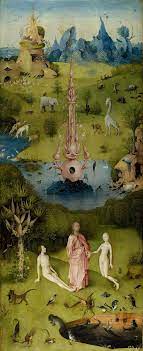
Genesis gives us the key to opening the door to everything. All we have to accept is that stories in Holy books almost certainly operate at many different levels beyond what is taught to children in Sunday School.

In the story of the original humans in the Garden of Eden, God ‘opens the eyes’ of Adam and Eve as punishment for Eve eating the forbidden fruit of the Tree of Knowledge. For in doing so their eyes are opened to the concept of ‘good and evil’, but we should not be side tracked by wondering what good and evil are. What is being revealed here, in my view, is that the Unity Consciousness of the blissful Garden, split into binary consciousness. If the reader overlooks the reference to newly realised binary opposites, then the message is repeated for reinforcement.

When Adam and Eve see each other naked, for the first time, their consciousness moves from being one, to two. This ‘same but different’ paradox between men and women is the same for all binary thoughts and words. Carl Jung suggested that the minds of men and women differ as metaphorically expressed by the nuanced differnces of their bodies.

The message in Genesis, is not about ‘good’ or ‘evil’ or ‘man’ or ‘woman’; it’s about binary thought; a fataly flawed characteristic.

But thinking in opposites creates an illusion of understanding. This is whispering serpent’…the one that slides down the ladders of thought.

In physics, nothing is black and white; there is just light and an absence of light and everything in between. But using opposites as a sort of ‘algebra’ for thought has enabled modern scientists to deconstruct nature and use it’s methods to make technology.

Batteries consist of negative and positive poles. The brain consists of left and right hemispheres. Breath goes in and out. Humans are born and die. Chromosomes are X and Y.
This is how have un-zipped the polarities that keeps atoms spinning, but there is a catch!

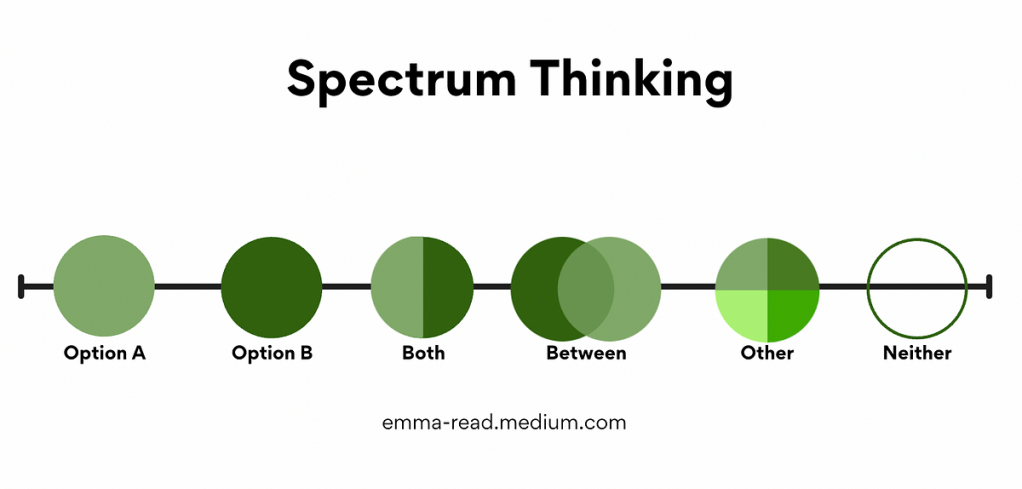
Our thoughts attach to the oversimplified opposites. Left and Right political views are a prime example of extremist views plunging the world into chaos. Edward de Bono introduced the non-binary word Po in his book Beyond Yes and No to express infinite possibility and a practical key to freedom of thought.

Opposite ideas should only ever be a mere framework for rational thought, otherwise the space in between disturbs ‘certainty’, leading to confusion and conflict. Consider a recent example;

In the United Kingdom, the Supreme Court has just ruled that a woman is a person who was born a ‘biological woman’. In other words, a ‘biological man’ cannot become a woman. This rule provides clarity for the lawyers; but is it true?

I would argue that the model does not fit neatly over reality. When it comes to the provision of public toilets, there will need to be a ‘third space’ for those with particular needs, for instance, those who feel different to their biological gender.

Is not an impossible problem for many ‘third spaces’ already exist as a ‘disabled toilet’. All that is needed now is a gender neutral sign on the door. Something that is not ‘men’ or ‘women’.

We see here that humans are not as simple as the rule of two ‘opposite’ biological genders. Consider the complexity of the body. We have a brain with left and right hemispheres. Each half has a nuanced contrast of functions; rational and creative respectively. Psychologically, each woman has an unconscious animus and each man has an unconscious anima. One in ten of us are left handed; the rest right. In some cultures, left is ‘evil’ and right ‘good’. There have been libraries written on the complexities of gender differences.

But we also experience a range of emotions, almost involuntarily, which can be categorised as ‘expansive’ or ‘passive’ in nature. Anger and valour are expansive and ‘male’, sadness and tenderness are ‘female’ emotions, for example. Of course, men and women have the whole range of emotions in varying degrees beneath the fig leaf.
Finally, the subtlest human characteristic that guides mind, heart and body is ‘intuition’. Albeit a peaceful, almost silent, internal voice, it has a function to guide us when we are lost. Another name for intuition is Soul, and yes, souls can be ‘good’ and ‘evil’ as illustrated in the Old Testament. There is a Bible story in which Joseph experienced wise, prophetic dreams. His soul’s ability to describe the future intuitively through the pathway of dreams is symbolised by his ‘coat of many colours’. Dream messages are not black and white, but as subtle as a colour from the subtle spectrum of light.

This level of subtlety is desperately needed today, in my view, if humankind is ever going to recreate the Garden of Eden on earth through deep compassion and understanding. If we do not, a Wasteland awaits.

Who is the third who walks always beside you? When I count there are only you and I together, but when I look ahead up the white road, there is always another one walking beside you, Gliding wrapped in a brown mantle, hooded. I do not know whether a man or a woman – but who is that on the other side of you?

What the Thunder Said (from line 359) from The Wasteland by T.S. Eliot

The Empires Strike

For centuries, Europe was dominated by Empire building around the world. In the Twentieth Century the Empires, such as the British Empire, finally broke down and gave autonomous sovereign states their freedom back. It might have appeared that the age of ’empire building’ was over, but that is far from the case.

In the Twenty First century it is clear that Empires are back. Key to the once powerful British Empire had been the Navy and control of the seas around the world. Today the vulnerable global ‘key points’ are canals and pinch points in shipping lanes. The Houthis in Southern Yemen potentially control the infamous Straits of Hormuz; gateway to the Red Sea and Suez Canal. They will stop attacking Israeli shipping, they say, when Israel stops attacking Gaza. Neither the British, USA or Israel have tested this, preferring to extend the genocide in Gaza and attack Yemen, than take the Houthis at their word.

One of the strategic reasons for the establishment of a pro-Western State in the Middle East in 1948 (Israel) was, and still is, control of the Suez Canal. In 1956 the British, French and Israelis sought to gain control of the Suez Canal when Egypt nationalised it, moving their tanks from the Gaza Strip into Egypt. In my view, this imperative has never gone away.

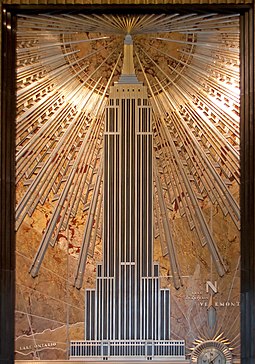
The Empire State Building, New York

MAGA? America is already ‘great’. It consists of a continent joined by an isthmus at Panama; again, a critical shipping route. The republic of the United States of America has a ruling president who wants to expand it’s 50 State Empire northwards and south. ‘Look at this arbitrary line between the USA and Canada,’ mocks Donald Trump, as if it means nothing just because it is straight. If it was meaningless, then Canada could claim the USA, as perhaps could Mexico and Denmark, but because of international law and common sense, they do not.

Putin wants the old Union of Soviet Socialist Republics back and China the island of Taiwan. Should then the British march back into India and Pakistan?

Should the French re-take French speaking Algeria?

Should Japan be given back it’s ‘Imperial’ territories in mainland China?

Should Italy claim back it’s Empire around the Mediterranean?

The list of historical reversals is absurd to all but the greedy and unpopular politicians who seek to stay in power indefinitely by empire building. Opponents are fed to the lions.

Today, Gibbon’s ‘The Fall of the Roman Empire’ is a critical read for the Trumps and Putins and Shi Jinpings of this world.

It is available in eight volumes and was read by a famous world statesman when he was twenty years old; Winston Churchill.

Now he knew a thing or two about world statesmanship and his preference for ‘jaw jaw instead of war war’.

Truth Against the World

or “Duw y Digon” ; an ancient Welsh Druid Motto

Swinside Stone Circle picture credit: Wikipedia

The first authority over our personal truth that we encounter is within the family. Losing power to others is an experience that we mainly survive, but should this loss influence us beyond childhood?

Most social organisation, whether it be for religion, employment, education, health, defence or politics, consists of submitting to the will of others; what is termed ‘the greater good’.

It’s a system that Western societies inherited from their forefathers. Consequently, most forms of government rely on the obsequence of the masses; the most extreme example being communism where the interest of the State trumps individual rights.

Even in democracies, the majority is granted authority over the minority; however small the difference. The assumed ‘unchallengeable constant’ is, that all people have the same intelligence, education achievement and wisdom. Socrates was at odds with such a premise two millennia ago!

The question is not whether to submit to authority or not. Someone, somewhere will have a hold over you. The question is not then, how clever are they? The challenge for all of us is not to give away all of our freedom but just to ‘render to Caesar what is Caesar’s’ (Matthew 22:21).

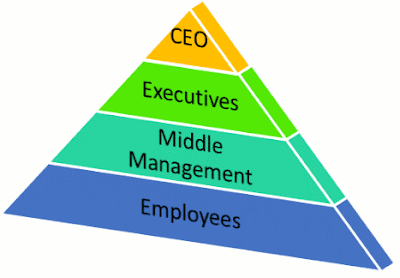
Authority manifests itself in social systems most commonly as a pyramid shaped hierarchy. In politics there will be an ‘overlord’ such as a President or Prime Minister, Chancellor or Chairman or Monarch.

Below the ‘head of government’ there are layers of middle ranking politicians. Unelected bureaucrats disseminate and legislate the strategies of the politicians. The general population occupy the lower part of the pyramid believing they are represented by those above and give away their power.

The military use an undemocratic system of organisation. There is a self organising ‘pyramid of power’. The organisation discourages individuals from thinking for themselves, requiring unquestioning obedience to orders from those higher in rank.

Take this ‘pyramid organisation’ model and transfer it to other social organisations and we see control by a minority of leaders;

Religions – Popes, Priests, Rabbis, Imams, Shaman

Companies – Managing Directors, CEO’s, Owners and Oligarchs

Education – Ministers of State, Head Teachers, Professors, Chancellors

Health – Ministers of State, Hospital managers, General and Specialist practitioners.

There have been exceptions to this ‘hierarchy of merit’. Google, for instance, practised an egalitarian approach to management for a while. At meetings, no individual oversaw proceedings. Each had a theoretical ‘equal say’. What happened in reality was that the person with the strongest personality and loudest voice controlled the meeting, rather than the person or persons with the best ideas.

So far we have considered how hierarchical organisations function. Now let us view the issue from another angle. Is it not the case that there have been in history, two types of leaders; good ones and bad ones?

This may sound trite, but it is an important distinction!

High ranking politicians for example, make promises about what they will do in government if elected. Few discuss the means by which they will achieve this objective. In this way, ‘making America great again’ fails to include a description of what greatness is, how it is going to be achieved and who is going to benefit. It even fails to describe what is meant by ‘America’. Does that include Canada, Greenland, Mexico and South America? Or does it just mean U.S. (us)? Such vague leadership is historically the breeding ground of disappointment at best and catastrophe at worst.

We know in Europe there have been good monarchs and bad monarchs. The last good monarch in England is said to have been King John of England (1166 – 1216). He was persuaded to give his royal power to his Barons. ‘Good King Wenceslas’ was good but European Kings and Queens were too often flawed by greed, anger, adultery, criminality such as murder, drug dependency, jealousy, war warmongering, excess tax demands, madness, religious dogma and bigotry, black magic and worse.

Good and bad are of course not always simple to define. In modern times political ideologies have split voters between the right and left. This is true in both the United States of America and an increasing number of European countries.

To summarise; in democracies people they to vote for who they regard as good leaders. The definition of ‘good leaders’ is unlikely to be agreed upon!

A creative thinker might desire moving power away from this divided collective schizophrenia.

A stabilising element of this unstable social organisation, is truth. For millennia, humans have obeyed whatever ‘truth’ those to whom they have given their personal power. They have been obliged to trust those who claim to be their superiors but in fact they are just acting out their weaknesses and lies! Hans Christian Anderson’s literary folk tale entitled ‘The Emperor’s New Clothes’ mocks the absurdity of delusional leaders and describes the masses failing to speak the truth to power.

Eventually, authority without truth, declines and falls. The Roman Empire is one of the best examples of this. So is there benign alternative to the many shades of autocracy?

In the North American indigenous tribes there was an interesting alternative form of leadership and wise counsel. People of the tribe would sit in a circle to debate important decisions on equal terms. To prevent them all speaking at once, a single feather was handed around in turn and whoever held the feather was permitted to say their truth without interruption. This was called ‘goose leadership’ after the manner of geese in flight that take turns to hold the point position at the front of the flocks V formation.

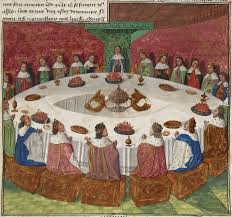
The legendary King of Britain, King Arthur, declined autocratic rule. He changed his throne into a round table for himself and his knights. In doing so he showed he was prepared to listen to others. Debate was valued for the truth of others, independent of their rank. Perhaps this was Arthur’s metaphorical sword of truth, ‘Excalibur’; released from stone hard systems of government.

As the internet today spreads it’s influence around the globe (another Round Table), disparate individuals try to speak their truth, honestly without fear or favour; so called ‘free speech’.

Humans of all races, have more in common than differences and thrive when not divided by powerful ruling minorities. Even the languages that once divided, are now being instantly translated by artificial intelligence. The ‘wisdom of the crowd’ is the ability of large groups of people to come to a benign consensus of how life is best lived.

A recent survey was made in the United Kingdom asking young people for their favourite word in 2024. It was not ‘artificial intelligence’, but ‘kindness’. The fact that the coming generation have this truth already in their hearts is good news for the population of the world in 2025…and world leaders would be wise to graffiti this word across their round tables.

An Annual Review

Am I Right?

At the end of several years of Matters Blog, it’s time for a review. As complex as life is, my aim is to express opinions based on common sense rather than personal or political bias. Not only that, but to suggest original and innovative solutions many of which have not been taken from the public domain.

The famous Dunning Kruger Effect states that amateur pundits have a false self image of themselves as knowing it all, while experts constantly doubt. So how did I do?

In 06 August 2018 I identified the shortage of affordable housing in the United Kingdom as a problem and offered a solution. My suggestion was that houseboats are moored on the UK’s inland waterways, rivers and lakes. They avoid the purchase of land and as temporary structures can be removed or replaced as needed. They can be built more quickly than a house and provided in enough numbers would create a stop gap whilst houses are built. The housing crisis had not been addressed by the previous government and the new government is intent on more building houses even though there are not the tradesmen to do it.

In 31 July 2021 the blog ‘HS2 Where?’ listed twenty reasons, including cost, on why the proposed high speed train route between London and Northern cities in England was doomed to failure. In 2024 the Conservative government reduced it’s reach to just Birmingham on the grounds of cost.

In 09 February 2019 I wrote a questionnaire for people who voted for Brexit. Apparently they were insulted at the suggestion they did not understand the consequences of Brexit. The questionnaire was intended to highlight the multi level complexity of the process and predictable effects of the UK leaving the European Union. When Brexiteers are asked today what the benefits of Brexit have been, few list any precise benefit. They say they no longer have to obey EU law and have gained ‘Sovereignty’. Ask how this has affected their lives and they will struggle to give an example.

In my blogs ‘Let Me In’ parts one and two in June 2022 and ‘Head for the Hills’ in December 2022, I examined immigration into the UK via unsuitable boats. The last Tory government made this problem a priority but chose a non-viable solution in an expensive plan to send unsuccessful asylum seekers to Rwanda. The slogan of intention missed out the detail of ‘how to stop the boats’ while their policy probably did the opposite. My suggestions included allowing asylum applications to be made from anywhere in the world to anywhere in the world. That hasn’t happened but the new Labour government have pledged to close down the people trafficking gangs which I also had suggested was long overdue.

In 22 October 2023, I published a blog I had written a week earlier following the attack on Israeli defence forces and civilians by Hammas titled Shalom, Salaam, Peace. I suggested that Hammas, as the vastly inferior force to the IDF, had no means to destroy Israel and were instead baiting Israel to over react to attack. Any ‘destruction of Israel’ would be done by the other Arab nations in defence of the people of Gaza, such as Iran. Since then the Iran backed Houthis in Yemen have taken up this role and significant others. I suggested an Arab leader would appear to take on Israel which has not yet happened.

In 20 February 2023 I wrote a parable called The Holy Forest about the politics of the Holy Land and how Israel will one day realise why people resent and hate the actions of successive Israeli Zionist Governments. I further commented on a better solution to bombing in Gaza as being the use of a multinational force of Special Forces to clear Hammas out of Gaza in my blog War Without End in October 24. To date the tactics of the Israeli Zionist government have not changed or met their stated aims of saving the hostages and destroying Hammas. I called out the genocide of the Palestinian early on in the process and qouted the Israeli post WW2 mantra of ‘Never Again’.

These and other blogs allowed me as an observer to suggest descriptions of complexity and apply problem solving techniques without using the techniques of over simplification, project fear and the illusionist’s destraction.

So thank you to those who click the ‘like’ button and may 2025 give us all hope my observations will become shorter and shorter as those in charge of us work smarter and harder for the benefit of those they serve.