Mean

One of the tricks employed by those who construct crossword puzzles is to include words which have multiple meanings.

Take the word ‘mean’ for instance. It may immediately have meant to you, ‘to be stingy, one with an ungenerous nature’. Then again it might have meant ‘something in the middle’. Or it might also have meant, ‘the significance of something’. It is this third meaning which I intend to explore.

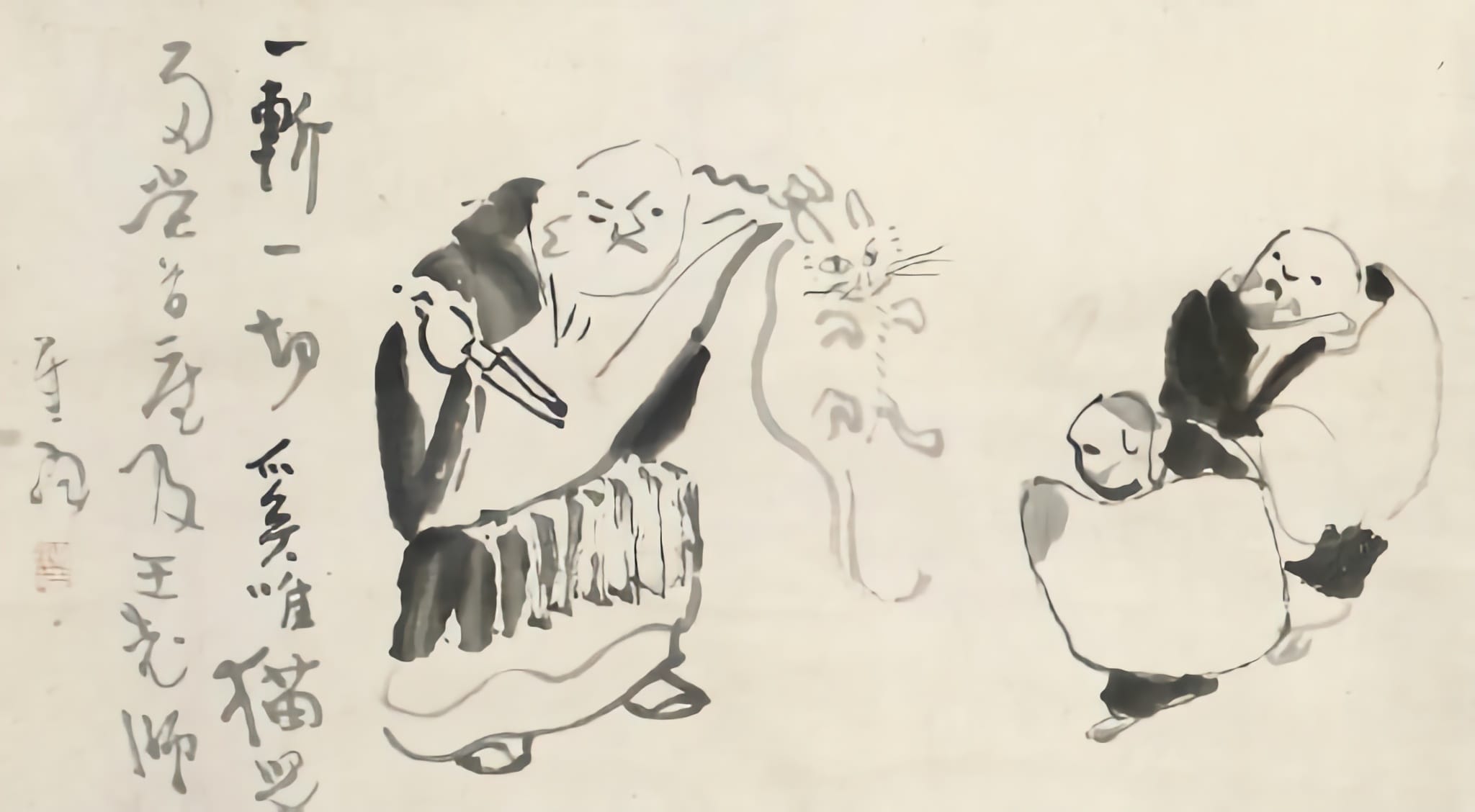
People with a philosophical bent of mind are often quizzing on what they construct as ‘the meaning of life’. This is as if the question, although perfectly constructed, can be answered. In reality it is one of those questions that has no answer, like a Zen koan. The Zen koan however is constructed because there is no expectation of an answer. Intellectual philosophers imagine that logic is without boundaries, when it is not.

‘Quick, who can save this cat?’

l who can save this cat

The ‘life of meaning’ is a far more fruitful place for philosophical meandering, because when we understand what everything in life means, then we must be approaching an understanding of life.

When I was a young man studying architecture, there was a course entitled ‘Architecture Studies’. This did not convey the content of the course at all and I did not sign up for the lectures; not least because the Professor who introduced the course had a highly debilitating stammer which I thought I could not endure for a year. The serried ranks of students had great difficulty containing their laughter including, I am ashamed to say, myself.

It turned out that this professor was only the head of the department and therefore gave no further lectures, for obvious reasons. Instead lectures were presented by one of the most inspirational teachers I have ever had. (I took the course without gaining credits for my degree as I was fascinated and delighted the ‘head of department’ earned his money in some other way than lecturing.) John Steel came from California, had long straggly hair, tan leather trousers with a lace fly and taught us to question everything.

He told us that when he studied anthropology, instead of heading out into the jungles of Borneo with the other PhD students, he remained behind and studied the tribe who were his professors. How I would have loved to have seen the look on their faces when they read his thesis!

In the third year of this course we focused on ‘meaning in buildings’. How buildings convey very subtle thought forms that have meaning to the creator and users of buildings is a fascinating, if little considered, subject.

We were lead in this year by professor Robert Maxwell who had made this theme uniquely his own. We read about semantics and semiology and how all life and all things are imbued with meaning, both consciously and unconsciously. The master creator will be fully conscious of what knowledge and or wisdom the building is to contain and convey. This additional level of complexity in design is not optional for without it, I would argue no building can be ‘great’.

The Pyramid of Cheops has to be the most obvious example of a building, despite or because of being geometric in form, is layered with levels of significance that we are still in the process of understanding today.

Pyramid; electromagnetic images at various frequencies

l pyramid energy

The challenge of seeping meaning into a creation is common to anything from popular songs to domestic appliance design. In popular songs, the lyrics can lift a mediocre melody into a new dimension and a singer songwriter who exemplified this has to be Leonard Cohen. His songs lumbered along on a series of notes that moved unspontaneously one tone at a time in either the upward of downward direction. Amadeus M0zart would have laughed if you told him the songwriter was famous. But Mozart might not have understood the high level of the poetry that Cohen achieved and how the meanings he explored, were loved by his fans. His contemporary Bob Dylan was likewise a major poet, and a slightly better constructor of melodies.

Contemporary Rap Music has learnt nothing from the example of the great musicians from the past and makes little of no effort in constructing melody. The whole song is contained in the rhythm of the words as if the complexity of melody is just too difficult, which is a loss to the genre and it’s advocates in my view.

Finding meaning in words is not hard to understand, but finding meaning in household objects?

If you wander into a shop selling kitchenware there is a brand which specialises in bringing salad tongs, toast racks and cruet sets, to life. They are given arms and legs and cute smiles that grin up at you creating that all important ‘love me’ moment.

The previously ‘dead’ object of utility has been ‘Lazarused’.

The Japanese are a culture who collectively love any object imbued with character and meaning. The front view of a Japanese car for many years, had to contain a smiling face rather than a sad one. Smiles sell.

l smiling car

Such examples of life entering objects of human design are sadly rare. Most buildings never feel the pencil of a loving creator that breaths life into form.

The anthropologist studying modern western culture will find few objects imbued with life and might conclude that 2020 culture is impoverished of meaning.

If you have no religion, then your walls of your living room will not be hung with smiling images of your guru, might not have a saint or cross on your wall and the sideboard will be empty of smiling Buddhas. But don’t worry, says popular atheistic culture, ‘just do what you want’.

But imagine you wake up one morning and decide on a whim, that you want a tattoo on your arm. You don’t know why, it is just something you ‘want’.

So you find yourself sitting on an uncomfortable metal chair in the waiting room of the local tattoo parlour. You are flicking through a well thumbed booklet of tattoo designs whilst listening to the gentle buzz of the tattoo artist’s machine behind a curtain.

As the moment draws nearer for your initiation, you realise that you cannot decide what you want. You quite like the Maori swirls but actually, the Tibetan clouds take you fancy as well. Or should you go for ‘I love Mum’, perhaps not macho enough?

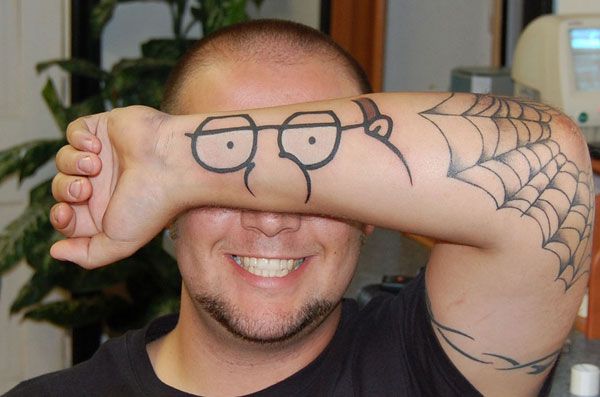
l stupid tatto

I would be very interested in a study of people who have chosen to be tattooed and how they made their choice. Do you think that the majority would present a meaningful explanation? ‘This is a prayer that my Aunty taught me when I was a child and I never want to forget it’ or ‘this is my blood group in case I have an accident’. Two thoughtful examples, but from what I have seen of the content of tattoos the answer is more likely to be ‘it’s what I wanted’.

Given that many in a multi-cultural western population will have few anchors of faith or ties with other belief systems such as ‘Hells Angels’, I expect that the majority of tattoos will be without meaning.

This is not a criticism of tattoos or those who have chose to have one. Traditionally, so called ‘primitive’ tribes around the world will have learnt to impregnate the skin with swirling patterns and designs that their ancestors taught them. The human skin was a book for writing on long before the invention of papyrus.

The problem we have today is that we have no subjects of interest and the readers don’t care if they did. Is this true even for architecture?

‘What is your favourite colour?’ asks the interior designer.

‘Blue’.

Most interior designers will know the significance of different hues and the psychological impact of these colours on mental processes and emotional responses. But the client will probably not understand these effects or wish to have them interfere with what they want. ‘I don’t know anything about art but I know what I like’ is the mantra of the uninitiated majority.

Those sceptical about the impact of colour in human messaging, should consider the skills of advertisers and marketeers.

l bbc logo

When the BBC have a red background to their logo there is a reason for this. It shows strength and an outgoing desire to search for truth.

l guardian newspaper

The Guardian newspaper online, chose yellow and black because this combination signifies a willingness to explore issues beyond the conventional. In nature it’s a waspy warning; in journalism it’s means ‘cutting edge’.

So to conclude, we ignore complexity at our peril. Yes, you can get by with just following a hunch and what you like. But you will rarely imbue your soul with the richness of any self or cultural understanding in this way.

By becoming a ‘skin deep’ society we risk losing contact with the expressions from the souls of our ancestors and beyond. We become no more than ink beneath the epidermis, injected to form a meaningless configuration. It stays for your whole life the body is returned to the ground.

Better luck next time.

I am

I am that, I am this, I am

There are three principle perceptions of the human mind. One is not ‘better’ than the other in moral terms, it is just useful to know how one works and experience mental and spiritual states objectively.

The first state of mind is the most common. It is the awareness of something other than self consciousness and is ‘I am that.’ It is the least real of all three and is summed up in the idea of ‘fantasy’. Like all human experience it can be positioned on a calibrated scale from weak to extreme. For example a person watching a narrative such as a film is fantasising, whilst also being aware of their own present mind and body. The fantasy is enjoyable. It fills the potential of unexplored human experience and is fulfilling in the regard of saving time, resources and often personal risk. Imagine watching a film in which the characters visit a wild life reserve in central Africa. There is an experience depicted by characters in the story; one or more of whom, the viewer will identify as being somewhere between ‘likeable’ and ‘I wish that was me’. They might sit in the evening around a camp fire and sing songs with the fire flies scattering in the flames and the crystal stars piercing the ocean black night sky. The roar of a hunting man-eating lion that has attacked several similar parties and is known in the area, sends them rushing to the safety of their vehicles.

I am Safari

This is a typical ‘I am that’ experience. Usually it is benign and is a willing and useful invigorating, promising stimulation to achieve such experiences ‘one time’ for real or just passing the time. It may add the ‘spice’ to an occupation such as those in ‘first responder’ roles experience. But in it’s harmful extreme, it is the illusion that drives a person to commit horrific crimes, such as mass shootings. The fantasy that they have nurtured for possibly most of their lives, finally overtakes their waking personality and they have to act out to achieve satisfaction. Acting out a fantasy is known as ‘psychosis’ and is so common that it is even a defence in law, though not a way of avoiding being withdrawn from society by the State. Humans acting out fantasy for real is not good and needs to be ‘enacted’ within an unreal place such as a modern gamer in ‘virtual reality’. The Ancient Greeks used the word ‘catharsis’ to describe the healing power of mentally exhausting the power of the fantasy over the rational mind, through theatre, songs and stories. Their stories such as Homer’s Odyssey remain powerful descriptions of the rudders, sails and oars of the human mind to this day.

The experience of such fantasy worlds is of course flawed in a very real and obvious way. The objection is ‘this is not you’ or ‘this is not me’ and that is clearly true. If the fantasy of being a world class athlete stimulates a person to become a world class athlete then the fantasy has worked as a transition tool, a stepping stone. But in modern society few get that chance. There is only one winner and one cup, one Oscar, one Nobel Prize. All the rest, in a competitive society, are left with unfulfilled dreams.

There is another state of mind which overcomes this. It is; ‘I am this’. This is a considerably more profound and rewarding attitude to personal experience. It gives no personal power to ‘the other’ whether these are other people or other activities or other places, times. The simple reward to being ‘I am this’, is realising that mind / personality has no real need to be other than itself. The reward is found in what one truly is. In this state of mind a Zen monk will relinquish identifying with possessions and social status, ‘cleverness’ in intellectual argument and most harmful of all, the allure of the other. Basho, the famous Japanese Zen poet and ascetic, was content with no worldly attachments;

The thief left it behind

The moon at the window

I am Basho

Because mind is realised as a totally personal experience independent of any other thing, the things that mind is not, are described as ‘illusion’ – or the dunna in Sufism, ‘samasara‘ in Hinduism.

The total clarity of ‘I am this’ can be achieved whilst wearing a pin striped suit, or two piece, driving a luxury car and living the a modern life style of ease. It is just that these objects and pleasures are not identified with as being any part of one’s higher self. They are as meaningless as the wind, because the person is continually aware and focused on ‘I am this’. Clearly having wealth and being detached from it, is more difficult than not having wealth and being detached from it. Ascetics have it easy and the Buddha realised this truth after nearly killing his body through starvation. He proposed a ‘middle way’ to truth without physical hardship.

This does not mean believing the fantasy of being a body. The sense of ‘this’ is so fundamental that it excludes one’s own body and body sensations. Buddhists argue quite rationally that if one loses a leg in an accident, one is still complete as a person – therefore we are not our bodies.

The was a song in the 1960’s by Donovan which included the lines;

‘First there is a mountain,

then there is no mountain,

then there is.’

This is a very clear summary of the states of mind being described. The perception of ‘that’ as being real, is seeing the mountain and all it’s mental and emotional associations. These associations are revealed as being mere ‘figments’ of imagination and not real; in which moment the mountain disappears. The relationship between viewer and viewed is realised as just a fantasy.

But of course, the mountain has done nothing through out all of this inner process. It has just done what it has been doing for millions of years – being a mountain.

This is the third state of mind summarised as; ‘I am’. The ‘I am this’ has been dissolved into the mist of the morning by the sun’s rays penetrating the dark night of the soul. The experience of life has become neither object nor subject. Things that were once held as real and true, never were and never will be. The only single experience is to become ‘I’ in the sense that the whole of created things and experience is identical and resonant to what human beings are.

We are not only created in the image of God, we are God and for suggesting this many a Sufi saint and Christian gnostic (Cathars, Templars), was flailed at the stake until death.

The irony was that such holy beings were never in their bodies in the first place and were laughing inwardly, no doubt, all the way to Heaven.

A Light to Lighten the Gentiles

I personally think Christianity would be a better religion if it recognised itself as a clever patchwork of beautiful stories arranged in a questionable order.

When Jesus was alive, there were many self proclaimed prophets, any of whom might have been chosen to be the ‘true’ prophet; not least of whom was the also immaculately conceived, John the Baptist. He has a following even today who are known as the Johannites. It is said he was the secret prophet of the Knights Templar and such Renaissance notables as Leonardo de Vinci. So who made Jesus – the Christ?

The Roman Emperor Constantine became a follower of Christianity and through the Roman Empires in the East and West at that time, Christianity became the State religion.

Constantine the Great: picture credit Wikipedia

Constantine the Great

In the process of change and at the Council of Nicaea in 325 AD, various books, were not included in the New Testament. In modern journalistic parlance, a ‘hatchet job’ – but a clever one. Clever because it contained the best of the old and the best of the new. It had to be good to have survived to the present day.

This Council meeting also sought to agree on the principle of a universal date for Easter, although it stopped short of setting down a method for this date to be calculated. After much disagreement this date became established according to the lunisolar calendar. No need to go into detail on this complicated subject here, but bear in mind that it is related to the 21st March in the Julian calendar; that is the vernal equinox.

Most religions are based on ancient ideas, but sometimes opportunities for improvements from new knowledge and reflection are missed.

If you asked a young child about the seasons, you would get a reply that spring is about birth and winter death. Despite this simple truth of natural cycles, Christians are given the story that Jesus died in the spring and was born in the winter. The Bible does not tell us this. Only copying other ancient religions have determined these dates. At the time, when Christianity was seeking dominance as a religion, resemblance to old ways was important in convincing people to adopt the new ways.

So, let us reflect on the story of the birth of Christ and see if it fits best into spring or winter.

picture credit: Pinterest

Three Kings and God's Sun

The Magi followed a star in the East. These astrologers would have known the difference between a star and a planet, but there are theories that in 7 BC in 4th April the planet Venus appears to stop in one place at it’s brightest, due east. Alternatively, Venus is the brightest object in the sky and the three Kings may be an astronomical metaphor.  What we do know is that the new prophet was the ‘sun of god’, a bringer of light and love, a new era, who later told us, ‘I am the light of the world.’

In Ancient Egypt the months were determined by the arrival of known stars on the horizon. There were twelve of them, from which our modern months are derived. We have kept the solar calendar of the ancients. When Herod interrogated the Magi, he ‘enquired of them diligently what time the star appeared.’ He wanted to know when the prophet was to be born and the answer they gave was only accurate to within two years (as Herod later ordered the killing of children under that age). Even these astrologers were unclear on when Jesus was to be born.

Joseph and Mary were responding to an edict to go to Bethlehem for a census and pay taxes. This was unlikely to have been arranged in the middle of winter when nights are cold and days shortest.

Mankind’s new spiritual era is symbolised by the birth of Jesus in a cave (not a stable as in some versions of the story). This cave was a well known symbol to the Ancient Greeks, such as Plato, of the human skull and therefore mind. The birth of a child of light in the brain represents a new level of consciousness and the opportunity for mankind to raise their understanding and experience of life. Historically, this is exactly what Christianity achieved, although it could be argued many other religions might have done the same equally well such as Buddhism in the Far East. 

Should we ask, why were shepherds were in their fields at night? Any country person will tell you that the time of year when shepherds are working around the clock is in the lambing season – the spring.

Common to many solar and Pagan religions, there are four important landmarks in the calendar. These are the summer and winter solstices and the spring and autumn equinoxes. Most churches face the spring equinox, for the sun rises due east on 21st/22nd March. The Sphinx which turns it back to the pyramid of Cheops in Egypt (and faces all four of these points exactly) faces due east.

So fundamental are these seasons and the new consciousness of light and love to the message of Jesus, that he is even crucified on a form of compass; the cross. That remains his symbol, although many other symbols could have been chosen.

Ishtar

The goddess Ashtaroth or Ishtar of the Babylonians was a fertility goddess. The word ‘Easter’ is probably derived from her name. The conflation of the word ‘east’ into ‘Easter’ should not be overlooked. Her symbol was also a rabbit, on account of their love of procreation, – but Jesus had no connection with rabbits!

Easter is all about looking to the east, for it’s wisdom, it’s new light, new hope and it’s rising sun. It is clear to me that the birth of Christ in the spring of each year represents a message of the dawn of love.

Ressurection with Rising Sun: picture credit Raphael

Resurrection-oil-Christ-wood-panel-Raphael-Sao-1502

If any of the above is likely to be true, then it would be more convincing if the death and rebirth of Christ fitted the narrative of the winter solstice. I have taken up enough of the reader’s time, so let me suggest that you explore this possibility with an open mind and form your own opinion. To compare the dying and re-birthing winter sun with the dying and re-birthing son of the Father, I found to be a light to enlighten the Gentiles.

Red Ball White Ball

These series of essays have one common theme. They take another view from the conventional one. In life, we encounter complexity and the principle way we deal with this, is to simplify. When this happens however, something is lost and often that thing was the most precious. It is called;

Throwing the baby out with the bath water

Problem solving is one life skill that is invaluable, more so than, dare I say it, algebra. Almost everything we do and our games are problems in need of a solution. If the bath water is cold, mothers remove the baby before throwing the water on to the garden. It may sound obvious but often problems present in confusing ways…too many things are at the same time. That is when the baby ends up in the rhubard patch.

baby_bathwater

A game such as Snooker is a problem solving game. The players are presented with the complex task of putting the red balls into the table pockets. Complexity is introduced by rules. One is that the balls can only be pushed with a stick; you cannot pick them up and put them into the nearest pocket! Then you have to push a coloured ball into a pocket alternately with a red ball, and a scoring system giving values to balls, means that the best player will win prize money and fame. But the most complex skill of all is the use of the white ball. This must be pushed with the stick to hit the other balls and it must always be controlled, so that it comes to rest in anticipation of the next move. Those not familiar with the game take a while to realise that hitting the red balls is not the primary objective, but skilfully placing the white ball as it rebounds off the red or coloured ball. With this skill you  solve the obvious problem and set up for the next problem, within your own hidden game strategy.

red ball white ball pocket

Complete problem solving involves a highly inclusive level of complexity, where consequences are anticipated rather than left to chance. There must be no ‘unintended’ consequences.

Stage illusionists know that the human brain simplifies what it sees in order to interpret what it is seeing. They use the technique of distraction. They know that the audience will watch the hand thrust towards them whilst something not to be seen is done so fast and discretely, that it is not seen. This is classic, red ball, white ball.

Politicians have to solve highly complex problems and apply practical solutions. The first stage of problem solving is to define the problem.

At present the world economy’s are being threatened by a pandemic. That is the problem. People with the disease are a short term problem, whereas the world economy needs to provide work and a livelihood for every citizen of every country. This is a far greater problem in the long term than the present ‘red ball’ events presented to us daily concerning Covid 19.

We are told that the origin of the new virus was from markets in China where bats were being sold. We all believe this. This is the red ball. We think we have seen it go into a pocket. But did the Chinese authorities close down the markets selling wild animals? Why didn’t they after SARS? Could there have been another source of Covid19?

One Chinese lady interviewed declared, ‘This could have happened anywhere’, being defensive over the suggestion that this and previous viruses like SARS, happen in China because of their love for exotic meats. Perhaps she has been told that people in the West also eat bats and rats and cats. That would be her ‘red ball’.

There is an Institute for Virology in Wuhan; the Province where the outbreak is alleged to have started. You might expect that they would be anxious to deny accusations that they let out and or create Covid 19.

Yet if you view the home page on their web site, the top story is about HIV. The top news story is that a delegation from the Ministry of Education of Kenya visited. No red balls present, just a white ball suggesting the aim of the Chinese to develop the untapped resources of Africa.

Was there a terrorist incident involving the release of this virus, as has been the plot in Hollywood films?  Are too many people now living in cities? Have individuals immune defences been reduced through poor diet and lack of sunshine? Is there more than one variety of Covid 19, one strain being more virulent than the other? (The purpose of this would be to increase fear of the virus whilst limiting deaths.)

Could there have been some political placing of the virus in a country to destabilise it more than other countries? Both China and Iran are viewed as threats to peace in the West and Middle East by western politicians.

These and many other possibilities, are unexplored but possible ‘white balls’ that indicate hidden agendas. But we are too engrossed with watching red balls (or red herrings!?) fall neatly into pockets.

Few journalists have asked challenging ‘white ball’ questions on the television screens in the west. What is being presented are ‘red ball’ events such as where the virus is now and in what strength. Which events have been cancelled, how is it going to affect various people in various situations, etc. etc. One red ball after another is being put into a pocket and as quickly as they go more appear on the table. It’s fascinating and distracting.

The real question is ‘what is the white ball doing?’

Who is behind what is going on, is an unspoken question. Any suggestion that the pandemic is a deliberate manipulation is ignored or described as ‘fake’ or ‘conspiracy’. And yet, the most important rational task, is to discover a conspiracy if one exists.

Puppet President

Who is pulling the strings of the puppet president of the United States of America for instance? Why? Because Mr T. started the health emergency by denying one exists and that it will go when the weather gets warmer in April…standard off the cuff remarks made by the uninformed. Behind the curtain a patriotic doctor who started testing for Covid 19 is told to stop, as that is the responsibility of another department. This department came up with a test three weeks later which did not work. By this time the Jennii was already in LA and not to enjoy the surfing. 

We saw the same ‘white ball’ tactics with 9/11. Every day of the year, every hour of the year, fighter jets are on the runway, ready to defend the USA from hostile aircraft entering US air space. But on 9/11 all those jets were off somewhere else on a pre-planned exercise. The guard was down. International conspiracy? The prize for the winner of that game was to up national surveillance and remove individual freedoms for Americans. It is called the National Security Agency and it is saving everyone from terror plots.

Who will gain from the current pandemic and the fall of western economy’s? No individual government gains. In fact they all lose. The only gains will be upping international surveillance and removing individual freedoms.

Specifically, cash will be removed as a system of payment, on the grounds that it ‘spreads viruses’. This has never been true in the past few thousand years but suddenly it is. In place of cash is the card (or RFID implant) and the control this brings to governments to know where it’ s citizens are and whether it wants to allow them to have personal money.

Second is the extinction of small and medium size businesses and the self-employed. Examples might be taxi drivers who own their own cars and certainly low cost airlines. This is in contrast to large and multinational corporations such as Amazon, Microsoft and Google, who act in the interests of the large white ball.

One day this large white ball will put the last ball of the game in the pocket. That will be the black ball worth seven points. If you think things are dark already, then that will be the blackest of black days; the end of personal freedom. Game over.

Don’t Fence Me In

This the title of a wonderful old song sung, I think by Bing Crosby. It’s all about the exploration of the west in nineteenth century North America. After millennia of humans and animals roaming free, cattle ranching introduced ‘ownership’. The Native American Indians didn’t understand it and gave away their lands before they realised they would have to fight and ultimately die for the ‘reservations’ that were left for them.

picture credit; WallpaperWeb.com

Stampede_African_Cape_Buffalo_Herd

It is an paradox that man craves freedom but loves boundaries. Astronauts report on viewing earth from space, that it appears as one planet. There are no political boundaries that we are so used to see on global maps. Boundaries are ultimately arbitrary. They serve only the tribal mentality of ‘them and us’ present in early man and persisting, almost unconsciously, to the present day.

The poet Robert Frost wrote a poem which included the line, good fences make good neighbours. This concept, at one end of the spectrum of possible combinations of freedom and enclosure, works – but only temporarily. Eventually, because of tribalism and greed, a fight breaks out.

When the British realised the rule of India by a distant Queen of England was over, they were faced with the problem of handing over a sub-continent to self rule. A problem because the Muslims and Hindus were at each others’ throats. If the British left there would be a blood bath. So they drew an arbitrary border on a map and created a new country, Pakistan. Like the creation of the Berlin walls, it divided families, created mass migration, a loss of homes and livelihoods and riots and slaughter. Tribalism, whether under religious or any other banner, is never good for all. Today India and Pakistan face each other with tolerant hostility, with a hundred nuclear missiles each, ready to wipe out each other and the rest of us. As an afterthought little Kashmir remains a flashpoint where this could happen. When you draw political maps, you had better know what you are doing for now and the next thousand years.

When the UK made the minority vote decision (only a quarter of the population voted in favour of Brexit ) to leave it’s partners in Europe, it had not considered the effects this would have on Northern Ireland and Scotland. The border in Eire was created centuries before to create a ‘non catholic’ portion of Ireland that could be controlled from England. The political reasons for it’s connection with United Kingdom are changing, and a likely consequence of the UK seeking ‘independence’ is losing Northern Ireland to the Irish and Scotland to the Scots.

Virus’s, and all the malign forces that nature unleashes on humanity; virus’s do not respect political boundaries. It takes two weeks for a virus to travel around the globe. The only way to extinguish a virus is for each person to crawl into their own cave and stay there. They may die or they may survive. In this situation one is not even aware that one’s neighbours, also potentially dying, are on the other side of the wall.

When this current Covid-19 pandemic is over, as it will be, the nations of the world should take stock. They need to seek to understand the lessons that come from such a pandemic, for virus’s are a greater problem than terrorism and extremism and wars and all our man made horrors. In 1919 the second wave of Spanish Flu killed everyone who caught it.

Surely, world leaders must learn that humanity has more to gain from co-operation and tolerance towards all living beings, whether animal or human. There are no boundaries in nature except those created by habitat and when there is enough habitat to go around, everyone is happy. When large populations move to escape political or natural upheavals, these people are ourselves coming in the other direction.

In Europe, the European Parliament and non-governmental organisations like the WHO, have failed to create a strategy to cope with immigration. Countries on the edges of Europe such as Greece and outside such as Lebanon are full to bursting point. Now Greece is shooting warning shots into the sea at immigrant boats.

In the United States, the solution to immigration from Southern American failing states, is of course ‘a wall’. As if we had not learnt from history how the Berlin wall was pulled down and how Palestine was shrunk into walls – good walls rarely make good neighbours.

Mankind craves to be free and this moment in history is a time for humans to come out of their caves and obeyance to tribal rules. Instead of hating and fighting each other, we are in a position to see the greater picture from above, where barriers do not exist. There is only humanity, and the sooner we treat the planet and each other with humanity, the sooner we will lose the feeling of being ‘fenced in’.

The Good Life

There is a remarkable pair of photographs on the BBC website today. They show satellite images of eastern China, Hong Kong and Japan. The images are filtered to show the intensity of air pollution. The January 2020 image shows ‘business as usual’ and the principal cities and urban conurbations are highly coloured from yellow to high risk, red. The February 2020 image shows no coloured areas at all! The air is clean because production in the factories has stopped. Ironic that such a gift to the populations, of sunshine and clean air occurs when millions are in quarantine.

The message we can draw is not how contagious viruses are – we know that. No, the message so plain to see is ‘slow down and stop!’

slow-down poster

The industrial tenets of, ‘more and faster’ for profit and a promise of prosperity for all, are also familiar to us. Humans deserve a good life so the growth of benefits from industrialisation, cannot be denied. Over one hundred and fifty years ago people started to leave the land and live in cities. This process means that now about half the populations of most countries live in cities.

In response industrial production is speeding up, as robots and AI are literally taking over from humans. The only question is; at what point is ‘a good life’ reached?

A casual observer in a modern metropolis, might perceive a collective sadness in the faces of passers by – anxious to reach their individual destinations. If asked if their life is a ‘good life’ – I wonder how they would reply?

picture credit: WithPause.com

Snail credit With Pause

When I was a student in London in the mid-70’s, I took part in a ‘slow walk’. A collection of willing volunteers met at the north end of Hammersmith Bridge and lined up across the wide pavement. We set of in a bunch like marathon runners, only it took us three or four hours to reach the south side of the bridge – a distance of maybe three hundred metres.

Slow walking took discipline at first, but soon became strangely normal. My mind felt completely relaxed. I might as well have been in meditation – in fact, I was.

picture credit: Londr.com

hare and tortoise credit Londnr

That was part of my ‘good life’ when I had time to be fast or slow and chose the latter. There are in the present day, many experiences of ‘slow living’ available as an alternative to the human ‘race’. There is slow food, slow travel, slow cities, slow schools, slow books, slow living and slow money. See www.slowmovement.com and tell your friends!

In 2020 humanity is crossing the threshold where too much – too fast – too wrong – is damaging the planet and as a consequence, ourselves. Whether it is air pollution, sea level rising, food shortages, water shortages – industrialisation is ‘biting back’ the hands that turn the handle.

Sloww-Slow-Living-Synonyms-Infographic

This latest virus Covid 19, is amongst other things, a firm message for humans to ‘slow down and stop!’ Perhaps those confined to a room for two weeks, will draw a positive from the experience. ‘Not doing’ can alter expectations significantly. If ones normal expectations are unrealistic then the distress that comes from failure to satisfy those expectations, will never be encountered. Success or shall we say, contentment, comes from watching a spider cross a floor or a raindrop slide down the window; experiences usually never observed and enjoyed.

We will inevitably all discover that less and slower is more!

Somewhere between the extremes of fast and slow, is where humans can find the ‘good life’ they seek. How close to ‘slow’ do you dare to go?

Agro Soap and Shampoo

What is it with Hotels? I have to admit to having a problem with them, however hard I try explain what I expect and need when booking.

A great big sleeping thing called a BED

q hotel corridor and bed

The clue is in each hotel room. Central to the arrangement of most hotel rooms is a bed and a bed is generally, for sleeping in. And there we have the crux of where I find most hotels get it wrong.

The whole notion that their guests basically just want to comatose, appears to be foreign to them. Because of this fundamental misunderstanding, much of what hotels provide becomes a waste of effort and money for all parties. People who want to sleep and or are asleep, do not require a conference suite, a swimming pool, a spa, a restaurant, a dining room, a cinema, a grand view of the city, an entertainment programme, a stage, a discotheque, wide screen television for sports coverage etc. etc.

We just want a bit of peace, a toothbrush and a razor.

Instead, you get aggravation, a piece of soap and shampoo.

The problem with so called ‘facilities’, is generated in part by the hotel star system, which awards stars not on the quietness of the hotel and politeness of its staff, but on the breadth  and extent of it’s facilities.

I can well imagine there are many families and business travellers who intend to spend days and weeks within the confines of the hotel and need these things, in which case these quests should be directed to hotels which are not focused on providing an environment for guests to sleep.

If I were head of Tourism in the United Nations International Peace on Earth Mission (if they don’t have one they should) I would categorise hotels between places of rest and unrest. I would award ‘bed’ symbols for quietness rather than ‘stars’ for what ends up being sources of disturbance.

The clue that you don’t have to be Sherlock Holmes to notice

quiet-please

Perhaps it is time to give some examples of what I mean about a hotels lack of sympathy to some guest’s needs and expectations. I think back to earlier last year when I went with friends to a charming town in the Alpujarras in Southern Spain. The hotel where we stayed the night had a central courtyard around which corridors accessed private rooms. The floors and walls of the corridors were tiled which meant that every footstep reverberated ten fold depending on the quality of the steel in toe caps. Even worse, my friends in the morning complained that they had to endure a woman talking for two hours on her mobile phone in the corridor, before they could get to sleep.

Last month, I booked a hotel on line seeking quietness above all other features. After as extensive a search as possible in a holiday town full of hotels and hostals of all descriptions, I decided upon a hotel. When I arrived I discovered it faced a busy main road, a feature no included in the photographs or descriptions. Worse than that, there were only five rooms and these were directly above a restaurant and bar.

When I asked the owner for a quiet room I was told that they were all quiet and if I didn’t want to listen to the traffic I only have to close all the windows. I said I liked fresh air, just to put myself amongst a minority of guests. She informed my that no noise would come from the bar except that tonight there was a Liverpool football game on and it might get noisy.

Leeeeeverpoool!

q Liverpool football

Later that evening as the game started, I wandered down to look for the source of the excitement. The door between the boisterous football fans and the corridor to the sleeping guests had been propped open, as if there was no issue at all for those in the restaurant. I had to ask the owner to close the door – which I suspected should be closed under fire regulations in any case. The owner was obliging but I had to wonder why it was necessary for me to ask. What is going on in the heads of people who rent out rooms for people to sleep in?

I abandoned this hotel as quickly as I could and appeared at another in the same town, that I had booked on line. It was the right time and day but the hotel stood adamantly closed.

I telephoned and knocked repeatedly but nothing I could do could help me. So, dragging my suitcase along the paving slabs I set off to find another. I was fortunate to find one open and rang the reception bell. I explained that I was tired and just wanted a quiet room at the back of the hotel.

The male receptionist said this was no problem and lead me key in hand, to a room at the front of the hotel overlooking the road. I was too tired to argue and eager to get an early night under the thick duvet and crisp white sheets. It was probably an hour before the problem began. Somebody started practising the piano in my room. Well, it was so loud it sounded as though they were in my room, or at least in the corridor. I peeked into the corridor expecting to see a smiling child on a piano I had not noticed earlier. Nothing. So I had to dress and bang the reception bell once more. I explained my problem of not being able to sleep. The receptionist said that it was not late in his view and that there was an apartment in the hotel. I reminded him that I had asked for a quiet room and suggested he give me another one. He quickly retorted that the hotel ( which appeared empty of guests ) was full and there was no question of having another room. He tried to compromise by promising that the piano practice would end in half an hour. Here he was giving me a clue, that he knew more about the mysterious piano than he was letting on. I suspected the apartment was occupied by his family, one of whom was learning to play the piano and had been told to practice vigilantly. I reluctantly agreed to listen to the piano for one half of an hour, returned to my room and hid under the bed clothes.

Within a few minutes there was a knock on the door. I dressed again and opened it and there was the receptionist who said that the piano would now stop in a few minutes. He had arranged this reluctantly though for he reminded me that, ‘this is Spain’, meaning that noise of all kinds is acceptable, even in hotels. I said that I knew it was Spain but that this was also a hotel where people were invited to sleep and I had never been in a hotel before where there were apartments with music practise taking place.

Sure enough, the piano quickly stopped and I was able to finally, sleep.

I have to wonder whether I am being unreasonable and have a false expectation of hotels? Am I in a minority of guests whose main priority is not to be woken to the refuse lorry collecting at two in the morning and the recycling lorry collecting at five in the morning?

Obviously I am not alone

quiet-hotel pentagram

If I am, then I am willing to pay for the privilege of uninterrupted sleep at a five bed hotel. Let the party goers and sports event fans, boogey on in the hotel down the road – if for them a hotel is a mini version of Las Vegas.

A quiet night in the Venetian

q las vegas hotel

I would give those hotels one bed in my scoring system, indeed, if it provided no beds at all, I expect there are many who would not care. Think how much more money hotels could make if guests were never allowed to sleep!

Is God King?

Alan Watts recounts the following anecdote in one of his erudite lectures entitled ‘The Nature of God and Death’;

An astronaut was asked on returning to earth, ‘did you see God?

‘Oh, yes,’ was the reply.

‘Tell us more about what you saw.’

‘She was black.’

When the Pilgrim Fathers sailed over the horizon, their great mission was to escape the rule of monarchy. Things from which we try to escape however, have an unnerving habit of following us around. So it was for the first settlers in the green and pleasant shores of eastern North America. Without a ‘lord and master’ or ‘father’ figure, everything would be much better, right?Pilgrim-Fathers-painting-Mayflower-Bernard-Gribble

The irony, in their religious beliefs, was that their metaphor for the Divine was a King. If it is odd that the Divine is restricted to being conceived as the masculine principle, we can forgive Biblical writers for being restricted by their own language. There are few words ascribed to neutral or ‘combined’ genders in most languages and unfortunately this has narrowed the way we think. ‘God the Queen’ would have been a very strange concept to Christians of most ages although they only had to refer back to ancient Egypt to broaden their views. The King Osiris was married to Queen Isis, who is often depicted with their infant son, Horus on his mother’s knee. The ‘Holy Family’ represent an all inclusive metaphorical Deity who is active and present throughout the entire biological process of pro-generation, as well as present throughout the entire cosmic process of creating the Universe. The origins of Judeo -Christian beliefs in the religion of Ancient Egypt, are preferred to be ignored despite clear paths of provenance.

It is a fact that religions per se, do not thrive on original thought. The Pilgrim Fathers were accepting of the fact that no one had thought to include the Pilgrim Mothers in the title of their congregation. They were also content to worship a ‘God the King’ even though the autocratic system of government was so abhorrent to them. Monarchs have a power over their subjects which ranges between the benign and malign, depending on the character, mood and carbuncles of the monarch. In a way, the freedom sought by the Pilgrim Mothers and Fathers, was a philosophical freedom as well as a temporal one. They felt justified in asserting their own free will over any other will.

Face-of-God-

But since the Christian God is one that has given ‘free will’ to his and her subjects, it is open to debate as to whether they were escaping God or a religious restriction of the concept of the Divine pedalled by an all powerful Church, usually in temporal cahoots with a monarch.

For political rather than religious reasons, the Constitution of the United States of America was written with precisely this abhorrence of the ‘all powerful King’ in mind. Judges and Representatives of the people were given tripatied power. No one person should wield political power over the people. For this reason the people were given the free to bear arms and form militias should the politically powerful become malign – in their view.

If government on earth is a mirror of celestial politics you have to wonder whether Angels are similarly empowered to zap their superiors with cosmic ray guns?

This did, of course, happen in the leaves of the Old Testament and the dualistic nature of even Angelic creatures is contained in the story of Beelzebub and his rebellious angelic army challenging the Divine ruler. The rest, as they say, is history.

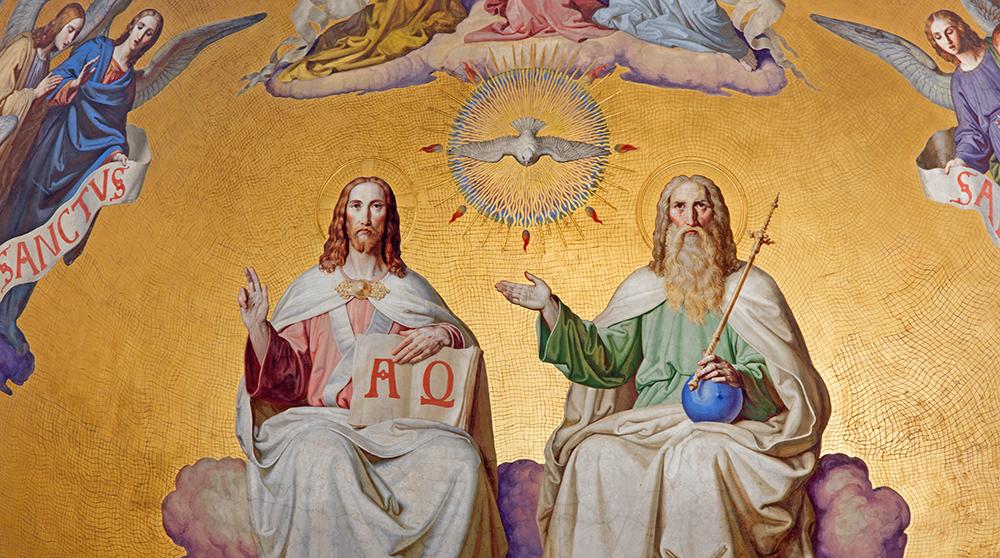
God with grey beard and dove

So to return to the question of whether the Divine Being is a white Anglo Saxon male, the answer is, clearly – doubtful. Long white beards aside, human kind has created the monotheistic God in his own image, and since King James and the other chroniclers of the good book were egotists, God has always been what psychologists call a ‘projection’.

This is fitting since much of the Universe is no more than an projection of the Universal consciousness. In this the Divine Feminine and Masculine principles interplay as a sort of fantasy dance – the gyrations of Kali and Shiva – who create and destroy in equal measure.

Eve and Godess

We depict any Godhead as male at our peril. If Jesus used the metaphor ‘Father’ it was not an implication of gender that was intended but the figure of the pro-generator. Jesus was fond of metaphors since mystics find the language of the market place appropriate to use to describe higher concepts. The parables he told contain metaphors which strongly describe unspeakable ideas in the sense that words are not enough. The return of the Prodigal Son to his father is describing the process of individuation within a maturing human being – the path which if followed leads to a union with the Divine. The ‘fat calf’ which we are all in danger of becoming during our easy lifestyles on earth, has to be slain and consumed.

When you eat remember this of me.

The errant son evolves to become a father. An errant daughter evolves to become a mother. An errant non-gender specific person becomes a vother*.

(*Using the principle of ‘ the infinite abundance of thought’ to make up words where missing – Vother is a neutral person.)

Light through clouds

So, no, God is not King, nor even a humble father. These were always crude metaphors, crudely carved by restrictive words and dualistic thought. The ancients and the religions of the Far East such as Buddhism and Hinduism, have no difficulty conjuring up ambiguous and contradictory Godheads who break and write as many rules as they can. Reality is not polarised, with one half favoured over the other. Neither does an authority figure ‘reign in heaven’ or anywhere else. Such prosaic concerns are respected by mystics but dismissed as irrelevant to higher task of the search for Divine Union.

Render unto Caesar the things that are Caesar’s;

The ( perhaps ) unpalatable truth to many, is that we the people are king, if only for a day or our humble fifteen minutes of fame. Even if only glimsped once in this lifetime it is my belief that;

Ours is the Kingdom, for ever and ever, Amen.

Whilst it is unfair to criticise the Pilgrim Fathers with the benefit of a good deal of hind sight, one has to wonder what would have happened if they had re-assessed their religion as well as their politics. If their aim in leaving Europe was to seperate from the percieved corruption of the Church of England they had an oppurtunity to wipe the slate of indoctrination clean completely. As unlikely as it was in 1620 for such a shift in belief, if the early church leaders had met and discussed universal outlooks with the native people and their holy men, they might have made some radical philosophical discoveries. At least it is possible for a present day comparison to be made.

black elk

The Holy Man of the Oglala Sioux, Black Elk, is described as understand God in the following way;

‘Black Elk learned that whoever found a centre also became the centre of the universe and that is where God dwells…By placing himself at this centre which is simultaneously physical, spiritual and metaphorical, he encountered the Great Mysterious One…the centre of oneself becomes the centre of the universe. The centre of the earth and the centre of the person are one and the same.’

‘Finding All Things in God’ by Hans Gustafson published by Lutterworth Press

Vote Me!

The day is approaching this December 2019 when the good citizens of the United Kingdom of Great Britain and Northern Ireland will have the opportunity to vote in a general election.

The outcome is being described as the most significant for a generation, so you would expect the process to be fair. Certainly, whoever wins is going to perch on the moral high ground of victory and fight off all criticism for a very long time indeed. Whether they will be entitled to be so smug, I suggest, is open to debate.

You see, I have a problem which is; how democratic is the voting system? My quandary as a voter, is that I approve of some of the policies of most of the parties. It should be explained that in the UK there is a left wing party, Labour and a right wing party, Conservative and Unionist. The middle ground is occupied by the Liberal Democrats and Greens. Other nationalist parties represent Wales and Northern Ireland and Scotland.

In the United States of America, the choice is more polarised between the Democrats and Republicans. Let us take this as an example. What if, as a US citizen, you decided that the choice was too small. Who do you vote for if you want to stop climate change but encourage industry? Who do you vote for if you want the state to pay for health care and a prosperous arms industry?

In a Spin About Voting?

Voting in Laundrymat

My point is that with polarised choices, there is no room for ambiguity that emerges from personal political perceptions and priorities. Worse still the politics of voting reduces to personality rather than policies.

Even in the UK, where the choice is greater, the democratic options are more confusing. Many voters now just spoil their ballot papers by writing ‘I don’t agree with any of this.’ They are being asked to vote for a leader they didn’t take part in selecting – unless they were the tiny minority of party members.

They might distrust all the candidates on offer and feel ambiguous about their policies.

Each party writes a manifesto prior to an election stating their political motives and means. This works to an extent but has the problem for some voters that their may be slipped in controversial motives that the voter does not want to happen. For instance, the Conservatives slipped in having a referendum on continued membership of the European Union. Suddenly it became an issue even though the majority did not think it worth consideration.

Worse still, when parties fail to win a majority in elections, coalitions have to be formed. Italy, Spain, possibly the UK next week, have this problem. Two parties may come together for the sake of forming a government at the price of compromise on their manifestos.

The public will have no choice over how these mixed manifestos will be prioritised. Which policies and method will be forgotten or ignored and which prioritised? Coalition manifestos are not published before an election if considered at all. This can lead to unrealistic expectations by voters when coalition governments are formed, as in the Liberal and Conservative Government in this decade. The direction of the ship will be decided by the Captain and officers, not the crew and certainly not the passengers.

No provisional consideration is given to coalition prior to an election as all parties have to perform the pretence that they are going to win even if it is clear to all that they will not.

The dangerous consequence of this for democracy, that occurs all too often, is that a minority party gains disproportionate power by owning the swing votes. This happened in the present Conservative government who allied with the Democratic Ulster Party and much of the muddle of mixed motives over Brexit has resulted.

In recent elections we have seen and or suspected that the over emphasis on the personality of candidates has given leverage to foreign governments and fake or real ‘whistle blowers’ and ‘news vendors’ questioning the reputations and ethical principles of candidates or even parties. Democracy as we know it is easily undermined by misinformation, view the Nazi propaganda news in 1930’s Germany, if you think this is a new phenomena.

Even the date of an election day can be manipulated to support a particular party in a manner which is clearly not in the interest of fairness. In the present UK election the Conservative government chose the day in which the students from Universities will end term and be returning home for Christmas. Informed young voters are not likely to support the Tories even though the election and it’s issues mostly affects their generation.

Young Voters in the USA Choose Not to Vote

  V I Dont Vote Badges.

Even such a consideration as ‘is it raining’ has been measured to be significant on election days. Sending people to village halls to scribble on a piece of paper has to be reviewed as the majority of citizens in the UK rarely turn out to vote. Some living abroad for over 15 years lose their right to vote.

Lone Voter

Voting Lone Voter

These then, are some of the problems for Democracy. Some people say, ‘well that’s the system we have got’ or ‘it’s the best of a bad lot’ but you have to wonder if the country that prides itself in it’s democratic systems is not kidding itself, it’s citizens and the world.

I am not suggesting that Democracy should be replaced with the pedantic and often corrupt systems of power like Communism or Autocracy. I am suggesting that with the aid of computers and the internet, a more democratic process is available to elect representatives. This is my idea.

Firstly, the party system is out. The in-fighting of politicians instead of their countries best interest, is something most voters are tired of.

Instead, all candidates will put themselves up for election as ‘Independents’. Radical, yes, but read on because they can form parties after election, not before.

They will state their personal political views by placing ten stars against a list of important areas of government. This will be shown to voters as something like this ;

Education *

Health **

Defence ***

Transport *

Law and Order **

Business and Industry *

Farming and Fisheries *

Environment    nil stars

Social Housing and Homelessness    nil stars

In this list each aspect of legislation and distribution of taxes is prioritised by the candidate, according to their own personal views. They are not under any party pressure to support policies with which they feel awkward about or strongly disagree. They can be honest; a quality in politicians which many voters express their suspicion about.

The candidate has, say, ten stars with which to indicate how which issues they prioritise and the amount of funding they would give in comparison to others.

Now here’s the clever part. Each citizen is given the chance to indicate their priorities and how strongly they feel funding should be allocated to each on their ballot papers. Instead of one cross or tick for a party – which in the twenty first century has to seen as a crude political choice – each voter has the same number of stars as the candidate.

The last piece of this process would have to be constructed from new but it’s not impossible. What I am envisaging is on-line voting from a phone, personal or public computer. In an age when personal internet banking, shopping, even gambling! – is managed with a high degree of security and reliability, it must be possible to create a secure on-line voting application.

Ten issues are listed either as broad areas for consideration or narrow ones. The voter can either ignore these as being worthy of state support ( such as health care in the USA) or indicate a need for state intervention. The strength of these feelings can be indicated by allocating some of the ten stars used to vote with.

It will be impossible to use up more than ten stars or whatever number is allocated to each citizen, but ten is an easy number for most people. Their choice can be re-adjusted until the voter is ready before selecting the ‘VOTE’ button.

For a population familiar with the internet, voting will be accessible, timely, considered, representative and accurately describing personal views.

The final phase of the voting process is for computers to match exactly the views of voters to those of independent politicians. It is already established what the views of the candidates are and matching a set number of candidates (say 300 ) to the views of the citizen public, will be doable for a computer.

The result will be a selection of representatives who will accept office and be fairly representative of public opinion. Being politicians they will almost certainly form party cliques (birds of a feather flock together) but at least the system by which they obtained power, will have been representative.

This could be a sea change for how populations choose those who represents them. With the emphasis moved to policies and issues rather than personalities and power politics, a higher level of honesty and fairness will be achieved.

We have the technology already to achieve this. We just need the thinkers to describe how it can be done – as I have just done. Vote me!

Space Wars

Butch Cassidy and the Sundance Kid is an enduring story of two bank robbers in the Wild West. In the film of the same name they are played by the good looking duo of Paul Newman and Robert Redford. They swagger through the film to a jolly accompaniment by Burt Bacharach (including Rain Drops Keep Falling on my Head) from one fruitful explosion to another. Inevitably the Federal authorities catch up with them and they manage to escape over the border into Mexico by the length of a horses tail. In Mexico they make a resolution never to rob a bank again, such has been the horror of their last experience. They realise they now have a clean slate to start their lives again. What happens next has always fascinated me. They start robbing banks in Mexico. A few bank robberies later, they die in a hail of Mexican army bullets.

butch_cassidy_and_the_sundance_kid1

The moral of this story in my view, explains a lot about the worst side of human nature. Remember that these are bad men even though they are played by a couple of smoothies. Humans find it very difficult to change their inner motivations, methods and objectives.

At present humans are plundering planet earth of her wealth. They have been doing it for a long time but now the scale and speed of the robbery is unprecedented. The villains have a plan;

‘Let’s start robbing again in space’.

China, Russia, the USA, Europe, even India have space programmes.

Why does India have a space programme when many of it’s rural villages don’t even have one flushing toilet and a sewer? The answer is complicated of course but one reason has to be the promise of new sources of raw materials; what in Klondike in the Wild West was nicknamed the ‘gold rush’. True to human greed for natural resources, these countries and others are not unaware of the promise of minerals ripe for harvesting from other planets and moons.

Without a World Government with an enforcement arm, it is hard to see how this rush into space and the allocation of unclaimed resources, will not turn into a laser gun fight.

On the 1st July 2019 the United States of America declared a new arm in it’s Defence Services; the Space Development Agency. Will the USA move itself into the role of World Government Peace Enforcement in space – like it has tried to enforce the non-proliferation of weapons of mass destruction on Earth? Will the USA being armed in space be accepted by those being told they cannot do the same? Bear in mind the present difference of opinions between the USA and North Korea and Iran.

The USA may or has assumed a role of Sheriff or ‘protector’ of the valuable scientific, communications and defence satellites already in orbit around the earth. This role is enhanced by the prospect of the new 5G satellites being privately launched – over 2000 in number – to provide fast internet to rural communities around the globe. Who asked for 5G is a subject for another blog. In democracies, no one votes for what private enterprise decides needs doing for profit. Arms manufacturers usually lobby for war.

It just happens because science and technology get the smell of cordite and can’t stop themselves blowing a few banks, and a few more and a few more. Ethics committees don’t carry.

The hugely wealthy entrepreneurs, Elon Musk (BFR) and Jeff Bezos (Blue Origin) both have their own visions for space exploration and travel. Will they be taking pot shots at each other across the craters on the moon or work together?

The space exploration of the 1960’s was famously driven by bitter competition between the Soviet Union and the USA. The latter likes to think it won the race but in the end what came out of those missions was a desire to monitor the earth from space, not keep going to the moon. This mutual desire and pooling of resources and know-how, evolved into a co-operative project which is the International Space Station.

Not surprisingly today, Russian and China want to co-operate in space and ban space weapons and they both signed a treaty in 2008 on the Prevention of the Placement of Weapons in Outer Space.

On 21st October 2017, the first committee of the United Nations discussed the non-placement of weapons in space. 122 countries voted in favour of such a ban and five against, which included Georgia, Israel, the USA, Ukraine and France. 48 countries abstained, including the European Union.

The reasons for co-operation disarmament in space are obvious so let us consider reasons for having weapons in space.

There may be attempts by rogue states or state sponsored dissident groups, to interrupt or destroy or threaten to do this to civilian or military satellites.

positions of satellites at time of publishing were correct but may have moved now

satellites

The problem with this argument is that a rogue state, or state sponsored dissident group, is being lawful in it’s actions in one view and unlawful in another. Robin Hood was by some definitions, a terrorist. Black and white hats are for cowboy films. The hats in space wars are multi-coloured and nuanced.

For instance, a GPS satellite is used for civil purposes and military. So is the mobile phone network and satellites and direct satellite communications used in those areas where there is no mobile telephone network.

You can describe the action as good or bad depending on which facts you select to present. The criticism is that the ‘threat’ that the threat on which the military base their plans and actions, can be exaggerated for funding approval reasons and, or just plain politics. A government likely to declare war on false intelligence on earth is just as likely to do the same in space. Different place, same gunmen.

There is also a non-military threat; namely asteroids. These are objects that enter the earth’s solar system from outer space and may be on a collision course with earth. The possibility is that a weapon of some kind may be able to alter the course of the asteroid. Comparing the then with now, money would be better spent on protecting the earth from humans rather than asteroids in my view, that threat being more immediate.

The last Hollywood blockbuster myth is one that has appeared on cinema screens since movies were invented – alien invasion. I call this a myth since my belief is that any civilisation that has found and is watching us for malign reasons would have acted by now. Because they have not I conclude that they are benign and waiting for humans to become spiritually aware enough to stop wanting to destroy the planet and each other.

Little Blue Men (and perhaps some ladies)

kind aliens

This is Butch and Sundance story yet again. The question for governments and billionaire entrepreneurs in search resources and a life boat for planet earth is;

Should we spend our time and money on fighting each other in space, or on protecting the earth and building a sustainable future?

I know what my answer would be because I have seen the statistics about life on Mars and in my view, it’s a hell not worth visiting.

I hope and expect we will forget Mars as an objective in the next decade, as future space based telescopes spy out so called, exo-planets. Astronomers now believe it likely that most stars have a system of orbiting planets based on observations of light from those stars. The new generation of telescopes will find new exo-moons. With so many new places to visit that are in the ‘Goldilocks‘ range of environmental factors similar to earth, man in the future will be spoilt for choice for places to colonise.

Those who choose to live in such places will have one important choice above all others. Shall we take guns to these places? My advice,based on Butch and The Sundance, is don’t.