Most people have some idea of what a prayer is. They will either pray on the basis of this belief or not. In the West young people are encouraged to pray in school and in some families at home as well. But as common as prayer is, I believe the question is rarely asked, ‘how does it work?’
I do not believe that prayer is a method of ‘getting things’ for yourself. It might be appealing to keep ‘requests to God’ as a back stop to failure in life, but that was never part of the deal with the Almighty. If we remember Genesis, part of the punishment for obtaining knowledge is freewill. That is, if we foul up it’s entirely our fault.
The Arabs have a saying; ‘Trust in God but tie up your camel first’. So when people ask the question, ‘how could God let this happen?’ they are imagining a perfect universe in which God is an autocratic ruler. That would be simple, but turning oneself into a victim and apportioning blame outside of oneself is a philosophy doomed to disatisfaction. It should be comon sense that camels will walk off on their own if not tied to a palm tree. We are responsible for our own actions and that was always the deal.
If you can agree with this philosophy of personal account and blameworthyness, then it is easy to adjust to the reality that God will not respond to prayers asking for earthly personal rewards. To an intellectual where words are all that there is, this is an unsatisfactory state of affairs. They might become so frustrated by the lack of answers that they form the conclusion that ‘there is no God’. It’s logical but of course, logic does not run the Universe. If it did there would be no access to and need for spirituality.
In my own view and probably others, prayer does create change but an inward change, not outward. If you examine the palmed hands and prostration and kneeling common to many religions, it is obvious that a submissive posture and quiet mind is paramount to effective prayer. The effect of this is like plucking a guitar string in one room and somewhere else another guitar string chimes in sympathy. This is the resonant universe in which all things are connected quiet naturally and without effort. In this way, I argue, we are connected to the all powerful Creator God however you imangine that ‘Mind’ to be.
If you look at sacred imagary throughout history, minor gods and angelic forms are depicted carrying and playing musical instruments. The classic example is angels with harps, flutes and even reeds in the wind are metaphors for resonance between God and the physical world.
Prayer, in any religion, can have the effect of stilling the human mind and spirit to become in harmony with the God-self, that is the tiny part of the Creative Mind within ourselves. This is hidden reason why Muslims are required to pray five times a day, to keep the inner Divine strings humming constantly.
Resonance, to paraphrase the prophet of Islam, Mohammed, (sas) can move mountains.
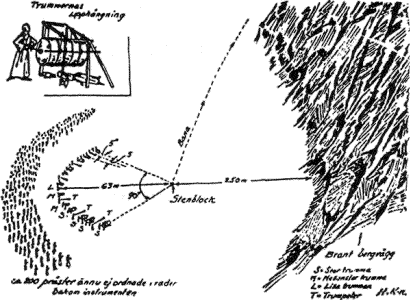
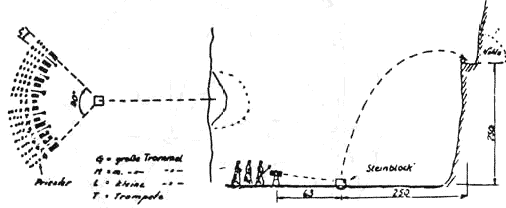
Tibetan monks in 1939 were recorded by Kjellson levitating huges rocks up a mountainside to build a monastery. They used the power of their long musical horns arranged in a specific pattern and backed by rows of humans in prayer.
By becoming One with the Universe we can create events that we want. This is part of the paradoxical nature of being alive in which a human with freewill can direct that freewill to union with the Creator of freewill and thus a ‘connection’ that is not connected…as in two strings vibrating in harmony.
So we move on to miracles. I said at the begining that prayer is not a means to get what we want. That was not quite true because there is an exception and that is miracle making. There are rare moments (and by that I mean very rare) where Divine intervention at a resonant level as described, can make a humble individual ‘all powerful’.
Jesus the Christ was revered for his miracles, some of which are described quite literally in the Holy Bible and some allegorically. An example of a literal miracle is raising Lazarus from the dead, something Jesus was taught to do by the gnostics of the time. An example of an allegorical miracle would be turning water into wine. In the old testament we have the Israelites being chased by the mighty Egyptian army and trapped by the Red Sea. One faithful follower entered the waters and started to walk. At the point where his head went under water the seas parted.
So if we ignore the allegorical stories about miracles as having another purpose, we can see the common theme that real miracles happen when an individuals or a collective’s very existence is in danger of extinction. It may not happen at a time and in accordance with human desire.
Delay and misdirection are caused by the impurity of our human resonance with God, not the other way around. As the old saying goes, ‘the pot always calls the kettle black’. So the sooner we stop ignoring or doubting His prescence within each one of us, the sooner our lives will change.
Quotation from ;The Great Reset by 2030 – World Economic Forum
What do the bad guys usually want? From the Blofeld’s and Goldfingers of our imaginations to the Alexander the Greats and Caesars, we might think the answer is, ‘world domination’.
In our present era, there is indeed smoke in the air warning us of a world conflagration. The word ‘global’ is something we are accustomed to hearing; in a way that would not have been, say one hundred years ago.
Since then, we have had round the world flights and sailing navigation’s and of course two world wars. Now we are told of a global climate emergency. Global is the new National.
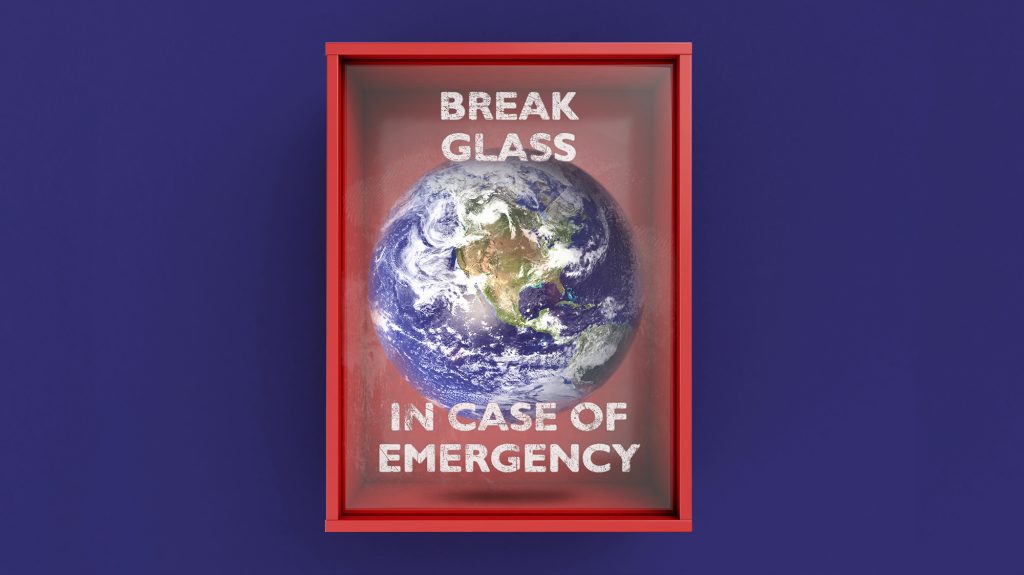
Sadly, for we had to wait until the sea was lapping at our toes and the wind spinning away our hats before taking responsibility – if that was achieved at the recent COP 26 in Glasgow. Those living near the sea may be wise to go out and buy aqualungs.
picture credit Bulletin of the Atomic Scientists
Concurrently we have yet another global emergency called the ‘pandemic’. This could also have been better prepared for, as humanity has been fighting virus’s for it’s entire history and has never been so well armed to respond as we are today; even if the common cold has escaped elimination.
And then there is China, and the Chinese Communist Party. When I studied China in school fifty years ago, the Chinese people went around on flocks bicycles and ‘stuff’ was made in Hong Kong. Now the Chinese are the center of the world’s commerce and principle producer of goods. This is driven by low wages, long hours ( ‘search engine ‘ the numbers 669) and economical (though global climate harming ) global traffic and trade. Most Pacific rim nations view the highly capable Chinese military as their principle threat and many human rights organisations lay numerous allegations of inhumanity, at the door of the Chinese leaders.
First Chinese bicycles. Historical artwork of people riding bicycles in Shanghai, China, in 1900. Taken from: Histoire de la Locomation Terrestre, published in Paris in 1936. Credit Science Photo Library
Is all this global Covid, Climate and China just chance or should we be suspecting ‘foul play’ on a scale never conceived of before?
If humanity feels it is being forced into a corner with basic freedoms being taken away, why is this and who is doing it?
In my view the ‘giant at the top of the bean stalk’ is technology. No one ever voted for new technology. A few scientists have had second thoughts on realising how destructive their discoveries are e.g. the A-bomb…but most inventions, like the washing machine, set us free.
For the freedom loving democracies, life, in my view, is about to become a whole lot less free. To understand the means to this end one must only look at China and how it uses technology to control in fine detail, the lives of it’s citizens. CCTV cameras produce images with names and numbers floating above each face in the supermarket or airport concourse. Money as cash has long gone as it cannot be traced. Instead citizens wave their phones at tills in shops and the transaction goes straight to CCP headquarters…just in case they might need it.
picture credit : My London
By the time it reaches Europe and the USA I predict mobile phones will enable our governments to more or less monitor and control our lives. Everything you are and do will go to a special sealed circuit board in your phone. It will be called your ‘Freedom Pass’. Sounds okay doesn’t it, but read on. Interestingly Elon Musk has other plans to insert this techology directly into your brain, something that may be used instead of or as well as mobile phones. Both will of course be presented as benefits to the individual.
‘Everything you are’ means your personal details and bio metrics, consumer profile, money and possessions, travel, education, health and politics.
‘Everything you do’ means your work and leisure, credit and tax records, work skills and placement, travel credits, health status, voting credits.
The first of these should not surprise us as this is what computers do and have been doing since the 1990’s. What we haven’t reached yet is the experience of having our money and assets frozen because we voted for the wrong party ( oh yes, you will use your phone to vote ) or our self drive car restricted to no further than a five mile radius, (known as a withdrawal of travel credits ) because we put up a post on social media criticising the government.
Cleverly your ‘Freedom Pass’ will measure your ‘credits’ not take your ‘freedom’ away. It will just take credits that you were awarded for following government protocols, away. Your fault, not the governments.
If this future shocks and horrors you then there is an alternative, but be warned, it is not for the faint-hearted.
picture credit Maribyrnong City Council
The alternative is to throw your mobile phone into a lake. Some of us lived before mobile phones and before domestic computers and I can assure you, life was fine and dandy. Birds sang, beaches were clean and people made love not war.
If you fancy this lifestyle today it is probably because you are spiritual. I mean by this that for your life is not just about local gossip and watching TV and going to the supermarket – the sort of life style acted out on the TV soaps.
Those who have a deeper vision of what it is to be human and free will probably be either extremely rich ( so that they are part of the Global Government Party ) or spiritual. By spiritual I encompass all religions and those who have a feeling of a Divine presence or if you prefer ‘goodness in life’. For them it is not important if the supermarket refuses to accept payment because their money credit has been taken over by the State. There is an option, an alternative lifestyle that is not ‘Mad Max’.
You will have to leave the cities, where 50% of humanity have already been funneled. Eventually most people will eventually be sent to cities in order to ‘protect the environment’ or ‘preserve a scientific special interest zone’ or some other ‘desirable noble cause’. In reality it is to put the sheep in their pen.
Freedom lovers will vote with their feet and choose to live in small self-sufficient communities in remote locations. The governments will be powerless to stop this because they will not need to. People living ‘off the grid and off the net’ are no threat to what governments are aiming to achieve. However hard you try to grow just corn, there is always a corner or a dip in the field where weeds grow. Governments know this.
picture credit: Educalingo
There will be ‘sheep’ and ‘goats’ in most countries across the globe. The sheep will be tended for their basic needs but under the watchful eye of the sheep dog. The goats will move to the wild lands, too high for sheep, too few in number for the sheep dog to chase.
Perhaps you will see in front of you the stairs that enable believers to climb into the ‘New Earth’ as Dolores Cannon calls it. Your vibrational level will change your perception fundamentally. Dolores uses the metaphor of an aircraft propellor which becomes invisible when it changes frequency of spin.
So even though your are still here , you will not be. What was important in the material world will become inconsequential. As a Tibetan monk once told the Dalai Lama after 18 years of captivity by the Chinese, ‘I was in danger twice. Both times because I came close to not forgiving my captors.’
What is it with Hotels? I have to admit to having a problem with them.
The clue is in each hotel room. Central to the arrangement of most hotel rooms is a bed and a bed is generally, for sleeping in. And there we have the crux of where I find most hotels get it wrong. The whole notion that their guests basically just want to comatose, appears to be foreign to them. Because of this fundamental misunderstanding, much of what hotels provide becomes a waste of effort and money for all parties. People who want to sleep and or are asleep, do not require a conference suite, a swimming pool, a spa, a restaurant, a dining room, a library, a grand view of the city, an entertainment programme, a stage, a discotheque, wide screen television for sports coverage etc. etc.
We just want a bit of peace, and a toothbrush.
Instead, you get aggravation and cheap shampoo.
The problem with so called ‘facilities’ is generated in part by the hotel star system, which awards stars not on the quietness of the hotel and politeness of its staff, but on the breadth of it’s facilities.
I can accept there may be families and business travellers who intend to spend days and weeks in the hotel and need these things. In this case these quests should be directed to hotels which do not provide an environment for guests to sleep.
If I were head of the United Nations Peace on Earth Commission (if they don’t have one, they should), I would categorise hotels between places of rest and the rest. I would award ‘bed’ symbols for quietness rather than ‘stars’ for what are sources of sleep deprivation.
Perhaps it is time to give some examples of what I mean. I look back to earlier last year when I went with friends to a charming town in the Alpujarras in Southern Spain. The hotel where we stayed the night had a central courtyard around which corridors accessed private rooms. The floors and walls were compleltely tiled. This meant that every footstep was amplified depending on the size of guests steel toe caps. Every cough, conversation and slamming door, was heard by everyone. My friends in the morning, complained that they had to endure a woman talking for two hours on her mobile phone in the corridor, before they could get to sleep.
I want to point out a problem that defies a solution in present international law.
It is about ownership of ‘resources’ by nation states. We know that many disputes have started over this issue so in my view it needs absolute clarity.
The issue is like where we find water. It is either static like in a lake or dynamic, as in a river. Nations acquire rights over lakes and that is simple. But when the resource is moving there are many parties interested to the water, in addition to the owner of the lands over which it passes.
The concept of a nation ‘owning’ both it’s static and dynamic resources, can lead to a loss of those resources to neighbouring states and in some cases, the whole planet.
Picture Credit: British Antartic Survey
The Antarctic Treaty was drawn up and agreed by twelve nations on 1st December 1959. It aims to protect the freedom of scientific investigation by peaceful cooperation. In reality it does a lot more than that. Antarctica is unique in being protected as a shared and protected world resource and the planet is no doubt a better place because of this.
However, global warming is affecting Antarctica. Glacial shelves are breaking off as giant icebergs with increasing size and regularity. Fresh water previously frozen is and will, affect ocean currents which in turn change climates.
Such issues are normally ‘dealt with’ by the government of that country but in this case there is no such responsibility held by a nation state.
This illustrates how the legal concept of ‘it’s in my country so I own everything in it’ sometimes falls short. The rule of thumb works in most countries but clearly not always.
Picture credit: Alliance Photo
When we forensically consider the case of a country ‘owning’ a resource because it is within that country’s boundaries, neighbours and or the whole planet, can be affected. For instance, the rain forests of South America are, or were, regarded as the ‘lungs of the planet’. They absorbed CO2 gas, slowing one of the main causes of climate change. If we examine the attitude of Brazil to it’s rain forest, the Bolsinario government refuses to be advised by non-Brazilian interested parties. It claims the right to destroy the rain forest and all the resources it contains. The rights of the indigenous tribes are also not respected.
If I found a hoard of Roman gold coins in my garden I would have to inform the government of the country I live in, let us say the UK. They might regard the ‘trove’ as a national treasure an take away my right to it’s worth. Or they could give all or part of it’s value to me, depending on the higher national interest. In this case a ‘lesser owner’s’ rights are trumped by a ‘higher owner’s’ rights. This concept could be appropriately upscaled to national and international rights. The latter trumping the former where the international interests serve a higher purpose than short term economic gain. At present this would not work because legal rulings require the threat of sanctions or even physical force if ignored. There are only limited means to do this at present.
Yet there is another perspective achieved when we consider just the dynamic resources of the country; those most like to be problematic. Dynamic resources are not rooted to the soil like trees and minerals. A simple example is water again. A river may often pass through several countries before it discharges into a greater body of water. Who owns this water as it moves? When the river flows at a constant speed and volume, then the concept of owning the water as it crosses ‘your’ country works. When the rainfall drops or a country near the source of the river pollutes it or decides to build a dam, then they are problems. Such a dispute is occurring between Egypt and Ethiopia at the present time as Ethiopia builds a dam to create hydroelectricity from the Blue Nile.
A moving resource should clearly respect the rights of all countries. As it passes though several countries each should have a right to influence it’s management.
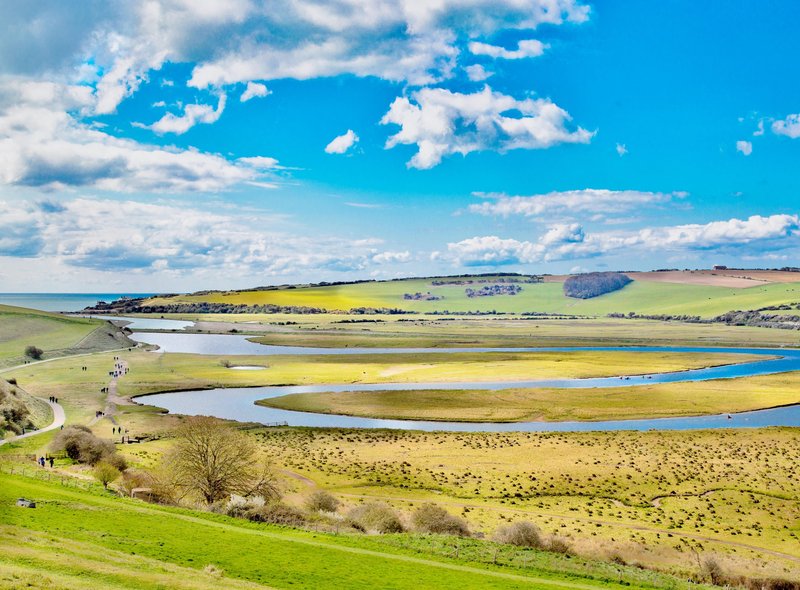
picture credit: Eastbourne Herald The River Cuckmere East Sussex England
Lawyers and Diplomats would clearly have a great deal to think about to formalise this concept But the world should not delay in my view. Every migrating bird, every ice berg, every bee and butterfly is a shared resource capable of influencing the well being of every human being.
The human race is presently facing an era of catastrophes caused by increasing populations desiring finite global resources and climate change. Denial of these facts was a phase in the 1970’s but not anymore.
When we consider how vital dynamic resources are, it is clear that many are jointly owned and enjoyed by all of humanity. In addition, human beings share a right for dynamic resources not to be destroyed or degraded. The concept of one country having a right to pollute water before it enters it’s neighbour’s land, should be trumped by an international law.
picture credit: NASA
Whales travelling through oceans have no concept of the countries they are passing. Why should one particular country, such as Japan, feel it has rights over whether these whales should live or die? If the consensus of the world is that the whales should not die, then an international body should have to power to order their protection.
Such a body could come under the wing of the United Nations. The chamber might find itself debating the right of the Brazilian government to destroy the Amazon rain forest for Brazil’s short term economic gain and the world’s long term loss. The debate would include the unique forna and flaura and the rights of future generations to have access to this DNA bank. The forest contains chemicals with medicinal properties, viruses that should never be released and countless creatures that once lost, will never be replaced. The neighbouring countries to Brazil, could demand their right to not have desert and refugees, wildlife and viruses crossing into their countries. The indigenous people would also be empowered to demand respect of their rights to the dynamic resources of the forest, in addition to their ancestral land rights.
If the resources that are dynamic are given the international status they deserve, there will be fewer international conflicts over ‘me and mine’ and more co-operation or ‘us and ours’.
Laws work when they embody truths the are Universal. If they are applicable in every corner of the Universe at all scales, they are more enduring and relevant than passing political values. The law would be called The Global Treaty of Dynamic Resources 2021.
Such a law and it’s enforcing body, will become even more important when humans begin to explore new planets and space. It might well be expanded to include static resources. The race to mine the moon that we see today, is about commercial rights to resources that are becoming scarce on earth, so called ‘rare earth elements’. Similarly, the filling up of the earth’s upper atmosphere and deep space with satellites, needs strategic guidance to avoid commercial exploitation and associated ‘space wars’.
If humans don’t get this right, then the next phase after the literal ‘carving up’ of our beloved planet, will be the ‘carving up’ of space and a repitition of the resource-driven disputes and wars in history. Even Helen of Troy was a dynamic resource and if a ruling had been made by a respected Greek god, the Trojan wars would never have happened!
One comment made by many of the men and women who have looked down on earth from space is that there are no national boundaries. We are so used to political maps that the real picture has, until now, been hidden by nationlism. Globalism, whether desired or not, will be the next paradigm for planet care, in my view. Without it, shared dynamic resouces will be seized or destroyed by the short term priorities and political ‘gain’ of politicians who rule without a trace of compassion for the people or the planet. You know who they are.
Twenty Reasons Why HS2 Might Not Be the Promised Public Transport Option of the Future
There is a project in England called HS2. It stands for High Speed 2 and is a plan to build a high speed rail route between London and Birmingham and then beyond. The stated justification for it by the government is to move the political centre of gravity away from London and nearer to the Northern and Midland cities; the so called ‘power house’.
These cities have conventionally voted for the socialist or LabourParty and HS2 was originally a Labour government idea in 2009. Why it has not been cancelled by the Tories in my view is that there may be some political gain for the Conservative and Unionist Party in making Westminster ‘closer’ to the North. In the last election these cities did largely swing to vote Conservative for, no doubt, many reasons.
One skill that I believe is essential for politicians is ‘problem solving’. There is a science to this subject and the first question to be asked in solving a problem is; what is the problem? As much as this may seem obvious, it is heart breaking to observe how much money is wasted on national projects that turn out not to solve the problem. I am reminded the airport in Spain that has never opened and you can probably think of some ‘vanity projects’ in your local area. ‘Vanity’ may be one reason those in power do not ask the right questions. Or perhaps it is theDunning-Kruger Effect…
(The Dunning–Kruger effect is a hypothetical cognitive bias stating that people with low ability at a task overestimate their ability), : source Wikipedia
…that makes politicians believe they understand the problem perfectly and have the perfect solution.
An Idiots Guide to Digging a Hole for Yourself : credit Reseachgate net
Another common pitfall for ‘problem solvers’ is the temptation not to apply a new solution when the original one does not work. This is known colloquially as to ‘dig a hole for yourself’. Rather than abandon the first location to dig, the blinkered view and or fear of admitting a mistake and or wasting time, money and effort… compels decision makers to keep applying the original problem solving technique. Feedback is rarely sought, dissenters are ridiculed and rational insight is lost in the rush to jump into the deepest hole ever dug…
The HS2 project in my view is a perfect example of this and even the PM used this metaphor…
Boris Johnson has suggested the only answer to the “hole” enveloping HS2 is “to keep digging”. BBC News 31 January 2020
So far three billion pounds has been spent on demolition and railway infrastructure. To change now would mean wasting all of this money and admitting a mistake. To admit to such things is political suicide, and career politicians need to impress upon their voters that they know what they are doing. This is what we see at the moment.
Personally, I would vote for any politician who is prepared to describe the white elephant under construction as just that. Here is my ‘off the cuff’ list of reasons to abandon the project. I am sure the list could be even longer but it hardly seems necessary. It is not all negative. It contains the precise locations where treasure can be found, should the current hole ever be realised to be just full of air.
Here is my list of strategic reasons to abandon HS2;
1.The people who live in the Midlands and North of England desire most to have better rail links between the East Coast and the West Coast of England and connecting the cities in between.
2. The people who live in the Midlands complain that the existing rail service to London is at full capacity and needs upgrading. This could be achieved quickly and relatively cheaply with additional conventional infrastructure and rolling stock.
3. HS2 is planned to go initially North South, adding a link to London which is contrary to stated intention to move the ‘centre of gravity’ of the country. The word ‘London’ is the clue.
4. The country has borrowed a vast quantity of money during of the Covid -19 pandemic. To reduce this burden ( and presumably vulnerability to any future rise in interest rates) it is proposing to reduce aid to the poorest countries in the world. In doing so it risks losing the ‘world leader’ status it aspires to. One obvious alternative is to admit it can no longer afford to pay for HS2.
5. Since the pandemic, people have become used to communicating using the internet. Moving physically between locations has become less important.
6. Trains are old technology. They have been improved as much as they ever can be and now only new technology should replace it.
7. High speed trains are at their most economic on long distances such as found on the continent of Europe, North America or Australia. As any continental traveller will tell you, the UK major cities are relatively close to each other and journeys short in comparison with countries where high speed trains have been a success.
8. Fast, long distance trains are rivalled by aircraft. In Spain, for instance, internal flights are cheaper and quicker than the extensive high speed rail network.
9. Trains are rivalled by new technology such as the Hyperloop. They are likely to become superseded in the next few decades, just as railways took over from canals. Technology and economics are more sustainable drivers than political policies. New technology by-passes the decision making processes of government. In the era of present rapid ‘advances’ in technology governments must work with new technologies in the way that voters do.
10. A large proportion of ‘clean’ electricity is produced by fossil fuel power stations and nuclear power stations. The first is neither clean nor efficient. The nuclear option is becoming more and more expensive (as decommissioning costs are included) and prone to the dual risks of nuclear accident and the problem of the indefinite safe storage of nuclear waste on planet earth.
11. The costs of major infrastructure projects can be reasonably expected to double by the time they are completed. The original estimate for HS2 in 2005 of 37 billion pounds has already doubled to 78.4 billion pounds by 2015! (according to Institute for Government statistics). At this rate of increase it will have doubled again by 2025 and that is only the estimated cost. There are inevitably going to be delays and unforeseen extra costs. This during predicted future decades of Covid 19 austerity.
12. Europe is joined to one nation by the Channel Rail Tunnel. The United Kingdom is connected to twenty seven countries by the Channel Rail Tunnel – and beyond. The train from Berlin to Manchester appeals to a minority who will either meet virtually, go by air or just not choose to do business in the United Kingdom.
The List Extends into the Tactical Reasons to Abandon HS2
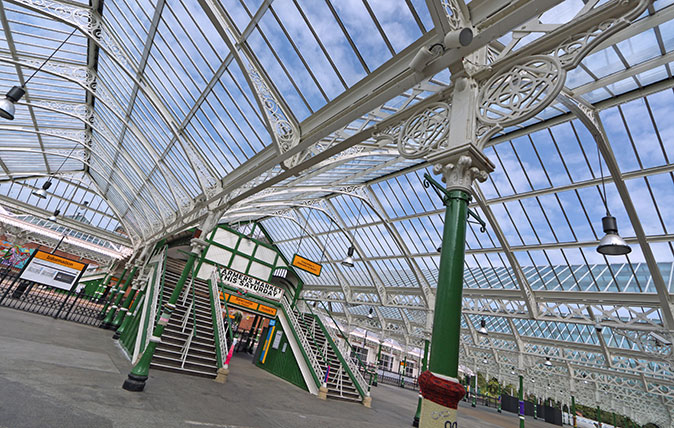
What have the Victorians ever done for us? picture credit Country Life
13. When the Victorians built railway stations, they were able to build their palace-like stations in the centre of towns and cities; just where travellers wanted to arrive! Due to high land values and ethical (archaeology, listed buildings, city centre decay, the housing shortage ) concerns around compulsory purchase, this is no longer practical. Most HS2 stations will be built outside the towns and cities they serve. The connecting transport will take away some or all of the time gained (1hour 21 minutes reduced by 29 minutes) by using a high speed train. An example I experienced many decades ago, was in Brisbane. When you arrive in Brisbane rail station you have to stand and wait for a bus or taxi to get you to the centre of Brisbane. I believe a local train has now reduced this problem but the insanity of these slow ‘connections’ remains.
14. Simple analysis of the problem will reveal there are many means to connect the regions of the UK other than high speed trains. The best and perhaps most cost effective of these, is to improve connectivity using the internet. This has the potential to allow passengers to work during their journey on conventional trains. This will make the speed of the train less important.
15. A new train route will cause considerable loss and damage to the countryside and communities through which it is intended to pass. The least of these is the one hundred ancient woodlands which will be destroyed. At a time when the country has been promised it will be more self sufficient in food, farms will be significantly negatively affected.
16. One hundred ancient woodlands, fauna and flora and in areas of outstanding natural beauty and special scientific interest will be permanently harmed or eradicated at a time when the environment is being prioritised, not least because of climate change.
17. Trains are a less safe means of travel than flying and in the future, the hyperloop. The later will be so safe that the prototype has already been trialled over a short distance by it’s designers and backers, personally. Hyperloop is frictionless so will require a fraction of the amount of energy required to propel an ordinary or high speed train.
18. To fit the broader brief of ‘increasing connectivity’ within England, new trains and routes should be started in the North. Phase One HS2, starts in London and therefore does not benefit those in the North unless they want to go to London.
19. The money spent by the Test and Trace and PPE procurement was approximately 57 billion pounds. This is in the same ball park as the current estimated cost of HS2! If HS2 costs reach 106 billion pounds, then this is the same as the cost of running the National Health Service for a year. Politicians have to be asked why not run the NHS for a year with this money?
20. The High Speed train network will not serve the satellite regions of the United Kingdom; known as Northern Ireland, Wales and Scotland. These areas already resent to control of an England-centric government based in the south of England. In my view this may become the straw that breaks the camel’s back and play into the hands of the Nationalist Parties of each country, the first to fall being Scotland followed by Northern Ireland, then Wales and then Yorkshire – Cornwall?!
I have not included any benefits from a High Speed train network in the United Kingdom.
Such as list should always be included in any rational ‘problem solving’ assessment. My problem is, I can’t see any benefits, except some good publicity photos of dolphin-nosed trains and grinning politicians in high visibility jackets.
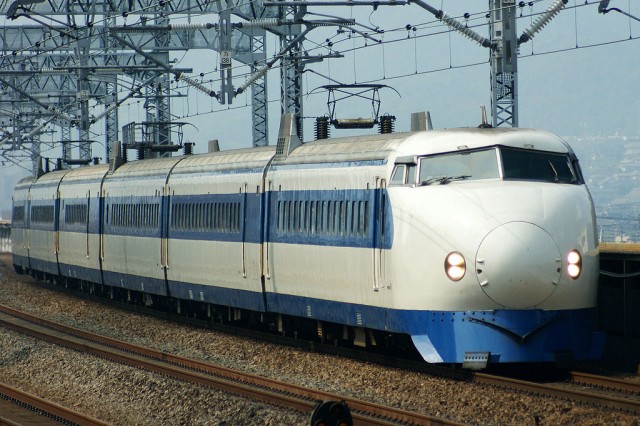
If there ever were benefits, these should have been gleaned after the second world war when the UK’s industrial cities had been demolished. Despite ‘winning’ the war in 1945 the UK was bankrupt. Japan ‘lost’ the war and in the 1970’s built some of the first high speed trains – the famous Skinhansen.
The Right Technology at the Right Time in the Right Place – Shinkansen
Perhaps some would argue that an electric train speeding along the tracks is much greener than the cars on the motorway running parallel. With the proviso that the National Grid is powered by carbon neutral fuel sources, this is true, but certainly by 2040 (as phase 2 is due for completion), cars and lorries are going to be mainly electric or hybrid. Any ‘green’ advantage to all trains is slowly disappearing.
And in the midst of a pandemic and in preparation for the next, is not personal transport going to be preferred to public transport?
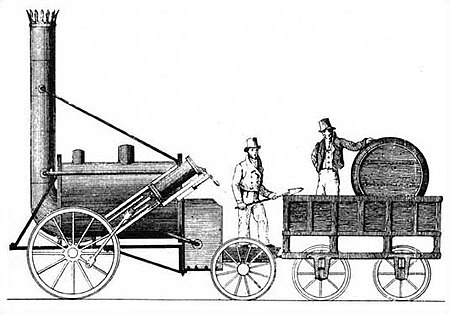
What would Robert Stevenson be thinking if he saw the final phase of his invention being acted out? What would he say about today’s ultra wealthy taking personal travel into the edges of space and is that why he called his invention Rocket?
1829 Rocket – Still the best public transport concept applicable two hundred years later?
In Part One of this trilogy entitled ‘Ancient Light’, I have described the curious electrostatic qualities of many ancient monolithic structures. They appear to be designed principally to concentrate weight upon piezoelectric rocks. This produces subtle effects that can be sensed by the human body and mind, even to the present day.
I have also examined the unique design of the King’s Chamber in the Great Pyramid of Cheops as an example of use of this same principle. The highly selective construction techniques suggest that static electricity was intentionally generated, stored and exploited in the pyramid. The Arc of the Covenant operates as a capacitor potentially discharging static electricity as an ‘arc light’ and even lightning from the pyramid’s peak.
In this final section I shall describe the ancient knowledge of the production of monatomic gold shared (and possibly inherited) with the Mesopotamian civilisations.
There are depictions of gold mined by humans for the Anunnaki ruling Mesopotamia in ancient times. Humans were possibly created as a slave race mining gold for their rulers. Even as far away as South Africa, Zulu legends speak of a time when “visitors of the stars” came to dig gold and other natural resources.
For more insight into the mystery of the ancient gold mining across Earth the work of Michael Tellinger is the authority on the subject.
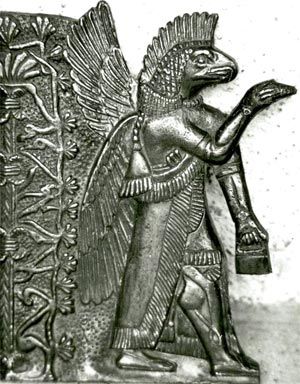
Interestingly there is little in the Mesopotamian drawings to suggest a use for their gold. What there is however is a remarkably common theme in visual representations of two ‘demi-gods’ standing either side of ‘the tree of life’ holding a bag and cone shaped object.
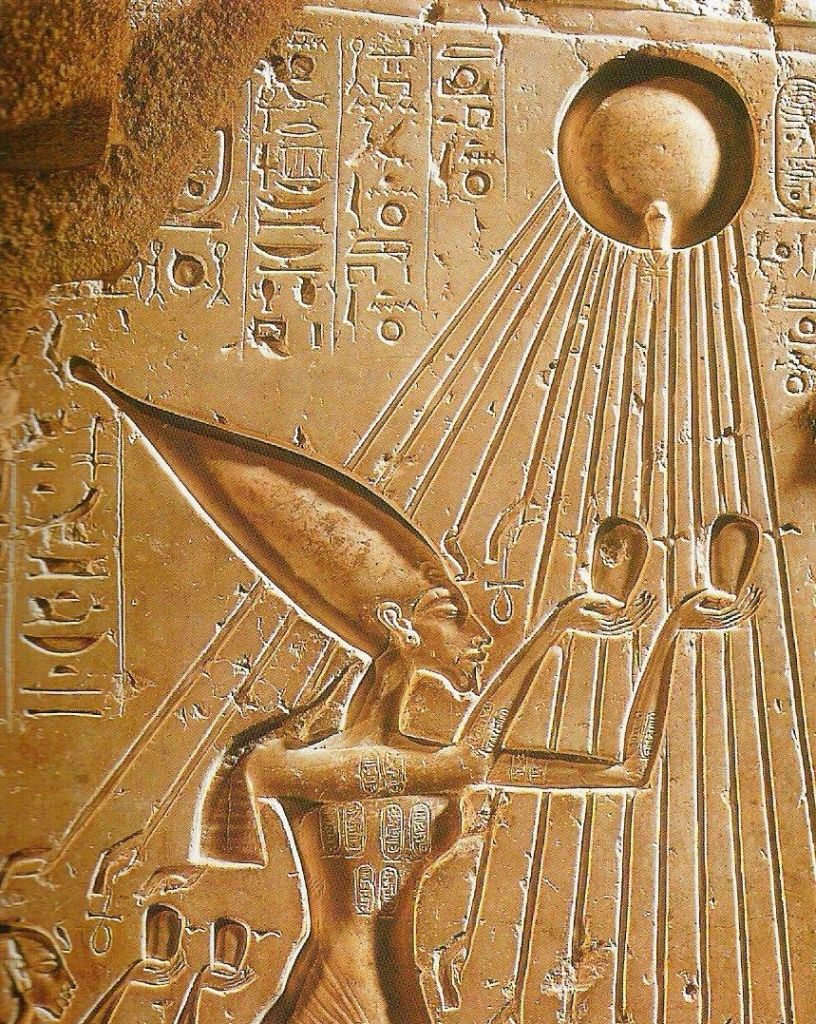
When examined closely the ‘cones’ appear to be made of many spherical objects which have been formed together into the shape of a cone. It is always held at mouth level as if in the gesture to eat. It is surely no coincidence that this same image appears in Ancient Egyptian hieroglyphs.
Akhenaten Offering / Honouring Bread to the Sun god Ra and the life giving ‘solar energy*’ symbolised by the Ankh at the end of the ray.
The best line of investigation that allows modern readers to penetrate this mystery, comes from a renowned Egyptologist Sir Francis Petrie of University College London. He produced a report for his sponsors on a trip he made in 1904 to Mount Horeb in the Sinai Peninsula.
The full story is described in detail by Sir Laurence Gardener in the excellent video below;
Gardener describes Petrie’s discovery of an ‘alchemical laboratory’ in an Egyptian Temple on Mount Horeb ( later Mt. Sinai), dedicated to the goddess Hathor. Within the temple store rooms, is found 50 tons of a mysterious white powder, conical stones, metallurgists crucibles, tanks and basins. Much of the design stylisation on these and other objects is Mesopotamian. Inscriptions mysteriously refer to ‘Mfkzt’ (pronounced Muf Khut)’ and ‘bread’ and ‘light’.
Petrie decided that the use of this laboratory went back to the very first Ancient Egyptian Dynasty and continued in production until the final 18th Dynasty. Laurence Gardener describes the story of the flight of Moses and the Israelites. Moses famously went up Mt. Horeb (or Mt Sinai, as it was later called) where there was seen fire and smoke at night. We are told that this came from an Alchemical Laboratory where Moses would have observed the transmutation of gold into a powder. Exodus describes how Moses burnt the golden calf in the fire and ‘ground it to a powder’.
We should be aware that Moses was trained as a priest by the Egyptians. His great grandfather was Thutmoses 3rd, who reorganised the ancient mystery schools of Thoth and founded the ‘School of Master Craftsmen’ at Karnak. They were called ‘The Great White Brotherhood’ because of their preoccupation with a mysterious white powder.
Hathor picture credit Worldhistory.org
In the tradition of the goddess Hathor, a cow and a nursing goddess, came the ‘powdered milk that;
‘…gave the Pharaohs their divinity’.
It is no secret today that gold can be transmuted into a white powder in a furnace and this powder confers good and longevity, (common to Royal families even to this day!). It is called ‘monatomic gold’ or ‘ormus’ and can be even purchased on E-bay!
‘There is nothing new under the sun’ – King Solomon
Is it possible that in large quantities over long periods of time, this powder may alter human consciousness to a higher ‘god-like’ level? Clearly the Mesopotamians and Ancient Egyptians thought so, to the extent that they must have processed large amounts of precious gold to deify the Pharaoh. After all, the role of the Pharaoh was to be both man and a god, and achieving this status whilst living, was his or her aim.
Just to explore the Old Testament, Moses story a little more, there is the narrative of ‘Mana’ appearing on the ground like dew ‘from Heaven’. This mana could be made into cakes and consumed and appeared when the Israelites had run out of food. Can we conjecture that this substance was also powdered gold placed there overnight by priests for the people, until we consider a clue from Mesopotamia. Here the name for powdered gold was Shemana and it is more than tempting to take this as being identical to Mana.
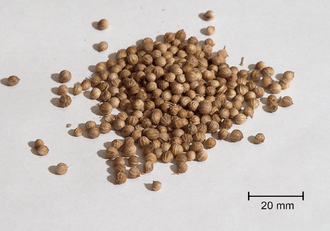
There is a discrepancy in appearance – or perhaps it appeared in two forms. The ‘mana from heaven’ described in Exodus as feeding the Israelites, is described as being ‘like a coriander seed in size and shape’. This appearance resembles the ‘seeds’ that make up the cone shapes in Mesopotamian reliefs.
Corriander Seed – picture credit Wiki
And thou shalt set upon the table shewbread before me always’
Exodus 25:30
This extract from Exodus show us firstly how important ‘shewbread’ (or white powder cakes) was. The cone shaped stones found by Petrie in the Temple of Hathor on Mt Horeb, may well have been moulds with which to make cone shaped vessels to hold or mould the shewbread.
Laurence Gardener tells us that the 4th Dynasty was the era of the pyramid building where Hathor is always depicted with representations of the Pharaoh. We can imagine a society in which the workers drank beer, the middle classes and aristocrats used a narcotic derived from the blue water lily and Pharoahs ate Monatomic gold.
With the Ark present in the King’s Chamber of the Great Pyramid, I have described in part two how high voltages and plasma could have been generated between the wing tips of the Cherubim. Such a high temperature might have been used as a furnace to turn gold into the precious white powder but I do not believe there is any evidence for this. Such a process would have produced smoke and waste materials and the interior of the King’s Chamber is remarkable for being clean.
The alchemical creation of white powder was in furnaces in the Temples, not in the pyramids, in my view. But there is another cleaner method for producing monatomic gold, which could have been one of the functions of the pyramids.
As a clue, one of the contents of the Ark of the Covenant, as well as the tablets on which the commandments were inscribed, was some Mana. According to the Book of the Epistles, this was possibly held in a pot made of gold.
Modern pyramid experimenters have found many extraordinary characteristics even in scale models of pyramids. Modern experimenters Mary and Dean Hardy of Allegan, Michigan took a gold coin and hung it at the King’s Chamber level of a Great Pyramid model. After some time the gold coin got a clear “oil” on it and the gold was etched away under the drops of oil. This oil can be reduced to the white powder known as Orm or Monatomic Gold.
From my own personal experience I once worked for an architect in Australia who described himself as a ‘modern alchemist’ and had a laboratory over our work place that he regrettably never showed me. I remember him telling me however, that it was possible to produce oils from metals, a fact that struck me at the time, as worth remembering.
An unlikely scientist in this story is Sir Isaac Newton. He was an alchemist for the second part of this life and deeply interested in the Bible and the pyramids. The following extract is from a recent sale of some manuscript belonging to the great scientist.
“He was trying to find proof for his theory of gravitation, but in addition the ancient Egyptians were thought to have held the secrets of alchemy that have since been lost. Today, these seem disparate areas of study – but they didn’t seem that way to Newton in the 17th century,” Gabriel Heaton, Sotheby’s manuscript specialist, told The Guardian.
The traditional quest of alchemists is that they tried to turn ‘lead into gold’. Such a ‘story’ in my view, is yet another example of a ‘red herring’ to hide the truth. The transmutation of gold using a ‘secret fire’, is the true ‘secret of alchemy’. Chemists such as Nicolas Flamel called the Shemana, Mana, white powder, Ormus – the Philosophers’ Stone.
Oil of Gold – picture credit Kymiaarts.com
The ‘secret fire’ may not be actual fire but the concentrated energy within the pyramid at the location of it’s inner chambers, where gold transmutes by the action of invisible fire or ‘energy’.
The findings and analysis of his ‘white powder’ by Sir Flanders Petrie where never published. This may have been because it contradicts some elements of the Old Testament. It may also be that the knowledge of the philosophers stone and it’s effects was desired to remain secret by those in powerful positions who already knew about it…such as the Freemasons and other Societies in possession of and trusted with guardianship of ancient secrets.
There is a twist in the story, because the white powder has been analysed in modern times by the physicist Andrei Sarhakov. He describes it as ‘exotic matter’ because one of it’s characteristics was that it weighed less than nothing! In other words it was not affected by gravity. It’s ability to levitate itself could be transferred when placed on other matter.
These gravitational effects remind us of the interest that Sir Isaac Newton took in developing a theory of gravity that has advanced civilisation to this day! Was he also exploring the possibility of ‘anti-gravity’?
Even more extraordinary is that Sarhakov found Orm could move into another dimension if we want it to, a concept familiar to Quantum physicists and modern mystics, but which the general public find hard to comprehend.
Interdimensional Travel – not new to mystics and of greater benefit than physcial space travel…
This three part story is one with many ‘loose ends’ as a pessimist would describe them or ‘exciting paths to explore’ for optimists. If we accept the possibility of knowledge, nay enlightenment, in the ancient past that is but a memory today, the narrative becomes just slightly easier to tie together.
The great unknown remains the ‘energy’ associated with the monoliths and large buildings from our past. We know that these buildings are found all over the world and were inspired by known effects on human consciousness . All of this was enhanced to a superlative level by the ingestion as ‘bread’ of a mysterious white substance which today is called monatomic gold.
I conclude with a quotation from the rear cover of John Michell’s classic book;
‘The View Over Atlantis’;
*’The entire surface of the earth is marked with traces of a gigantic work of prehistoric engineering, the remains of a once universal system of natural magic, involving the use of a polar magnetism together with another positive force related to solar energy’.
There remains a great mystery about this energy known as ‘Chi’ and many other names. What we can be sure of, is that there is no smoke without, fire.
The thing with pandemics is that they are far from being ‘unprecedented’ as many politicians offer as an excuse for making mistakes. Historically there is a long list including the plague or ‘Black Death’ as it was known in England.
So aware are public health experts today that, certainly in the UK, pandemics are regarded as the number one risk. Governments have to be prepared for even the most unlikely eventualities and there will be a plan, somewhere. This will describe the risks – particularly the level of harm – and how to mitigate and eventually, eliminate, those risks.
A well thought out emergency plan will include the ‘hardware’ and ‘software’ needed. Warehouses across the country will store vast quantities of ‘just in case’ resources, from dried baby milk to personal protective equipment. Software will be posters and public information announcements already prepared for broadcasting to worried populations. It’s a whole area of expertise and those trained will be employed in all levels of government, from national to local. Protecting the population of a country is, after all, one of the primary functions of government.
Let us examine, pandemics caused by viruses. To mitigate and plan for a new viral infection there are six stages;
Identify the origin of the virus and strictly control the contributory factors.
Analyse the virus and it’s methods of transmission between hosts.
Analyse the effects of the virus on the human body.
Identify ways of preventing and treating the virus and it’s transmission.
Share all of the hardware and software between countries of the World to do the above.
Initiate prevention and treatment programmes throughout the global population.
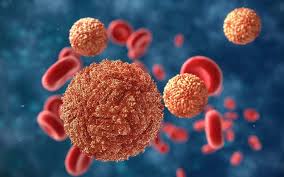
At the time of writing there is a pandemic which is estimated as causing between 100,000,000 and 400,000,000 infections a year, according to the World Health Organisation. There has been a dramatic growth of cases in recent decades and at least half of the world’s population are at risk.
picture credit: thenativeantigencompany.com
The virus causes mild symptoms but in some cases can produce acute flu-like symptoms in humans. There are four serotypes meaning it is possible to be infected four times. According the BBC News App, ‘explosive outbreaks can overwhelm hospitals.’ In it’s most lethal form, fatality rates are 1% of the population when proper treatment and care is available.
Readers will probably have realised by now that I am describing dengue fever or DENV.
It’s a viral infection that you certainly do not want to experience. It’s commonly known as ‘break bone fever’ as it causes severe pain in muscles and bones. Like all viruses it poses a significant threat to the human population.
The good news for those living in high risk urban areas in the tropics, is that a new method of prevention has given very promising results in trial. The BBC News App reports that infections in the city where the trial took place were cut by 77%.
The method used ticks item 4. in my list above. Researchers used a ‘miraculous’ bacteria (Wolcachia) to infect host mosquito’s that spread the virus. The bacteria makes it much harder for the DENV to survive in it’s shared host so the mosquito is less likely to cause an infection. The trial set about introducing this bacteria into the local mosquito’s; fighting fire with fire.
What we can learn, in common with most viral outbreaks is that the origin of the virus and it’s method of transmission must be thoroughly investigated (1. above).
With this understanding, whenever new virus’s are discovered, pandemics can be prevented more quickly and as we know – speedy intervention is vital to reduce transmission. In an ideal world, governments will work together. Knowledge and resources should be immediately sent to the centre of any outbreak and paid for by global contributions rather than the host country, in my view. NGOs and strategic public health organisations, I believe, should be given overall control of treatment of the outbreak, with politicians merely signing off the allocation of national resources. Each country contributes according to it’s means, the rich and those without any outbreaks (pre-pandemic) pay more.
And if one pandemic is given disproportionately more publicity and resources than equally serious concurrent pandemics, what could possibly be the reason? Mind the mind gap!
The standard monkey cage encloses a space using three dimensional planes; x,y and z.
Take one standard monkey, place him in the cage and it’s game over for monkey freedom.
Humans also occupy a cage only it is less simple to observe – because it is infinite. We live in an ‘infinity monkey cage’ in which we can travel in any direction – but with the restrictions of always coming back to the start.
Then it gets complicated. Scientists measure time; from leaky water clocks to atom accurate atomic clocks. This single act of measurement creates a past and a future – pressing our minds into an ever smaller space, or is that a larger one? Either way it puts human endeavour into a tight spot.
Things must be done ‘on time’. In a kind of cosmic act of cookery, we are placed in a dome shaped oven to cook for a measured period and then emerge as plump loaves of bread. The cosmic clock is not our friend but our enemy, for it cannot be beaten. It ticks inexorably in the background of all our endeavours.
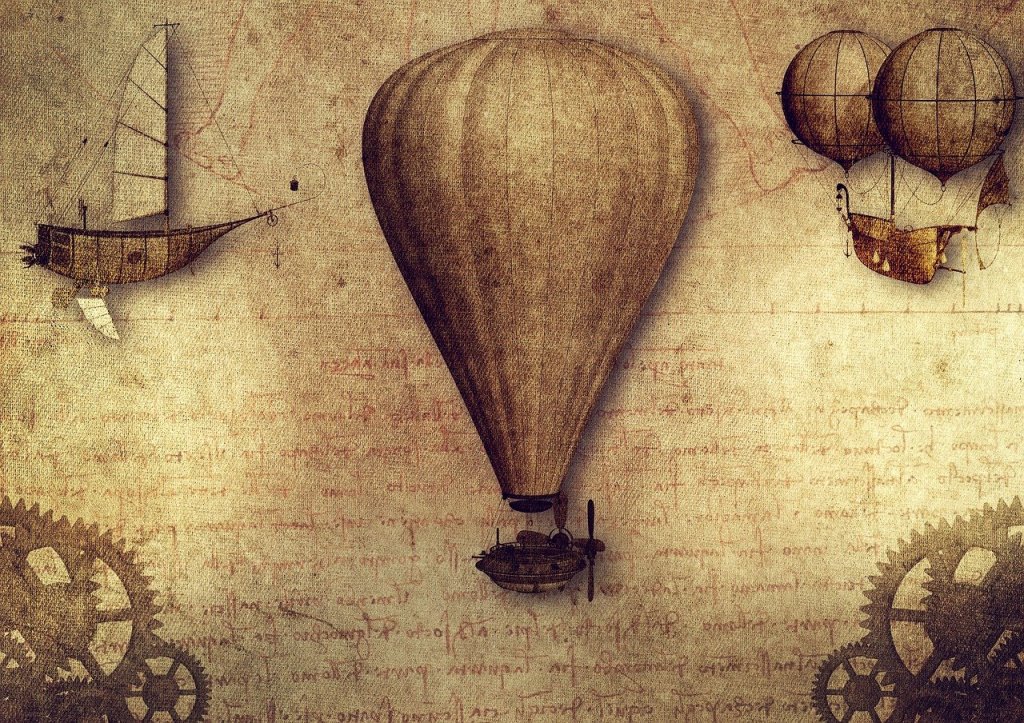
picture credit My Modern Met
This dominant dimension in our lives – I would argue it is not a dimension at all. The act of measuring a thing will not make it real if it is imaginary. Can you measure freedom?
Time picks us up and places us in a social order on a point of singularity within the Universe; it is called ‘being born’.
And as we grow into adults we accept this social order. We indulge in it’s whims which are justified as ethical (providing complexity and contradiction are ignored) and therefore acceptable. If you reject the ‘normal’ of that moment, you must risk being regarded as ‘not normal’.
An 18th century normal is not a 19th century normal. Slavery – which had been around for thousands of years – was voted out as unethical.
Humans were not learning but unlearning bad habits. It was never ‘natural’ to enslave your own species. Nature (if ever) rarely does it. This change in human consciousness was restricted by time. Slaves had been enslaved for millennia. Eventually, for ethical reasons – slaves were released to live in social equality.
It was just an imaginary game that had been played out by the victors at the cost of ruining millions of lives and their descendants.
Were there Roman aristocrats who refused to have slaves? I don’t know but such a person would have been described as ‘out of their time’.
Human societies evolve – not because of time but despite time. Some evolutionary steps are incredibly slow, but if you can not measure time, that is an invisible transition.
There is no ‘one direction’ for human evolution. We have freewill so do not hit the bars of the space cage, just as we do not hit the bars of the time cage. This fact alone should make us query the reality of space and time.
Are they not mere conventions?
Of course without matter and gravity we could not walk to the shops for a pint of milk, but physicality was only ever, a compromise. By shedding our acceptance of what is ‘normal’ or ‘fixed’ or ‘normal’ we edge closer to the reality of an infinite space.
The ‘man of the age’ who is lauded as a hero, is not a better human being. They are simply so much caught in the conventional illusion of what matters and what does not – that they go along with the fickle opinions of others – especially if they are being flattered.
The true ‘hero of the age’ is not of the age they appear to others to be in. Such a person acts independent of time either as a scientist like Nicola Tesla, an artist like Leonardo de Vinci or any of the prophets.
picture credit: Ivanep
Examine the words of their words and their thoughts are independent of space and time.
They uncover / reveal / expound truths which are out of ‘time’ and ‘space’. Their starting and finishing point is infinite and exist in every reality.
Such truths as ‘love one another’ and 1+1=2, subvert corruption in human societies. They ‘unpeeled’ coverings that have been revealed as real in previous centuries. They will always be true.
Man has not been on Earth for long. If Earth was created in 1000AD then we came along on 22 December 1999. We are no more than a passing thought created just in time for the end of the year. It would do us well to remember how truly insignificant humans really are but some of us, sometimes, get a glimpse of infinity, a quality which is not ours to hold.
My personal interpretation of the flood-myth story departs from the account in the Old Testament of the Bible. I take issue with the simplistic account of wild animals compliantly lining up in pairs. We are told that the majority (seven of each) of the animals were domesticated, not wild and selected as food for Noah and his tribe. Therefore, I suggests that the only live animals taken onboard the ark were domesticated. Could it not have been that a considerable amount of work had gone into transforming wild species into domesticated varieties?
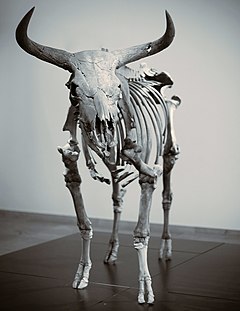
There was a strong motive to harness the power of a giant Aurochs in a ‘lite’ version which we now know in bovine form as bulls and cows.
picture credit Wikipaedia An Auroch
Animals supported the burgeoning transition into settlements and farming. There is evidence from the excavations at Gobleki Teke in Anatolia that the monolithic structures there were created by agricultural communities 5000 years before the ‘official’ date. Nobody knows who these communities were but the appearance of the Mullilu ‘bags’ carved onto one stone, suggests an intriguing link with the Annunaki.
picture credit: Wikipeadia – Goblekli Tepe in Anatolia Turkey – the so called Vulture Stone
So we should not be surprised when we see mummified pussy cats in Ancient Egypt. Domestication of big cats to, presumably rid grain stores of vermin, lead to the creation of the domesticated feline. She was even elevated to the position of ‘god’ and many statues of her exist, as do mummified cats in such numbers their bodies were once burnt for heating.
The final step in this theory and certainly the most disturbing and controversial is that homo sapiens are ourselves domesticated animals, not for food but also as genetically engineered ‘gods’. Animals so beautifully perfect in their form that cosmic consciousness felt free to enter and inhabit human bodies as ‘soul’.
Let us return to the animals being selected to be preserved in the Arc. Should we take at face value the account in the Bible?
The reference to the animals going into the arc ‘two by two’ is a conspicuous detail. Why state this? Why not explain what happened to the plant, reptile, bird and insect kingdoms? And there is surely a fascinating tale to tell about the animals that did not survive, such as Unicorns.
The omissions are glaring, including the assumption that Noah and his family were the only humans at that time to own a boat. Many other races survived to tell the tale, one on similar lines as Noah only perhaps with smaller boats and their own food banks; we have their stories so no proof is needed on that point.
With reference to the Biblical version, we might ask why the precise dimensions of the ship were worth recording. If there is any detail we require it is its means of propulsion, navigation and anchoring. If we are examine the credibility of the Arc’s uncontrolled travels on a tempestuous ocean, it is hard to take it literally.
A boat, loaded with wild carnivorous animals, was always going to be an impossibility. How do you stop the animals eating each other like they do in nature? A powerless and rudderless ship was more likely to hit a mountain top and sink, than preserve life with a big L.
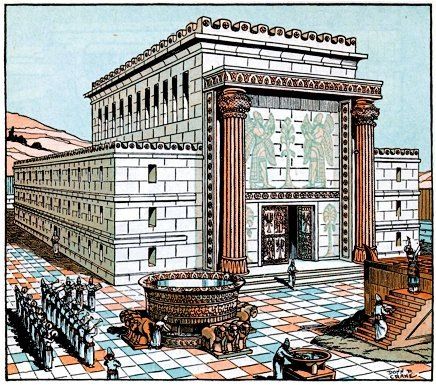
Picture credit: Pinterest King Solomon’s First Temple with the Molten Sea supported by animals in the foreground
Was the Arc really a ship? Since the proportions of the Arc in the Bible are given as a cubic rectangular shape, I personally think it more likely it was a giant building. The dimensions of the Arc are exactly proportional to the First Temple of Jerusalem, which of course, was a building. Not only that but there is a truth in the creation of similar geometric forms at different scales, what we call today, fractals. The proportions demonstrate a complete understand of the Divine mathematics that governs all Creation. Perfect mathematical proportions are beauty and beauty is Divine.
So perhaps the Arc was a beautiful and functional building. Perched on a mountain top it would have had a far better chance of surviving. There might even have been several such buildings scattered around the globe around the world erected by different cultures and described, we know, in their own myths. After all, there was no real rush. To flood the world would have taken several hundreds if not thousands of years.
What we are missing in the Bible is an overview. Perhaps it has been over redacted over time, but certainly the Annunaki put a lot of effort into fine tuning a wobbling world so that it could emerge from catastrophe completely cleansed of impurity.
An Annunaki with Tree of Life in background
When we look at the records of how the Annunaki Sumerian gods are repeatedly depicted in pictures, they are standing either side of a flowering tree, a ‘tree of life’. This firstly gives us an idea of a ‘family tree’ with it’s various branches – genetic connections – as in ‘royal family’. The ‘blue blood’ of the modern royals might well be a linguistic remnant of the reptilian DNA in humans.
The pictures are intriguing. In one hand the ‘god’ or ‘demi-god’ is holding one of those bags already mentioned, and in the other, something resembling a fir cone. The bracelet contains a clue; an eleven petalled flower and a central ovary, one for each month of the solar year.
Pine cones are counter clockwise spiral forms that obey the arithmetical, Fibonacci growth patterns. They hint, symbolically, of the process of genetic engineering and or horticultural hybridisation. The seeds of a pine cone are fractals of a tree in nascence, and seeds is where this hypothesis goes next.
There are very few contemporary descriptions of what the ‘fir cone’ and ‘bag’ represent. However there is one translation from the Acadian language which uses the word, BANDUDDU or ‘Turkish Pine Cone’. The bag is a MULLILU or ‘purifier’. If we accept that the Sumerian gods were active in global DNA management, part of that process would be to eradicate unwanted elements of DNA, or as it is known today, ‘gene editing’. It was vital that disease and inferior life was eradicated or ‘purified’, for future generations, whether prior to a catastrophe or in micro-management of earth’s delicate ecosystems. At another level it was vital that humans became able to access ever increasing levels of consciousness.
picture credit: Wakehurst Place, Sussex, the Millenium Seed Bank
The subject of genes returns us to this ‘two by two’ anachronistic detail. It is an interestingly similar mathematical picture of the double helix of mitochondrial DNA. Could Noah’s Arc have been a bank of DNA? Does the Mullilu contain genetically altered / improved pollen to fertilise the tree of life? Small bags, even today, usually contain light, high value items. (One of the strategy’s adopted by the scientists today in order to preserve life in the event of a global catastrophe is to create seed banks.)
Should we be surprised that DNA codes are binary and there are two sets of two letters to describe them; A and C = 0 / G and T = 1. As we know, 0 and 1 is the binary language of computers. This code and it’s most recent ‘quantum’ addition (neither 0 nor 1) is now understood by many scientists to be how not only life forms are described, but the whole fractal universe. This is why beings from infinitely large distances away can come to our small planet and know the deep structures, or programming, of our three dimensional existence. It’s the same everywhere in the binary code Universe…two by two.
There is presently being considered in the UK parliament a ‘Police, Crime, Sentencing and Courts Bill’. It is wide ranging in it’s intended effects. So much so that citizens are worried and they are asking questions are;
Are these new legal powers necessary and if so are stricter legal powers the best way to achieve the intended result?
In other words, is shooting the cockerel the best way to have a lie-in?
It is coincidental that the timing of these proposals coincided with a public vigil for a murdered woman, Sarah Everard. Sarah was tragically murdered, allegedly by an off duty police officer, whilst walking home.
The vigil was held in Clapham Common in South London. Unfortunately there were ugly violent scenes when police enforced the Covid regulations, which ban such public events. The confrontation had been foreseen. Prior to the vigil, an organisation called ‘Reclaim These Streets’ approached the police and then the High Court. The High Court told the organisers to sort it out with the police.
The question has to be asked, how ‘negotiations’ failed to find a solution that eliminated the risk of confrontation and violence.
picture credit: thedailymail comment: how the media encourage dualistic thinking
People with an iota of problem solving sense and mediation skills, will know that if you set up two sides with conflicting agendas, they will always disagree with each other.
The BBC News webpage comments; For almost a year, the ambiguities and omissions within the coronavirus restrictions have left both the police and the public grasping for answers as to what is possible in public. It’s so complex we’ve even seen people fined for walking while holding a cup of tea.
The Covid ‘regulations’ are already a cause for antagonism between the public and the police. The police are having a hard time maintaining public confidence in their impartiality and fairness. The Police are currently lumbered with issuing Enforcement Notices, fines of £200, under the Covid Regulations.
Personally, I can see good reason to remove the police from the enforcement of Covid rules.
Police are principally responsible to protect the public from those breaking criminal law. They stopped being responsible for lost dogs and parking on double yellow lines long ago, so why are they involved with Covid rules?
One possible solution would be to create a new temporary role of ‘Covid Enforcement Officers’. This process of specialist enforcement officers has already been successfully with non-criminal offences, such as parking fines. Police used to issue parking fines decades ago. Then Traffic Wardens were created for this purpose and currently used ‘Parking Enforcement Officers’ have the role.
The Home Office might be able to recruit volunteers to enforce Covid Rules, given the large number of community spirited citizens who have already put their names forward for public service during the emergency. Alternatively, or as well as, the Home Office could pay CEO’s in the full time role. Alternatively or in addition, the Home Office might use the services of those currently paid to ‘furlough’ at home. This at least would be a better use of tax payers money. The role might also be given to a strictly selected portion of those ‘homeless’ and living in hotels at public expense and even released prisoners. Both groups who might well rise to the being awarded public trust and benefit for the rest of their lives for some experience of employment. My point is that there are many avenues to explore before dismissing the role of CEO.
Let us next examine the subject of public protests during the Covid state of emergency. It cannot be denied that where there is a public protest planned over an issue of current high public interest, there is good reason for respecting public feelings. If the government restricts the human right of protest it runs the risk of appearing draconian. When the government and rule of law is perceived by citizens to lose the high moral ground, ‘policing by consent’ becomes difficult to impossible. We see this in Hong Kong and Myanmar at the moment where protest has effectively been made illegal.
The problem for the British government that the vigil in Clapham Common posed, was for a potential ‘mass Covid spreading event’ to take place. This was the fear and Police had a duty to prevent such an outcome. They would be sure to be blamed for not using their powers should there be a subsequent localised outbreak of Covid infection.
The problem solving method used was for both sides to line up against each other like in a medieval battle. Even the High Court ran from this confrontation. All were victims in my view of the process of dualistic thinking or ‘either or’ solutions.
The way I would look at this problem is that it is not only a ‘police’ responsibility. In most problem solving processes, problems will be found to be widely shared. Who might the other stake holders be?
Just of the cuff I would suggest that the problem was owned by the organisers, those attending, the Park Authorities and the by-laws, the National Health Service (local hospitals), Human Rights organisations, the Courts, scientists of the health and social variety, the local MP and London Mayor’s Office, Legislators and the Home Secretary.
The only intervention the government could conceive was a new law, because that is what governments do; a classic case of ‘digging the hole deeper’. This is how they intend to make the present police powers more stringent;
The Bill being proposed wishes to prevent public protest that creates “serious public disorder, serious damage to property or serious disruption to the life of the community”.
The lack of any nuance to this ‘nail – hammer’ thinking was, in my opinion, is woeful. If the complexities of solving a problem are embraced, then solutions are abundant.
For instance in the case of this public vigil by, say one thousand people, it can be be managed to achieve the clearly set out objective…to let people have their moment of remembering peacefully and without disproporthionate harm to themselves or others. After all, if strangers mix inside a supermarkets without creating mass Covid spreading events each day, then a single outdoor event is considerably less risky. Experience of public gatherings outdoors, including when not socially distanced, has shown that mass Covid events do not take place afterwards. This was shown to be the case at recent public protests in the USA such as the Black Lives Matter marches or the infamous storming of Capitol Hill.
Aside from the spread of infection it is hard to see why any peaceful outdoor protest should culminate in;
“serious public disorder, serious damage to property or serious disruption to the life of the community” if managed properly.
There are clear Covid rules of social distancing, mask wearing and hand washing and the attendees would willingly follow such rules as they Sainsbury’s where public disorder is not considered an imminent threat.
A vigil by definition, is a passive affair where people sit or stand with candles and placards to express their feelings of solidarity, sadness and, in this case, discontent that a young woman’s public murder makes many women feel unsafe.
Imagine how a Problem Solving / Protest Management Meeting that I am envisaging, might have taken place. There would be numerous attendees with multiple points of view but with a overlapping and shared desired outcomes. The aim of the meeting will be to express and examine all views in a spirit of co-operation to solve a shared problem. The fruit of such meetings is that solutions can be just as impactive as force, but in a subtle and almost invisible way.
So if you were the Superintendent of Parks, would you not be a good person to involve in how to make this peaceful event as safe as possible whilst supporting the Human Right to protest? You could provide detail maps of the park showing entrances and exits, toilet facilities, how previous public events had been managed, first aid and other emergency considerations (normal for large gatherings), catering etc. etc. in as much detail as you need and that’s just the Park Keeper.
The Fire Service say they could provide sand bags for people to sit on at the required distances…good idea…and safe bins to dispose of used candles. The local press and police might hire a drone to take photographs from above. The police use it to monitor events and the press get some great photograhps. Those attending are told that by staying on their sandbags they images will be spectacular visually, whilst respecting privacy and not spying on indiviuals. Instead of a grid, an local artist might design a shape for the sandbags and candle holders, like a flower of rememberance. You get the idea. It’s soft management designed to delight not draw battle lines.
The Covid Enforcement Officers might have produced some posters which will be clearly displayed at the entrances to the Vigil Arena, reminding attendees of the Covid safety rules and the fines for infringement.
I could list the inputs of each party but you get the picture. Towards the end of the meeting the person representing the local police, shares that there is intelligence that the an anarchist organisation are planning to attend. There is a history of them creating public disorder and damage to property. A few mug shots are shared.
Are These People Mourners or Political Activits?
The Police therefore commit to having 200 riot trained officers on hand but out of view, in case of “serious public disorder, serious damage to property or serious disruption to the life of the community”. They confirm that there are existing laws under the Public Order Act, Criminal Damage Act and Breach of the Peace to make arrests and allow the vigil to continue peacefully.
Dame Cressida Dick, Metropolitan Police Commissioner, is at the meeting and says that she intends to take part in the Vigil. Everyone applauds. Apparently, several other celebrities and leaders of Human Rights and Women Safety organisations are also going to take part. There is decided to be a VIP area next to the area designated for the Press.
In this hypothetical scenario the event takes place and the Anarchist ‘rent-a-mob’ do make an appearance. They are ‘kettled’ away from the vigil into an area that the Park Superintendent recommended which is surrounded on three sides by high fences. Flood lights had been secretly positioned their and their switching on allows for CCTV surveillance to begin and the press to get some good pictures. The police keep them there until the vigil has ended and the park is clear. Two anarchists are arrested are, both for previous offences using outstanding warrants.
My conclusion is that any public protest with warranted public interest and sympathy, should be allowed to take place under Covid regulations, and the Regulations should be amended to permit this. It is for the committee of interested parties to decide what level of public interest and support exists, not the courts or the police.
In summary, when the only parties involved are cast as protagonist and enforcer, the result will tend towards the violent scenes sadly witnessed on Clapham Common. Giving the enforcers more powers to enforce is no solution, and leads to the very thing purported to avoid, that is;
“serious public disorder, serious damage to property or serious disruption to the life of the community”.
So in answer to the question at the top of this essay which was;
Are these new legal powers necessary and if so are they the best way to achieve the intended result?
…my answer is no. The existing laws were sufficient for the nine arrests made at this vigil. Next time, organisers should seek the help of the ‘partnership approach’ to public protest event planning. Use it or ignore it at your peril.